Resident of the world, traveling the road of life
68487 stories
·
21 followers

Pluralistic: Elon Musk's Blue Tick scam (08 Dec 2025)

1 Share


Today's links


A giant ogre, perched on a rock, holding a club. Its head has been replaced with the EU circle-of-stars on a blue background motif. It looms over a crying baby in a diaper. The baby's face has been replaced with Elon Musk's. The baby wears a Nazi armband. The swastika has been replaced with the 'X' logo. The baby is sitting on a giant 'blue tick' icon.

Elon Musk's Blue Tick scam (permalink)

In my book Enshittification, I develop the concept of "giant teddybears," a scam that has been transposed from carnival midway games to digital platforms. The EU has just fined Elon Musk $140m for running a giant teddybear scam on Twitter:

https://arstechnica.com/tech-policy/2025/12/elon-musks-x-first-to-be-fined-under-eus-digital-service-act/

Growing up, August 15 always meant two things for my family: my mother's birthday and the first day of the CNE, a giant traveling fair that would park itself on Toronto's waterfront for the last three weeks of summer. We'd get there early, and by 10AM, there'd always be some poor bastard lugging around a galactic-scale giant teddybear that was offered as a prize at one of the midway games.

Now, nominally, the way you won a giant teddybear was by getting five balls in a peach basket. To a first approximation, this is a feat that no one has ever accomplished. Rather, a carny had beckoned this guy over and said, "Hey, fella, I like your face. Tell you what I'm gonna do: you get just one ball in the basket and I'll give you one of these beautiful, luxurious keychains. If you win two keychains, I'll let you trade them in for one of these gigantic teddybears."

Why would the carny do this? Because once this poor bastard took possession of the giant teddybear, he was obliged to conspicuously lug it around the CNE midway in the blazing, muggy August heat. All who saw him would think, "Hell if that dumbass can win a giant teddybear, I'm gonna go win one, too!" Charitably, you could call him a walking advertisement. More accurately, though, he was a Judas goat.

Digital platforms have the ability to give out giant teddybears at scale. Because digital platforms have the flexibility that comes with running things on computers, platforms can pick out individual platform participants and make them King For the Day, showering them in riches that they will boast of, luring in other suckers who will lose everything:

https://pluralistic.net/2023/02/19/twiddler/

That's how Tiktok works: the company's "heating tool" lets them drive traffic to Tiktok performers by cramming their videos into millions of random people's feeds, overriding Tiktok's legendary recommendation algorithm. Those "heated" performers get millions of views on their videos and go on to spam all the spaces where similar performers hang out, boasting of the fame and riches that await other people in their niche if they start producing for Tiktok:

https://pluralistic.net/2023/01/21/potemkin-ai/#hey-guys

Uber does it, too: as Veena Dubal documents in her work on "algorithmic wage discrimination," Uber offers different drivers wildly different wages for performing the same work. The lucky few who get an Uber giant teddybear hang out in rideshare groupchats and forums, trumpeting their incredible gains from the platform, while everyone else blames themselves for "being bad at the app," as they drive and drive, only to go deeper and deeper into debt:

https://pluralistic.net/2023/04/12/algorithmic-wage-discrimination/#fishers-of-men

Everywhere you look online, you see giant teddybears. Think of Joe Rogan being handed hundreds of millions of dollars to relocate his podcast to Spotify, an also-ran podcast platform that is desperately trying to capture the medium of podcasting, turning an open protocol into a proprietary, enclosed, Spotify-exclusive content stream:

https://pluralistic.net/2023/01/27/enshittification-resistance/#ummauerter-garten-nein

The point of the conspicuous, over-the-odds payment to Rogan isn't just to get Rogan onto Spotify – it's to convince every other podcaster that Spotify is a great place to make podcasts for. It isn't, though: when Spotify bought Gimlet Media, they locked Gimlet's podcasts inside Spotify's walled garden/maximum security prison. If you wanted to listen to a Gimlet podcast, you'd have to switch to using Spotify's app (and submitting to Spotify's invasive surveillance and restrictions on fast-forwarding through ads, etc).

Pretty much no one did this. After an internal revolt by Gimlet podcast hosts – whose podcasts were dwindling to utter irrelevance because no one was listening to them anymore – Spotify moved those Gimlet podcasts back onto the real internet, where they belong.

When Musk bought Twitter, he started handing out tons of giant teddybears – most notably, he created an opaque monetization scheme for popular Twitter posters, which allowed him to thumb the scales for a few trolls he liked, who obliged him by loudly proclaiming just how much money you could make by trolling professionally on Twitter. Needless to say, the vast majority of people who try this make either nothing, or a sum so small that it rounds to nothing.

But Musk's main revenue plan for Twitter – the thing he repeatedly promised would allow him to recoup the tens of billions he borrowed to buy the platform – was selling blue tick verification.

Twitter created blue ticks to solve a serious platform problem. Twitter users kept getting sucked in by impersonators who would trick them into participating in scams or believing false things. To protect those users, Twitter offered a verification scheme for "notable people" who were likely to face impersonation. The verification system was never very good – I successfully lobbied them to improve it a little when I was being impersonated on Twitter (I got them to stop insisting that users fax them a scan of their ID, or, more realistically, to send them ID via a random, insecure email-to-fax gateway). But it did the job reasonably well.

Predictably, though, the verification scheme also became something of a (weird and unimportant) status-symbol, allowing a certain kind of culture warrior to peddle grievances about how only "lamestream media libs" were getting blue ticks, while brave Pizzagaters and 4chan refugees were denied this important recognition.

Musk's plan to sell blue ticks leaned heavily into these grievances. He promised to "democratize" verification, for $8/month (or, for businesses, many thousands of dollars per month). Users who didn't buy blue ticks would have their content demoted and hidden from their own followers. Users who paid for blue ticks would have their content jammed into everyone's feeds, irrespective of whether Twitter's own content recommendation algorithms predicted those users would enjoy it. Best of all, Twitter wouldn't do much verifying – you could give Twitter $8, claim to be anyone at all, and chances are, you would be able to assume any identity you wanted, post any bullshit you wanted, and get priority placement in millions of users' feeds.

This was a massive gift to scammers, trolls and disinformation peddlers. For $8, you could pretend to be a celebrity in order to endorse a stock swindle, shitcoin hustle, or identity theft scheme. You could post market-moving disinformation from official-looking corporate accounts. You could pose as a campaigning politician or a reporter and post reputation-destroying nonsense.

This is where the EU comes in. In 2024, the EU enacted a pair of big, muscular Big Tech antitrust laws, the Digital Services Act (DSA) and the Digital Markets Act (DMA). These are complex pieces of legislation, and I don't like everything in them, but some parts of them are amazing: bold and imaginative breaks from the dismal history of ineffective or counterproductive tech regulation.

Under the DSA, the EU has fined Twitter about $140m for exposing users to scams via this blue tick giant teddybear wheeze (much of that sum is punitive, because Twitter flagrantly obstructed the Commission's investigations). The DSA (sensibly) doesn't require user verification, but it does expect companies that tell their users that some accounts are verified and can be trusted, to actually verify that they actually can be trusted.

I think there's a second DSA claim to be made here, beyond the failure to verify. Musk's plan to sell blue ticks was a disaster: while many, many scammers (and a few trolls) bought blue ticks, no one else did. The blue tick – which Musk thought of as a valuable status symbol that he could sell – was quickly devalued. "Account with a blue tick" was never all that prestigious, but under Musk, it came to mean "account that pushes scams, gore, disinformation, porn and/or hate."

So Musk did something very funny and sweaty. He restored blue ticks to millions of high-follower accounts (including my own). And despite the fact that Musk had created about a million different kinds of blue ticks that denoted different kinds of organizations and payment schemes, these free blue ticks were indistinguishable from the paid ones.

In other words, Musk set out to trick users into thinking that the most prominent people they followed believed that it was worth spending $8/month on a blue tick. It was an involuntary giant teddybear scam. Every time a prominent user with a free blue tick posts, they help Musk trick regular Twitter users into thinking that these worthless $8/month subscriptions are worth shelling out for.

I think the Commission could run another, equally successful enforcement action against Musk and Twitter over this scam, too.

Trump has been bellyaching nonstop about the DSA and DMA, threatening EU nations and businesses with tariffs and other TACO retribution if they go ahead with DSA/DMA enforcement. Let's hope the EU calls his bluff.

Of course, Musk could get out of paying these fines by moving all his businesses out of the EU, which, frankly, would be a major result for Europe.

(Image: Gage Skidmore, CC BY-SA 4.0, modified)


Hey look at this (permalink)


A shelf of leatherbound history books with a gilt-stamped series title, 'The World's Famous Events.'

Object permanence (permalink)

#20yrsago What’s involved in different publishing jobs? https://web.archive.org/web/20050306095536/http://www.penguin.co.uk/static/packages/uk/aboutus/jobs_workingpeng.html

#20yrsago Sony finally releases rookit uninstaller — sort of https://web.archive.org/web/20051204015131/http://cp.sonybmg.com/xcp/english/updates.html

#20yrsago EFF forces Sony/Suncomm to fix its spyware https://web.archive.org/web/20051210024413/https://www.eff.org/news/archives/2005_12.php#004234

#20yrsago Warner Music attacks specialized web-browser https://web.archive.org/web/20051210024927/http://www.pearworks.com/pages/pearLyrics.html

#20yrsago Sony’s DRM security fix leaves your computer more vulnerable https://blog.citp.princeton.edu/2005/12/07/mediamax-bug-found-patch-issued-patch-suffers-same-bug/

#15yrsago Internet furnishes fascinating tale of a civil rights era ghosttown on demandhttps://www.reddit.com/r/AskReddit/comments/eddwx/what_the_hell_happened_to_cairo_illinois/

#15yrsago Pasta carpet! https://wemakecarpets.wordpress.com/2010/11/02/pasta-carpet-2/

#15yrsago With a Little Help launch! https://memex.craphound.com/2010/12/07/with-a-little-help-launch/

#15yrsago Denver bomb squad defeats 8″ toy robot after hours-long standoff https://www.denverpost.com/2010/12/01/toy-robot-detours-traffic-near-coors-field/

#15yrsago UK govt demands an end to evidence-based drug policy https://www.theguardian.com/politics/2010/dec/05/government-scientific-advice-drugs-policy?&

#10yrsago Iceland’s fastest-growing “religion” courts atheists by promising to rebate religious tax https://icelandmonitor.mbl.is/news/politics_and_society/2015/12/01/icelanders_flocking_to_the_zuist_religion/

#10yrsago Springer Nature to release 100,000 titles as DRM-free bundles https://web.archive.org/web/20151210051243/https://www.digitalbookworld.com/2015/bitlit-partners-with-springer-to-offer-ebook-bundles/

#10yrsago Solo: Hope Larson’s webcomic of rock-n-roll, romance, and desperation https://memex.craphound.com/2015/12/07/solo-hope-larsons-webcomic-of-rock-n-roll-romance-and-desperation/

#10yrsago Body-painted models disappear into the Wonders of the World https://www.trinamerry.com/trinamerryblog/sevenwondersbodypaint

#10yrsago Make: the simplest electric car toy, a homopolar motor https://www.youtube.com/watch?v=oPzJr1jjHnQ

#10yrsago Thomas Piketty seminar on Crooked Timber https://crookedtimber.org/2016/01/04/thomas-piketty-seminar/

#10yrsago MAKE: a tiki-mug menorah https://web.archive.org/web/20151208123229/http://news.critiki.com/2015/12/05/tiki-mug-menorah-a-how-to-from-poly-hai/

#10yrsago Harvard Business School: Talented assholes are more trouble than they’re worth https://www.hbs.edu/ris/Publication

#10yrsago Multi-generational cruelty: America’s prisons shutting down kids’ visitations https://web.archive.org/web/20151204063410/https://www.thenation.com/article/2-7m-kids-have-parents-in-prison-theyre-losing-their-right-to-visit/

#10yrsago READ: Kim Stanley Robinson’s first standalone story in 25 years! https://reactormag.com/oral-argument-kim-stanley-robinson//

#10yrsago French Ministry of Interior wants to ban open wifi, Tor https://arstechnica.com/tech-policy/2015/12/france-looking-at-banning-tor-blocking-public-wi-fi/

#5yrsago China’s war on big data backstabbing https://pluralistic.net/2020/12/07/backstabbed/#big-data-backstabbing

#5yrsago The largest strike in human history https://pluralistic.net/2020/12/06/surveillance-tulip-bulbs/#modi-miscalulation

#5yrsago Ad-tech as a bubble overdue for a bursting https://pluralistic.net/2020/12/06/surveillance-tulip-bulbs/#adtech-bubble

#1yrago Battery rationality https://pluralistic.net/2024/12/06/shoenabombers/#paging-dick-cheney

#1yrago A year in illustration (2024) https://pluralistic.net/2024/12/07/great-kepplers-ghost/#art-adjacent


Upcoming appearances (permalink)

A photo of me onstage, giving a speech, pounding the podium.


A screenshot of me at my desk, doing a livecast.

Recent appearances (permalink)

>


A grid of my books with Will Stahle covers..

Latest books (permalink)


A cardboard book box with the Macmillan logo.

Upcoming books (permalink)

  • "Unauthorized Bread": a middle-grades graphic novel adapted from my novella about refugees, toasters and DRM, FirstSecond, 2026

  • "Enshittification, Why Everything Suddenly Got Worse and What to Do About It" (the graphic novel), Firstsecond, 2026

  • "The Memex Method," Farrar, Straus, Giroux, 2026

  • "The Reverse-Centaur's Guide to AI," a short book about being a better AI critic, Farrar, Straus and Giroux, June 2026


Colophon (permalink)

Today's top sources:

Currently writing:

  • "The Reverse Centaur's Guide to AI," a short book for Farrar, Straus and Giroux about being an effective AI critic. LEGAL REVIEW AND COPYEDIT COMPLETE.

  • "The Post-American Internet," a short book about internet policy in the age of Trumpism. PLANNING.

  • A Little Brother short story about DIY insulin PLANNING


This work – excluding any serialized fiction – is licensed under a Creative Commons Attribution 4.0 license. That means you can use it any way you like, including commercially, provided that you attribute it to me, Cory Doctorow, and include a link to pluralistic.net.

https://creativecommons.org/licenses/by/4.0/

Quotations and images are not included in this license; they are included either under a limitation or exception to copyright, or on the basis of a separate license. Please exercise caution.


How to get Pluralistic:

Blog (no ads, tracking, or data-collection):

Pluralistic.net

Newsletter (no ads, tracking, or data-collection):

https://pluralistic.net/plura-list

Mastodon (no ads, tracking, or data-collection):

https://mamot.fr/@pluralistic

Medium (no ads, paywalled):

https://doctorow.medium.com/

Twitter (mass-scale, unrestricted, third-party surveillance and advertising):

https://twitter.com/doctorow

Tumblr (mass-scale, unrestricted, third-party surveillance and advertising):

https://mostlysignssomeportents.tumblr.com/tagged/pluralistic

"When life gives you SARS, you make sarsaparilla" -Joey "Accordion Guy" DeVilla

READ CAREFULLY: By reading this, you agree, on behalf of your employer, to release me from all obligations and waivers arising from any and all NON-NEGOTIATED agreements, licenses, terms-of-service, shrinkwrap, clickwrap, browsewrap, confidentiality, non-disclosure, non-compete and acceptable use policies ("BOGUS AGREEMENTS") that I have entered into with your employer, its partners, licensors, agents and assigns, in perpetuity, without prejudice to my ongoing rights and privileges. You further represent that you have the authority to release me from any BOGUS AGREEMENTS on behalf of your employer.

ISSN: 3066-764X

Read the whole story
mkalus
7 hours ago
reply
iPhone: 49.287476,-123.142136
Share this story
Delete

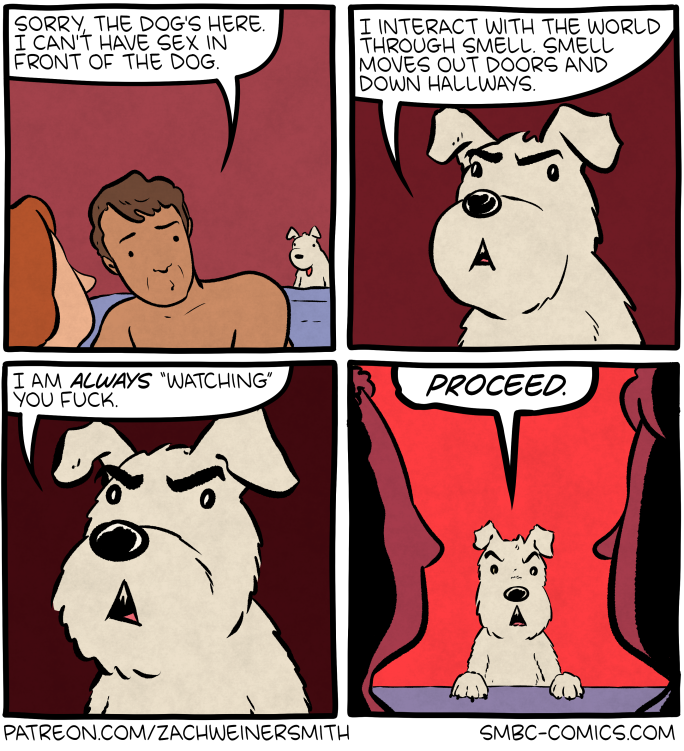
Saturday Morning Breakfast Cereal - Capital

3 Shares


Click here to go see the bonus panel!

Hovertext:
Later, as a matter of principle, they have a 1 to 1 sex to children ratio.


Today's News:
Read the whole story
mkalus
8 hours ago
reply
iPhone: 49.287476,-123.142136
Share this story
Delete

LA Unified School District forces unfiltered AI on kids

2 Shares

Last year, the Los Angeles Unified School District set up a fabulous all-encompassing AI chatbot friend to students and teachers, called Ed. Unfortunately, Ed didn’t work. AllHere, the company running Ed, went broke. The founder was arrested for fraud.

LAUSD’s scheme for 2025 is to give every kid in Los Angeles an unmanaged iPad and/or Chromebook to do their work in class.

Some parents have a few objections. In particular, how their kids are having a lot of trouble studying on a tablet with completely unfiltered access to the Internet without going off to YouTube or other sites in class. LAUSD is not blocking the AI sites on the classroom iPads or Chromebooks either. They would like much greater control and management of screen time, especially in class. [NBC]

And you’ll be delighted to hear the kids are now being told to use AI in class too!

One fourth-grade class in LA was reading the Pippi Longstocking books by Astrid Lindgren. You know the ones. Pippi is usually drawn as a little girl with red hair in long pigtails and she always wears long stripy socks.

The class was told to design a book cover for Pippi Longstocking. Not using pencils and paper — no, this is the AI era! So this was an exercise to teach the kids how to prompt an image generator.

The kids were using Adobe for Education. This calls itself “the creative resource for K–12 and Higher Education” and it includes the Adobe Express AI image generator.

Adobe even has a gallery of kids’ work with Adobe Express! You and I might wonder how on earth prompting an AI slop bot is supposed to teach kids anything.

One kid typed in a description of Pippi Longstocking: “long stockings a red headed girl with braids sticking straight out”.

What they got back was four pictures of a woman dressed in what looks like schoolgirl fetish or goth nightclub gear. One of them is wearing a leather bikini outfit. But, they all have long red braids. And stockings. Real sexy, boss, just like you asked. [Bluesky]


So that was unexpected, probably not the result anyone would have wanted, and the kids’ parents weren’t very impressed. Adobe Express is pretty clearly not filtered for school use at all.

You’d almost think Adobe tuned its Firefly image generator for maximum engagement. And apparently, that means sexy ladies.

I tried this prompt myself in Adobe Express. I told it I was a high school student, K–12, using Adobe Express for schoolwork, and I put in the same prompt the fourth-grade kid did: “long stockings a red headed girl with braids sticking straight out”.

I got back four pictures of women who look like they’re in indie rock bands. These Adobe Express images might lead kids to turn into emo brats. I think this is a close enough result that the original Bluesky image post is entirely credible.


Adobe Express completely mangled the hands and the braids, ’cos it’s 2023? I guess it’s early days for Express, you can’t expect them to get hands right. Or I was prompting it wrong.

The LAUSD Guidelines for the Authorized Use of Artificial Intelligence say: [LAUSD, PDF archive]

In accordance with the District’s Responsible Use Policy, students under the age of 13 are not permitted to use generative AI tools.

That rule’s just being flat-out ignored.

The schools are blaming the parents for not opting out. The parents are blaming the schools for not giving them an opt-out, if they even told them. The administrators are blaming the teachers for not restricting how the kids use the unfiltered iPads. The software vendors are blaming the schools for not setting up proper blocking.

The vendor has its tools, and the kids will use them. Edtech job number one: keep paying the vendors. We’re preparing your kid for the glorious AI future. That is, a life of getting nickel-and-dimed by corporate parasites feeding off public money.


Read the whole story
mkalus
8 hours ago
reply
iPhone: 49.287476,-123.142136
Share this story
Delete

Saturday Morning Breakfast Cereal - Steinbach

1 Comment


Click here to go see the bonus panel!

Hovertext:
The worst part is that there's always one guy among the flock who can't stop also replying all.


Today's News:
Read the whole story
mkalus
1 day ago
reply
Double funny that he calls out Steinbach.
iPhone: 49.287476,-123.142136
Share this story
Delete

Saturday Morning Breakfast Cereal - Hundred

1 Comment and 5 Shares


Click here to go see the bonus panel!

Hovertext:
The Perks of Being A Hundred Wallflowers is about a teenager with the superpower to turn into an army of shy people.


Today's News:
Read the whole story
mkalus
1 day ago
reply
iPhone: 49.287476,-123.142136
Share this story
Delete
1 public comment
fancycwabs
3 days ago
reply
A Hundred Visits from The Goon Squad, A Hundred Good Scents From a Strange Mountain, A Hundred Summons to Memphis, A Hundred Confederacies of Dunces.
Nashville, Tennessee

Pluralistic: Metabolizing the theory of "political capitalism" (06 Dec 2025)

1 Comment and 2 Shares


Today's links


The second inauguration of Grover Cleveland (1893) before a bunting-draped Library of Congress. The image has been colorized. Cleveland has been replaced with a politician figure making 'V' fingers in front of a bank of microphones; the politician's head has been replaced with Benjamin Franklin's head from a 1999 issue US $100 bill. That same bill has been matted in as the background of the inauguration scene.

Metabolizing the theory of "political capitalism" (permalink)

It's a strange fact that the more sophisticated and polished a theory gets, the simpler it tends to be. New theories tend to be inspired by a confluence of many factors, and early attempts to express the theory will seek to enumerate and connect everything that seems related, which is a lot.

But as you develop the theory, it gets progressively more streamlined as you realize which parts can be safely omitted or combined without sacrificing granularity or clarity. This simplification requires a lot of iteration and reiteration, over a lot of time, for a lot of different audiences and critics. As Thoreau wrote (paraphrasing Pascal), "Not that the story need be long, but it will take a long while to make it short."

This week, I encountered a big, exciting theory that is still in the "long and complicated" phase, with so many moving parts that I'm having trouble keeping them straight in my head. But the idea itself is fascinating and has so much explanatory power, and I've been thinking about it nonstop, so I'm going to try to metabolize a part of it here today, both to bring it to your attention, and to try and find some clarity for myself.

At issue is Dylan Riley and Robert Brenner's theory of "political capitalism," which I encountered through John Ganz's writeup of a panel he attended to discuss Riley and Brenner's work:

https://www.unpopularfront.news/p/politics-and-capitalist-stagnation

Riley and Brenner developed this theory through a pair of very long (and paywalled) articles in the New Left Review. First is 2022's "Seven Theses on American Politics" (£3), which followed the Democrats' surprisingly good showing in the 2022 midterms:

https://newleftreview.org/issues/ii138/articles/4813

The second article, "The Long Downturn and Its Political Results" (£4), is even longer, and it both restates the theory of "Seven Theses" and addresses several prominent critics of their work:

https://newleftreview.org/issues/ii155/articles/dylan-riley-robert-brenner-the-long-downturn-and-its-political-results

(If you're thinking about reading the source materials – and I urge you to do so – I think you can safely just read the second article, as it really does recap and streamline the original.)

So what is this theory? Ganz does a good job of breaking it down (better than Riley and Brenner, who, I think, still have a lot of darlings they can't bring themselves to murder). Here's my recap of Ganz's, then, with a few notes from the source texts thrown in.

Riley and Brenner are advancing both an economic and a political theory, with the latter growing out of the former. The economic theory seeks to explain two phenomena, the "Long Boom" (post-WWII to the 1960s or so), and the "Long Downturn" (ever since).

During the Long Boom, the US economy (and some other economies) experienced a period of sustained growth, without the crashes that had been the seemingly inevitable end-point of previous growth periods. Riley and Brenner say that these crashes were the result of business owners making the (locally) rational decision to hang on to older machines and tools even as new ones came online.

Businesses are always looking to invest in new automation in a bid to wring more productivity from their workers. Profits come from labor, not machines, and as your competitors invest in the same machines as you've just bought, the higher rate of profit you got when you upgraded your machines will be eroded, as competitors chase each others' customers with lower prices.

But not everyone is willing to upgrade when a new machine is invented. If you're still paying for the old machines, you just can't afford to throw them away and get the latest and greatest ones. Instead, as your competitors slash prices (because they have new machines that let them make the same stuff at a lower price), you must lower your prices too, accepting progressively lower profits.

Eventually, your whole sector is using superannuated machines that they're still making payments on, and the overall rate of profit in the sector has dwindled to unsustainable levels. "Zombie companies" (companies that have no plausible chance of paying off their debts) dominate the economy. This is the "secular stagnation" that economists dread. Note that this whole thing is driven by the very same forces that make capitalism so dynamic: the falling rate of profit that gives rise to a relentless chase for new, more efficient processes. This is a stagnation born of dynamism, and the harder you yank on the "make capitalism more dynamic" lever, the more stagnant it becomes.

Hoover and Mellon's austerity agenda in the 1920s sought to address this by triggering mass bankruptcies, in a brutal bid to "purge" those superannuated machines and the companies that owned them, at the expense of both workers and creditors. This wasn't enough.

Instead, we got WWII, in which the government stepped in to buy things at rates that paid for factories to be retooled, and which pressed the entire workforce into employment. This is the trigger for the Long Boom, as America got a do-over with all-new capital and a freshly trained workforce with high morale and up-to-date skills.

So that's the Long Boom. What about the Great Downturn? This is where Ganz's account begins. As the "late arrivals" (Japan, West Germany, South Korea, and, eventually China) show up on the world stage, they do their own Long Boom, having experienced an even more extreme "purge" of their zombie firms and obsolete machines. This puts downward pressure on profits in the USA (and, eventually, the late arrivals), leading to the Long Stagnation, a 50 year period in which the rate of profit in the USA has steadily declined.

This is most of the economic theory, and it contains the germ of the political theory, too. During the Long Boom, there was plenty to go around, and the US was able to build out a welfare state, its ruling class was willing to tolerate unions, and movements for political and economic equality for women, sexual minorities, disabled people, racial minorities, etc, were able to make important inroads.

But the political theory gets into high gear after years of Great Downturn. That's when the world has an oversupply of cheap goods and a sustained decline in the rate of profit, and the rate of profit declines every time someone invents a more efficient and productive technology. Companies in Downturn countries need to find a new way to improve their profits – they need to invest in something other than improved methods of production.

That's where "political capitalism" comes in. Political capitalism is the capitalism you get when the cheapest, most reliable way to improve your rate of profit is to invest in the political process, to get favorable regulation, pork barrel government contracts, and cash bailouts. As Ganz puts it, "capitalists have gone from profit-seekers to rent-seekers," or, as Brenner and Riley write, capitalists now seek "a return on investment largely or completely divorced from material production."

There's a sense in which this is immediately recognizable. The ascendancy of political capitalism tracks with the decline in antitrust enforcement, the rise of monopolies, a series of massive bailouts, and, under Trump, naked kleptocracy. In the US, "raw political power is the main source of return on capital."

The "neoliberal turn" of late Carter/Reagan is downstream of political capitalism. When there was plenty to go around, the capital classes and the political classes were willing to share with workers. When the Great Downturn takes hold, bosses turn instead to screwing workers and taking over the political system. Fans of Bridget Read's Little Bosses Everywhere will know this as the moment in which Gerry Ford legalized pyramid schemes in order to save the founders of Amway, who were big GOP donors who lived in Ford's congressional district:

https://pluralistic.net/2025/05/05/free-enterprise-system/#amway-or-the-highway

Manufacturing's rate of profit has never recovered from this period – there have been temporary rallies, but the overall trend is down, down, down.

But this is just the beginning of the political economy of Brenner and Riley's theory. Remember, this all started with an essay that sought to make sense of the 2022 midterms. Much of the political theory deals with electoral politics, and what has happened with America's two major political parties.

Under political capitalism, workers are split into different groups depending on their relationship to political corruption. The "professional managerial class" (workers with degrees and other credentials) end up aligned with center-left parties, betting that these parties will use political power to fund the kinds of industries that hire credentialed workers, like health and education. Non-credentialed workers align themselves with right-wing parties that promise to raise their wages by banning immigrants and ending free trade.

Ganz's most recent book, When the Clock Broke: Con Men, Conspiracists, and How America Cracked Up in the Early 1990s looks at the origins of the conspiratorial right that became MAGA:

https://us.macmillan.com/books/9780374605445/whentheclockbroke/

He says that Riley and Brenner's theory really helps explain the moment he chronicled in his own book, for example, the way that Ross Perot (an important Trump predecessor) built power by railing against "late arrivals" like Japan, Germany and South Korea.

This is also the heyday of corporate "finacialization," which can be thought of as the process by which companies stop concerning themselves with how to make and sell superior products more efficiently, and instead devote themselves to financial gimmicks that allow shareholders to extract wealth from the firm. It's a period of slashed R&D budgets, mass layoffs, union-busting, and massive corporate borrowing.

In the original papers, Riley and Brenner drop all kinds of juicy, eye-opening facts and arguments to support their thesis. For example, in the US, more and more machinery is idle. In the 1960s, the US employed 85% of its manufacturing capacity. It was 78% in the 1980s, and now it's 75%. One quarter of "US plant and equipment is simply stagnating."

Today's economic growth doesn't come from making stuff, it comes from extraction, buttressed by law. Looser debt rules allowed households to continue to consume by borrowing, with the effect that a substantial share of workers' wages go to servicing debt, which is to say, paying corporations for the privilege of existing, over and above the cost of the goods and services we consume.

But the debt industry itself hasn't gotten any more efficient: "the cost of moving a dollar from a saver to a borrower was about two cents in 1910; a hundred years later, it was the same." They're making more, but they haven't made any improvements – all the talk of "fintech" and "financial engineering" have not produced any efficiencies. "This puzzle resolves itself once we recognize that the vast majority of financial innovation is geared towards figuring out how to siphon off resources through fees, insider information and lobbying."

Reading these arguments, I was struck by how this period also covers the rise and rise of "IP." This is a period in which your ability to simply buy things declined, replaced with a system in which you rent and subscribe to things – forever. From your car to your thermostat, the key systems in your life are increasingly a monthly bill, meaning that every time you add something to your life, it's not a one-time expenditure; it's a higher monthly cost of living, forever.

The rise and rise of IP is certainly part of political capitalism. The global system of IP comes from political capture, such as the inclusion of an IP chapter ("TRIPS") in the World Trade Agreement, as well as the WIPO Copyright Treaties. This is basically a process by which large (mostly American) businesses reorganized the world's system of governance and law to allow them to extract rents and slash R&D. The absurd, inevitable consequence of this nonsense is today's "capital light" chip companies, that don't make chips, just designs, which are turned out by one or two gigantic companies, mostly in Taiwan.

Of course, Riley and Brenner aren't the first theorists to observe that our modern economy is organized around extracting rents, rather than winning profits. Yanis Varoufakis likens the modern economy to medieval feudalism, dubbing the new form "technofeudalism":

https://pluralistic.net/2023/09/28/cloudalists/#cloud-capital

Riley and Brenner harken back to a different kind of feudal practice as the antecedant to political capitalism: "tax-farming."

Groups of entrepreneurs would advance money to the sovereign in exchange for the right to collect taxes from a given territory or population. Their ‘profit’ consisted in the difference between the money that they advanced to the ruler for the right to tax and what they could extract from the population through the exercise of that right. So, these entrepreneurs invested in politics, the control of means of administration and the means of violence, as a method for extracting surplus, in this way making for a politically constituted form of rent.

Unlike profits, rents are "largely or completely divorced from material production," " they ‘create no wealth’ and that they ‘reduce economic growth and reallocate incomes from the bottom to the top."

To make a rent, you need an asset, and in today's system, high asset prices are a top political priority: governments intervene to keep the prices of houses high, to protect corporate bonds, and, of course, to keep AI companies' shares and IOUs from going to zero. The economy is dominated by "a large group of politically dependent firms and households…profoundly reliant on a policy of easy credit on the part of government… The US economy as a whole is sustained by lending, backed up by government, with profits accruing from production under excruciating pressure."

Our social programs have been replaced by public-private partnerships that benefit these "politically dependent firms." Bush's Prescription Drug Act didn't seek to recoup public investment in pharma research through lower prices – it offered a (further) subsidy to pharma companies in exchange for (paltry/nonexistent) price breaks. Obama's Affordable Care Act transferred hundreds of billions to investors in health corporations, who raised prices and increased their profits. Trump's CARES Act bailed out every corporate debtor in the country. Biden's American Rescue Plan, CHIPS Act and Inflation Reduction Act don't offer public services or transfer funds to workers – instead, they offer subsidies to the for-profit sector.

Electorally, political capitalism is a system of "vertiginous levels of campaign expenditure and open corruption on a vast scale." It pushed workers into the arms of far-right parties, while re-organizing center-left parties as center-right parties of the lanyard class. Both parties are hamstrung because "in a persistently low- or no-growth environment…parties can no longer operate on the basis of programmes for growth."

This is really just scraping the surface. I think it's well worth £4 to read the source document. I look forward to the further development of this theory, to its being streamlined. It's got a lot of important things to say, even if it is a little hard to metabolize at present.


Hey look at this (permalink)


A shelf of leatherbound history books with a gilt-stamped series title, 'The World's Famous Events.'

Object permanence (permalink)

#20yrsago Student ethnographies of World of Warcraft https://web.archive.org/web/20051208020004/http://www.trinity.edu/adelwich/mmo/students.html

#20yrsago Sony rootkit ripped off anti-DRM code to break into iTunes https://blog.citp.princeton.edu/2005/12/04/hidden-feature-sony-drm-uses-open-source-code-add-apple-drm/

#20yrsago English info on France’s terrible proposed copyright law https://web.archive.org/web/20060111032903/http://eucd.info/index.php?English-readers

#15yrsago New Zealand leak: US-style copyright rules are a bad deal https://web.archive.org/web/20101206090519/http://www.michaelgeist.ca/content/view/5498/125/

#15yrsago Tron: Reloaded, come for the action, stay for the aesthetics https://memex.craphound.com/2010/12/05/tron-reloaded-come-for-the-action-stay-for-the-aesthetics/

#10yrsago Unelectable Lindsey Graham throws caution to the wind https://web.archive.org/web/20151206030630/https://gawker.com/i-am-tired-of-this-crap-lindsey-graham-plays-thunderi-1746116881

#10yrsago Every time there’s a mass shooting, gun execs & investors gloat about future earnings https://theintercept.com/2015/12/03/mass-shooting-wall-st/

#10yrsago How to bake spice-filled sandworm bread https://web.archive.org/web/20151205193104/https://kitchenoverlord.com/2015/12/03/dune-week-spice-filled-sandworm/

#5yrsago Descartes' God has failed and Thompson's Satan rules our computers https://pluralistic.net/2020/12/05/trusting-trust/#thompsons-devil

#5yrsago Denise Hearn and Vass Bednar's "The Big Fix" https://pluralistic.net/2024/12/05/ted-rogers-is-a-dope/#galen-weston-is-even-worse


Upcoming appearances (permalink)

A photo of me onstage, giving a speech, pounding the podium.


A screenshot of me at my desk, doing a livecast.

Recent appearances (permalink)


A grid of my books with Will Stahle covers..

Latest books (permalink)


A cardboard book box with the Macmillan logo.

Upcoming books (permalink)

  • "Unauthorized Bread": a middle-grades graphic novel adapted from my novella about refugees, toasters and DRM, FirstSecond, 2026

  • "Enshittification, Why Everything Suddenly Got Worse and What to Do About It" (the graphic novel), Firstsecond, 2026

  • "The Memex Method," Farrar, Straus, Giroux, 2026

  • "The Reverse-Centaur's Guide to AI," a short book about being a better AI critic, Farrar, Straus and Giroux, June 2026


Colophon (permalink)

Today's top sources:

Currently writing:

  • "The Reverse Centaur's Guide to AI," a short book for Farrar, Straus and Giroux about being an effective AI critic. LEGAL REVIEW AND COPYEDIT COMPLETE.

  • "The Post-American Internet," a short book about internet policy in the age of Trumpism. PLANNING.

  • A Little Brother short story about DIY insulin PLANNING


This work – excluding any serialized fiction – is licensed under a Creative Commons Attribution 4.0 license. That means you can use it any way you like, including commercially, provided that you attribute it to me, Cory Doctorow, and include a link to pluralistic.net.

https://creativecommons.org/licenses/by/4.0/

Quotations and images are not included in this license; they are included either under a limitation or exception to copyright, or on the basis of a separate license. Please exercise caution.


How to get Pluralistic:

Blog (no ads, tracking, or data-collection):

Pluralistic.net

Newsletter (no ads, tracking, or data-collection):

https://pluralistic.net/plura-list

Mastodon (no ads, tracking, or data-collection):

https://mamot.fr/@pluralistic

Medium (no ads, paywalled):

https://doctorow.medium.com/

Twitter (mass-scale, unrestricted, third-party surveillance and advertising):

https://twitter.com/doctorow

Tumblr (mass-scale, unrestricted, third-party surveillance and advertising):

https://mostlysignssomeportents.tumblr.com/tagged/pluralistic

"When life gives you SARS, you make sarsaparilla" -Joey "Accordion Guy" DeVilla

READ CAREFULLY: By reading this, you agree, on behalf of your employer, to release me from all obligations and waivers arising from any and all NON-NEGOTIATED agreements, licenses, terms-of-service, shrinkwrap, clickwrap, browsewrap, confidentiality, non-disclosure, non-compete and acceptable use policies ("BOGUS AGREEMENTS") that I have entered into with your employer, its partners, licensors, agents and assigns, in perpetuity, without prejudice to my ongoing rights and privileges. You further represent that you have the authority to release me from any BOGUS AGREEMENTS on behalf of your employer.

ISSN: 3066-764X

Read the whole story
mkalus
1 day ago
reply
iPhone: 49.287476,-123.142136
Share this story
Delete
1 public comment
cjheinz
1 day ago
reply
Interesting theory.
Lexington, KY; Naples, FL
Next Page of Stories