Resident of the world, traveling the road of life
69465 stories
·
21 followers

Porn Platform Gives Sex Workers Stake in the Company's Profits

1 Share
Porn Platform Gives Sex Workers Stake in the Company's Profits

The co-founder of adult creator subscription platform MintStars announced she’s leaving the platform and donating her ownership shares in the company to its creators and sex workers. 

In an email to creators using the platform in late June, Jessica Van Meir wrote that 20 percent of her shares would be used to create a co-ownership pool for creators, while her remaining three percent of the company will be donated to SWOP Behind Bars, a non-profit that supports incarcerated sex workers and sex trafficking survivors in the U.S. 

“With this step, which completes my personal mission to launch a company for and by adult content creators, I will also be officially moving on from my position as a Director at MintStars,” Van Meir wrote in the email. Van Meir is a Harvard PhD candidate studying the sex workers’ rights movement in Latin America, and also co-founded the Boston Sex Workers and Allies Collective three years ago. Van Meir and Daniel Sargent co-founded MintStars in 2021; Sargent will remain at the company as CEO.

Setting up a share pool sets a precedent rarely seen on subscription sites, where creators are directly rewarded for the success of the platform, not just their own individual work.

Van Meir said attacks on her academic work outside of MintStars contributed to her decision to step away. “In the past year, my PhD research has faced attacks from anti-sex work organizations that have attempted to use my affiliation with MintStars to undermine the credibility of my research,” Van Meir wrote in the letter to creators. “I would never want my work with the company to prevent my research and activism from benefiting sex worker communities, so it is time for me to pass the baton.” 

The pool of shares for creators will be allocated “in proportion to their contributions to the platform,” Van Meir wrote, adding that the platform plans to launch a points system to earn ownership. If the company is ever sold or pays out dividends to shareholders, creators will be paid in proportion to those points via phantom shares. Phantom shares or stock are a cash incentive tied to company performance that doesn’t dilute the company’s ownership stock or give holders voting rights, but do reward holders — typically executives or employees, but in this case, creators — for their contributions to the company’s success.

According to Van Meir, MintStars creators will be able to earn points in accordance to their earned revenue, how many referrals they’ve made, and number of months they’ve actively used the platform. “This means that you will share in the profits of the company’s success, in a fair proportion to how much you’ve contributed,” she wrote. 

Podcast: Why AI Porn Sucks (with Noelle Perdue)
Noelle and Sam discuss everything from sexbots and AI porn to censorship, age verification legislation, and their favorite parody porn flicks.

Many social media and user-generated content platforms have grown massive on the strength and support of sex workers who popularized it. Some of the biggest, like X and Instagram, grew thanks to sexual content; others, like OnlyFans, have been criticized for considering banning adult content due to payment processing problems and banking discrimination in the past. 

Demonia, a financial dominatrix who’s used MintStars since 2023, told 404 Media she’s felt frustrated by unstable creator platforms and online censorship in the past, and hopes to put more effort into her MintStars presence following this announcement. “I will be honest, I didn't think I'd live to see such a revolutionary choice in a strictly capitalistic society and environment that promotes individualism to embarrassing levels, and I am elated to have chosen to be part of this project from its early steps,” Demonia told me in an email. “Not only cooperative enterprises are healthier environments to work in on a general level, but there is now a further level of security for the creators who decide to invest in the platform as a source of income, and a great deal of motivation to see it succeed.” 

AVN reported that the program for earning points will launch this month and take retroactive activity into account, and that MintStars will also introduce new governance measures including a Creator Advisory Board.

“This co-ownership means to me that MintStars aims to empower sex workers on a practical level, recognizing their importance and their rights, without limiting our creativity and safety in the name of profit, and it will definitely impact my effort into making sure such an example lives to make the adult industry's history, not only because it's a better choice for myself only, but because it also shows to everyone that there is a better way to enjoy our kinky spaces without being afraid of being deplatformed, of our content being rejected or deleted, of our entire existence being put into discussion,” Demonia said.

“This partnership is another important step forward in creating a complete ecosystem of care that is both for and by adult industry workers,” a spokesperson for SWOP Behind Bars told 404 Media. “We're excited to deepen our ties in the MintStars community and anticipate that Ms. Van Meir's shares donation will enable us to better understand and meet those workers' needs.”

MintStars uses the U.S. dollar-pegged stablecoin USDC to process payments. Fans and customers can pay as they would on any other website, with a credit card. Creators can receive payouts in fiat as well. Last month, MintStars announced a new partnership with Payy Network. "Creators face financial discrimination every day, bank accounts shut down, payment processors blocking transactions, and earnings delayed for weeks," Sargent said in an announcement of that partnership. "Crypto solved access, but it didn't solve privacy or safety. Nobody's financial activity should be publicly exposed on a blockchain." Settlements on the blockchain also prevent some of the most risky aspects of accepting payments as an adult site, including chargebacks, censorship, and banking discrimination.

“The fact of the matter in the adult industry is that without the working women who make platforms all of their revenue, the latter would never succeed and we can now choose for what we believe in and choose who believes in us, MintStars has given us the opportunity to have our voices heard,” Demonia said. “I do hope more sex workers will put their safety and rights first and focus their energies where they will be undoubtedly rewarded, as it's been proven over and over again since the beginning of this project.

Read the whole story
mkalus
5 minutes ago
reply
iPhone: 49.287476,-123.142136
Share this story
Delete

We Are Living in a ‘ChatGPT Flyer Pandemic’

3 Shares
We Are Living in a ‘ChatGPT Flyer Pandemic’

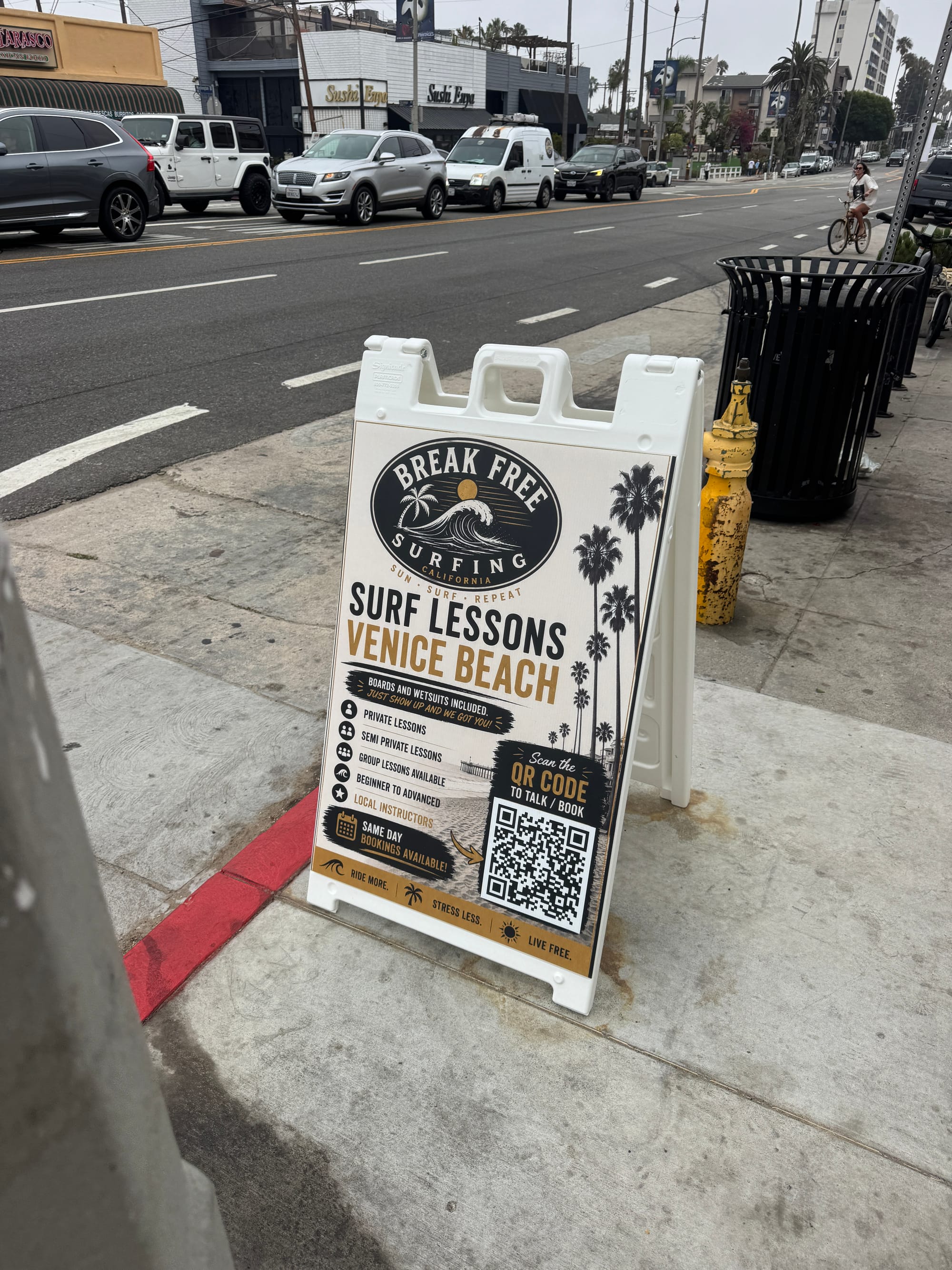
I am not sure, exactly, how many ChatGPT signs, flyers, or advertisements I had seen without noticing. But I do remember that once I began noticing them, I saw them everywhere. A few blocks from my house, on a display easel: “Break Free Surfing California: SURF LESSONS VENICE BEACH.” On Instagram, a going out of business closeout sale for a skateboard shop. On invites to parties from friends, Fourth of July barbecues being thrown by bars, concert posters. I saw ChatGPT-designed advertisements for drug deliveries in Berlin, World Cup parties in France, junk hauling services in South Carolina, and fundraisers in Texas. The scourge of low effort, stylistically indistinguishable AI-generated signs and flyers have flooded both social media and, increasingly, posters, billboards, and signs in real life: “So ain’t nobody gonna address this ChatGPT flyer pandemic we’re in?” one viral post on Threads read last month.

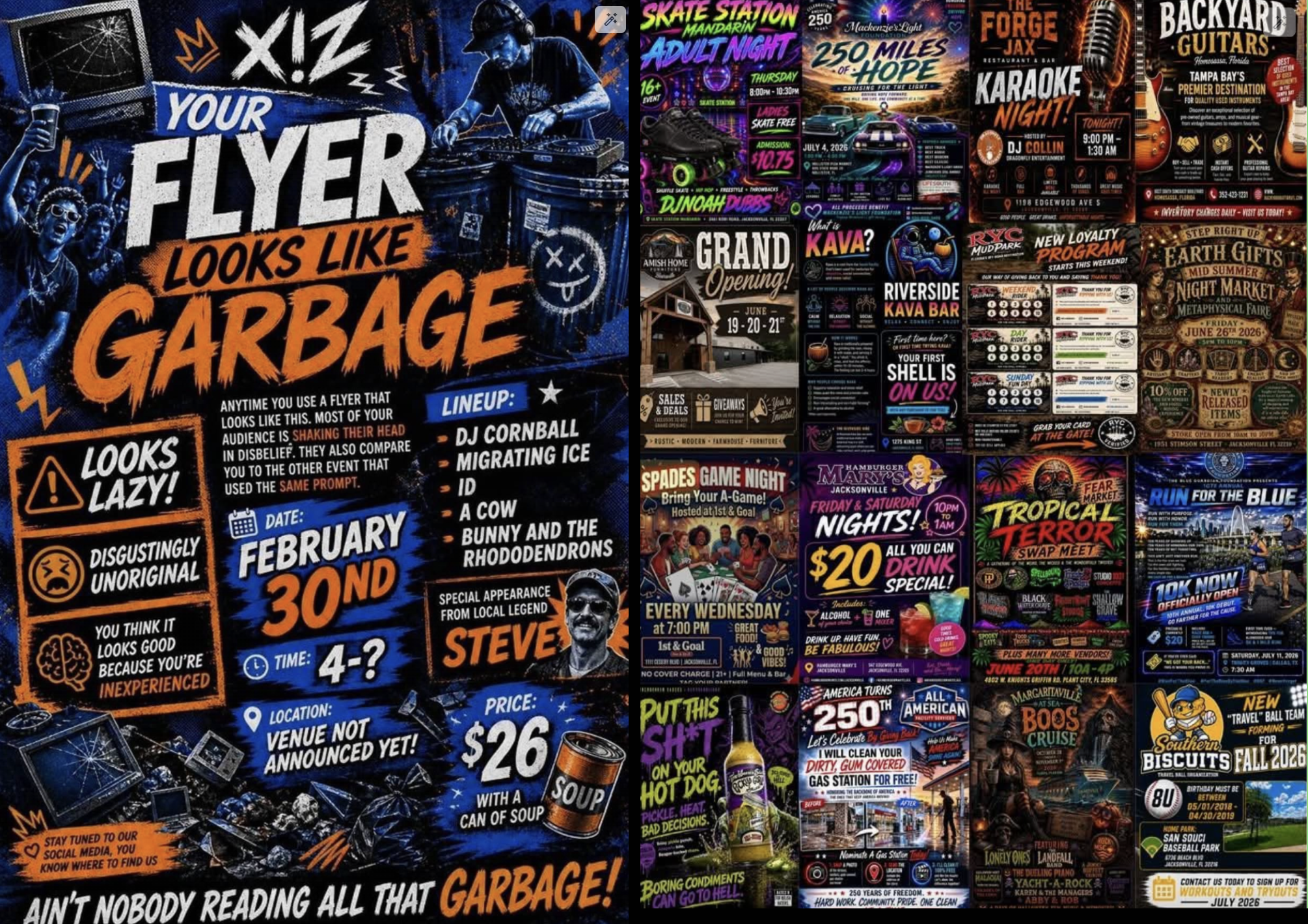
“YOUR FLYER LOOKS LIKE GARBAGE,” a viral ChatGPT-generated parody of the genre posted by Jill Oliver reads. “Hey if this is your flyer, I’m not going, I’m not donating, I’m not sharing. Don’t ask me.” The “ChatGPT flyer pandemic” has become a big topic of conversation among graphic designers, musicians, bars, and small business owners who care about design and showing that they’ve put effort into something.

We Are Living in a ‘ChatGPT Flyer Pandemic’

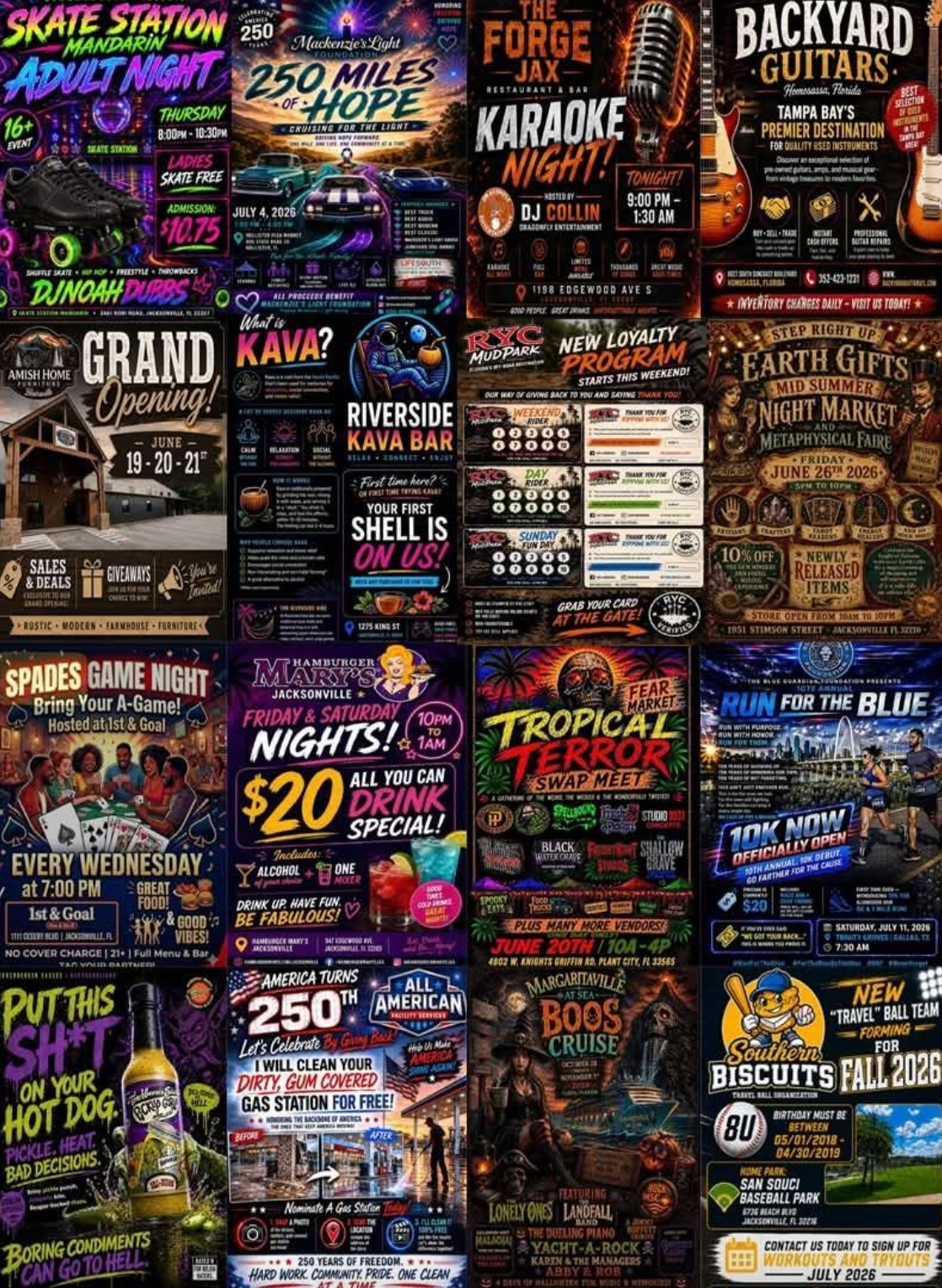
Once you notice a ChatGPT flyer, you will see them everywhere if you keep your eyes open. The art of the format is basically big, flashy bright text on dark background and an AI-generated or AI-altered image. There is almost universally a little box of generic icons in a bulleted list vaguely tied to whatever event or business it’s advertising, lines coming off of the text to emphasize whatever it’s saying, and either bolded words or underlined text and tons of arrows and checkmarks haphazardly strewn throughout. It is easier to just show you what they look like than describe it, because they all look basically the same:

We Are Living in a ‘ChatGPT Flyer Pandemic’
From a post by Facebook user Zakkai Rayne Morningstar
Read the whole story
mkalus
25 minutes ago
reply
iPhone: 49.287476,-123.142136
Share this story
Delete

'Knockoff' Browser Extension Hides Sketchy Brands on Amazon

1 Share
'Knockoff' Browser Extension Hides Sketchy Brands on Amazon

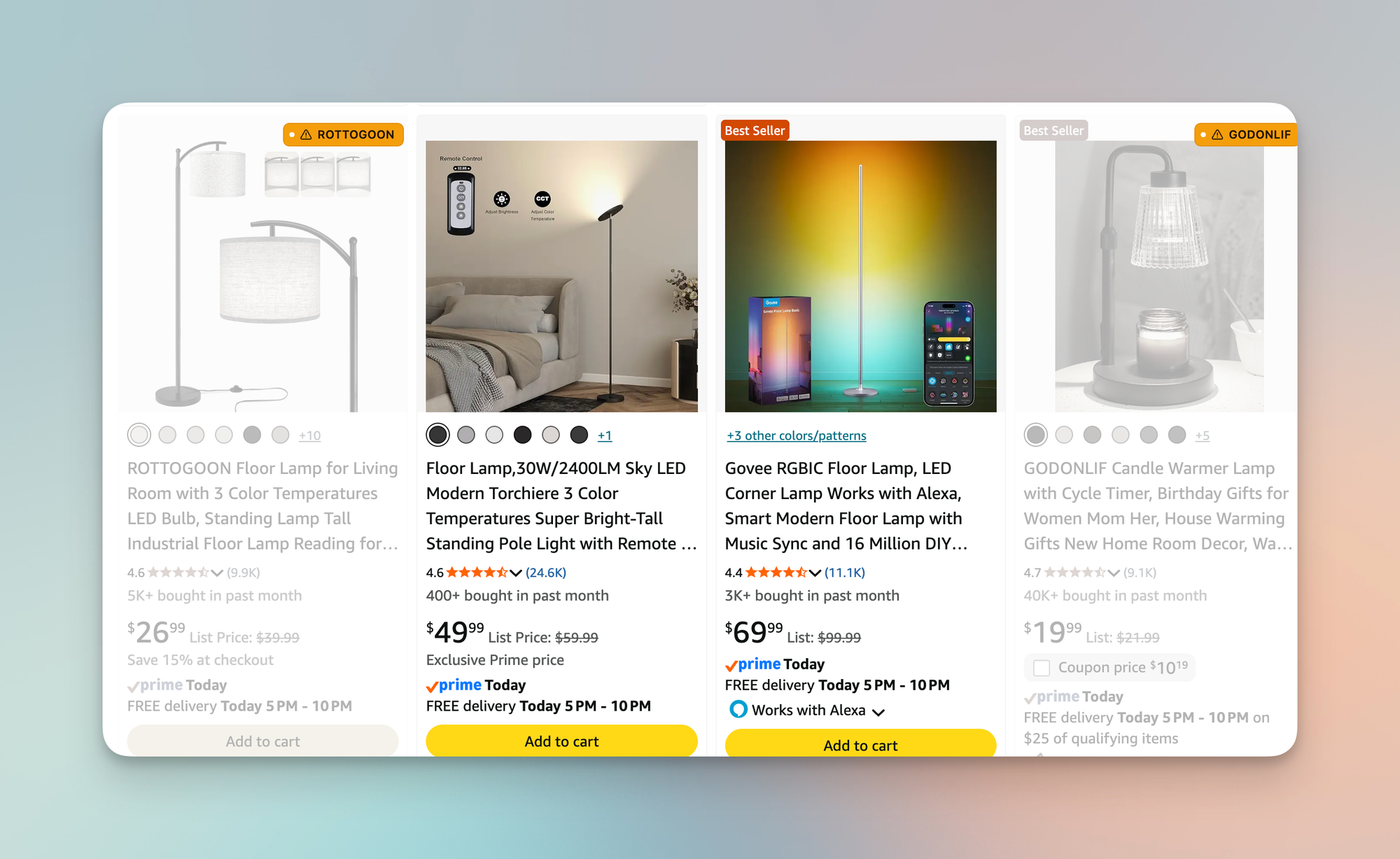
A software developer made a Chrome and Firefox extension called Knockoff that automatically hides, grays out, or filters products from sketchy brands on Amazon, which highlights just how many shady brands are on the platform and how commonly they show up on searches for basic items. 

In just a few minutes of using the extension, Knockoff dimmed product listings for screwdrivers made by “SUNHZMCKP,” spoons made by “SACATR,” and a lamp made by “ROTTOGOON.” In a tweet announcing the extension, developer Josh Pigford wrote “Sorry to brands like WNPETHOME, EHEYCIGA, YXYL, LU&MN, JOYIN, TOMY, GODONLIF, YOOJEE, LINGTENG, LANEIGE, VISCOO, BIODANCE, COOFANDY, BALENNZ, TOSY, and LUENX.” The extension can also hide all sponsored product listings. The extension quickly went viral as a much-needed filter for people who still use Amazon and, for those who don’t use Amazon because of its horrendous labor practices and other concerns, it is evidence of what an incredible wasteland the platform has become. 

In a video call, Pigford told me that he had been thinking about making Knockoff for a while but that he finally decided to do it last weekend. “I was cutting the grass and about to get my trimmer out to do some weed eating, and it wouldn’t crank. So I decided to get some specific tools, and I searched for them and was like ‘What are these brands? Am I going insane?’ I just wanted something from a common brand or something I was familiar with,” he said. “I was like ‘man, I’ve gotta build something.’”

Pigford said that Knockoff is essentially building a list of brands to allow or not allow, and that it uses several different criteria to do this, including looking at the names of the brands: “Basically number of consonants, number of vowels, how they are grouped together, whether they’re in all caps or not,” he said. This means that brands like “EHEYCIGA” will be automatically added to the filter list. But the list of blocked brands is intended to be determined by its community of users, and any user can ask the extension to allow or block any specific brand for themselves. The project builds on previous similar attempts to highlight sketchy brands on Amazon, including one called AmazonBrandFilter and The Markup’s Amazon Brand Detector. The extension also allows anyone who has downloaded it to report potentially sketchy brands and to report brands that have been accidentally flagged as knockoffs. 

The extension runs locally and doesn’t require an account to use, and doesn’t send data back to any server. It is free. “I stand to benefit nothing directly economically, it’s a nice little tool I wanted to make,” Pigford said.

Knockoff is pretty useful whether you use Amazon or not. For those who don’t use Amazon, it highlights a problem repeatedly shown by Joe Biden’s Federal Trade Commission in an antitrust lawsuit against the company, which is that much of Amazon is pay-to-play, with brands needing to buy ads or placement boosts in order to be featured at the top of search results. The platform has also become an algorithmic and financial race to the bottom, with companies stealing others’ designs, jamming their product pages with keywords that will perform well in search, and creating fly-by-night brands to try to end up at the top of search results.

“There was somebody who sent me a screenshot from using the extension and the first 20 items or something were all grayed out. Like there were all these knockoff brands before they could find a legitimate item,” Pigford said. “It’s like, OK, that about sums it up.” 

“I think people want control over what it is that they're seeing on the internet,” he added. “This sort of gives some control back to just getting everything shoved in your face. It’s like fighting back against the algorithm to some extent.”


Read the whole story
mkalus
1 hour ago
reply
iPhone: 49.287476,-123.142136
Share this story
Delete

OpenAI ‘Stargate UK’ plan was completely fake

1 Share

The UK announced its AI Opportunities Action Plan in January 2025 — a signature programme for the new and otherwise ideas-free Labour government. It would include a huge OpenAI data centre or two, part of OpenAI’s Stargate plan! £20 billion of new UK data infrastructure!

In February this year, the Guardian found that none of this existed: [Guardian]

the money isn’t necessarily real, the datacentres may not be new, the jobs are unaccounted for — and the supercomputer site 12 miles north of London is still a scaffolding yard.

In April, OpenAI said it was pulling out of the UK Stargate plan entirely — blaming power costs and “regulatory uncertainty.”

The Guardian has a new exposé on OpenAI’s plans for a data centre in North Tyneside outside Newcastle. Or what didn’t happen — anything at all. The government got OpenAI and alleged data centre firm NScale to go along with a press release: [Guardian]

Sources with knowledge of the process to set up Stargate UK suggested the government had approached the UK firm Nscale and OpenAI shortly before Donald Trump’s visit to the UK last year, asking them to agree to develop the Stargate UK site in Cobalt Park, a business park in North Tyneside. “They needed a big announcement,” said one.

The UK government touted £30 billion of AI investment. At least £20 billion of that was just made up for the press release! The government just thought it sounded like a nice number:

The government said the figure of £20bn was given because that was the amount of money the site would need in order to build a datacentre and obtain the computing power necessary to utilise its electricity supply, which it said was 1.1GW.

Someone guessed it would cost £20 billion, so the press release said that much was coming. It was not. It never was. This claim was a lie.

The Guardian sent a freedom of information request to the National Energy System Operator, asking where this 1.1 gigawatts would be coming from. The plan that NESO sent back did not include a grid connection. It was going to power itself — but didn’t specify how.

North Tyneside Conservatives leader John Johnsson told the Guardian:

There’s just not the infrastructure there to be able to actually support it … The fundamentals, energy costs, grid capacity and infrastructure do not appear to have been in place to support a project of this scale.

The entire thing was made up.

OpenAI told the Guardian:

We continue to explore Stargate UK and will move forward when the right conditions such as regulation and the cost of energy enable long-term infrastructure investment.

So that’ll be never, then.

Read the whole story
mkalus
18 hours ago
reply
iPhone: 49.287476,-123.142136
Share this story
Delete

Bonobo mit zwei neuen Singles

1 Share

Bonobo überrascht mal eben mit gleich zwei Singles, die heute erschienen sind. Zum einen „Drift“ mit offiziellem Video und „Fire on the Water“ (feat. Arooj Aftab) mit einem Visualiser. Beide Tunes sehr gelungen, das dazugehörige Album „Distance in Static“ erscheint am 11. September bei Ninja Tune.


(Direktlink)


(Direktlink)

Read the whole story
mkalus
18 hours ago
reply
iPhone: 49.287476,-123.142136
Share this story
Delete

Footage Shows Cop Stalking Woman He Met on a TV Set After Surveilling Her With a License Plate Reader

1 Share
Footage Shows Cop Stalking Woman He Met on a TV Set After Surveilling Her With a License Plate Reader

A police officer speeds 70 MPH down a two-lane highway running over a bridge in the Florida Keys. He passes a dump truck in a no-passing zone, then immediately does it again, crossing over a double-yellow line to pass another truck. He passes a third vehicle, nearly causing a head-on collision with a white pickup truck that veers away from him in the oncoming traffic. The cop keeps driving, and sees the SUV he’s been in pursuit of. He flicks his sirens and lights on and pulls it over. 

The cop, Lamar Roman, wasn’t trying to pull over a suspected criminal. He was tracking and chasing a woman that he met and harassed on the set of the AppleTV+ show Bad Monkey, which he had worked a security detail shift on a few weeks prior to pulling her over. After meeting the woman, catcalling her and harassing her for her full name and Instagram details, the cop illegally looked up her vehicle information on DAVID, a Florida Department of Motor Vehicles database for law enforcement. He then put her license plate details on a surveillance “hotlist,” meaning he would get a notification in real time anytime she drove by an AI-powered license plate surveillance camera. 

Roman told investigators that he saw the woman as a “shiny thing” and knew that using surveillance tools to track her was illegal, according to police records. He told investigators that “I knew that when I put [her into DAVID], I’m like ‘fuck’ and that’s why I stopped right after and nothing else.” But that wasn’t the end of it; he investigated the woman then used a powerful license plate tracking database to find her location and chase her down. In doing so, he also “almost cause[d] a head on collision while passing as a white truck traveling northbound had to veer off the roadway to avoid a collision.”

The shocking and egregious incident highlights the fact that police around the country have abused their access to surveillance tools for their own personal stalking projects, and shows how different law enforcement databases and surveillance tools can be tied together to investigate and follow anyone. 

Read the whole story
mkalus
1 day ago
reply
iPhone: 49.287476,-123.142136
Share this story
Delete
Next Page of Stories