X’s algorithm learns what you hate and shows you more of it, according to a new study just published in the Proceedings of the National Academy of Sciences (PNAS). The paper, titled Value misalignment of X’s feed algorithm is a reflection of value tensions in engagement, found that the site’s algorithm prioritized engagement above all else when it generated a user’s For You Page. It also showed that X serves more ragebait to people who say they are Democrats, although the exact reason for that is unclear.
“In 2026 that’s maybe not the most surprising headline ever,” Ziv Epstein, a postdoctoral researcher at Stanford University, and co-author of the paper, told 404 Media. “So we actually dug in a little deeper to figure out why this is actually happening, and it turns out that X's feed algorithm, like a lot of these social media algorithms, is optimized for engagement [but] it turns out that not all types of engagement are considered equally.”
The study’s goal was to understand how a user’s self-professed values system might shape what they see on X. “We recruited a nationally representative sample of N = 715 Americans who are active users of X in September and October 2024, quota matched on ethnicity, gender and partisanship, to install a browser extension to collect their [For You Page] and Following feeds,” the study said.
Epstein said the study was observational and meant to get people asking questions about what they want to see on social media, how their feed is designed, and by whom. “There are these social media algorithms that have enormous amounts of power in our lives, they shape the information that we consume, and we have very little transparency into how they operate and what their implications are,” he said. “And so, we were very interested in trying to understand the particular effects of this particular algorithm, and so I think that has kind of important implications for civil society and just fighting some of the technofeudalistic tendencies of platforms to control these algorithms.”
For the study, researchers collected a “values inventory” of the volunteers using a research tool called the Schwartz Theory of Basic Values. The values inventory in the study is presented as a wheel with 19 points that corresponded to features like “tolerance,” “dominance,” “hedonism,” and “openness to change.” Users also reported their political alignments.
Then researchers watched how users engaged with posts on X and how those posts reflected their self-reported values. “We observe that the inventory of posts from followed accounts reflects users’ self-stated values — but that there is an overall negative correlation (misalignment) between users’ explicit values and the values in content that the algorithm is more likely to amplify,” the study said.
When a user on X sees a post that makes them mad — like a press release from a politician from a political party they don’t like — sometimes they’ll fight about the post in the replies. It doesn’t matter who you follow or what your stated values are, X reads replying as engagement and will send more of the infuriating posts the user’s way.
“When we look at commenting, the act of replying to posts, that's where we actually see some kind of meaningful misalignment between people’s values and the values of the content they’re replying to,” Epstein explained.
Most of the participants liked and reposted content on X and got served more of the same sort of content. Replying was rare, just 6.8% of the interactions according to the study, but had an outsized impact on the algorithm. “Replying is only a fraction of engagement, but there does seem to be some evidence that these algorithms are prioritizing and learning more from this kind of rarer form of engagement,” Epstein said. “So it’s this feedback loop of outrage baiting. The algorithm learns that you get outraged and then continues to serve more content in that direction and that seems to be particularly true of the Democratic users of our study.”
Though this happened across the political spectrum, the study found that ragebaiting occurred more for users that identified themselves as Democrats. “Democrat users confront the abundant value-misaligned content by replying to it, which the algorithm in turn preferentially learns from and continues to feed them,” the study said. “This highlights a core tension with how engagement-maximizing algorithms operate on social media: frictions between users’ stated preferences and their behaviors of reactive confrontation are exploited by engagement-maximizing algorithms to create runaway feedback loops of increasing value misalignment.”
Epstein said he’d need to do more research to find out why X seems to serve ragebait to Democrats more often than Republicans. It could be that there’s more rightwing content on X overall or it could be that Democrats tend to engage with posts they disagree with more often. “There might be some kind of differential effects on information diets there, or it might be something more psychological about how different you know partisan identities are triggering different kinds of actions and reactions, but ultimately I don't want to speculate too much,” he said.
I asked Epstein if he worried that prioritizing “values” in a social media algorithm might lead to more siloed user bases and more echo chambers. “I do think that if we go kind of down this path of thinking through and imagining value line social media feeds, we do have to be very aware of the potentials of value echo chambers, right?” he said. “Where people just, you know, they have the certain values that they have, and all the content they see is just aligned with those values. I think that is a very scary and dark reality.”
But he also said that values are intentional and that thinking about the kind of stuff you want to see on a social media site before you pull up your feed is a positive. “You're pumping the brakes, you're taking a breath, and you're thinking about what you actually really care about. In this world — and I don't have the data for this — but I would speculate that a lot of people actually do care about seeing a diverse set of content and engaging meaningfully across these lines, and you know maybe that isn't a particular value on my 19-dimensional wheel, but this is just a starting point of thinking about our intentions and thinking very deliberately about the kind of information we want to be exposed to, versus the the knee-jerk reaction that we're kind of learning in this very kind of short, shallow attention span, emotion and negative affect-driven model of these very myopic forms of engagement.”
The National Park Service (NPS), the agency tasked with managing the U.S. national parks and monuments, has purchased Flock cameras and had them installed at parks including in Yosemite.
Current and former NPS rangers are not happy about it.
“Flock protects property, not people or parks. People should be free to recreate in ways that are respectful to the ecosystem — but the surveillance is a disrespectful invasion of privacy,” a current NPS ranger told 404 Media. 404 Media granted the ranger and others anonymity because they weren’t permitted to speak to the press.
💡
Do you know anything else about Flock? I would love to hear from you. Using a non-work device, you can message me securely on Signal at joseph.404 or send me an email at joseph@404media.co.
Another current NPS ranger said, “I just think that every American should be free to visit our national parks without their location being traced and tracked by the federal government. Wild places are at the core of American freedom and nobody should be afraid to visit them.”
A former NPS ranger added, “I think if the public knew that their public lands were being surveilled, they would push back.”
Flock cameras constantly scan the license plate, color, model, make, and other identifying features of every vehicle that drives past, creating a timestamped record of where a vehicle was at a particular time, and by extension, a person. This data is then available to Flock’s law enforcement customers and is usually queried by police without a warrant. Many of Flock’s cameras are part of a national network that other law enforcement officials can then query. For example, a cop in Texas might query the network to look for a specific vehicle and search cameras across the country. This, among increased reporting of cops abusing their access to Flock to stalk people with no legitimate investigative purpose, and local cops performing lookups for ICE, has contributed to a nationwide conversation around Flock and whether communities want the company’s cameras in their neighborhoods.
There is also a Flock camera on a road towards the Golden Gate National Recreation Area, according to the data.
NPS also plans to install cameras from Verkada, a controversial company with a history of abusing its own products and whose products sometimes have facial detection capabilities, according to a letter from Michael Donato, the acting deputy superintendent of National Capital Parks - East, sent to the Washington Support Office Visitor and Resource Protection Program.
“Some parks have USPP [United States Park Police] Flock cameras for license plate recognition, but for parks that don’t, the Verkada cameras will provide LPR,” the letter, which 404 Media viewed, reads.
The NPS told 404 Media in a statement: “Yosemite National Park uses a traffic-monitoring system to measure vehicle counts, travel times and entrance-station wait times. The system helps the park better understand traffic conditions and provide visitors with information to help them make informed decisions about when to visit and where parking is available. The cameras are not connected to law enforcement or DMV databases.”
One of the current rangers said, “Last year Yosemite changed the rules about hanging flags on El Capitan and tried to backdate the rule change to make it look like the people involved had committed a crime. What happens when that sort of malfeasance is combined with the ability to track any park visitor's location, anywhere in the country? If that happens, we are no longer free in this country.”
They added, “I fear for the day when a visitor's National Park experience is interrupted by being pulled over and held at gunpoint because a license plate reader misread their plate.”
Pornhub's parent company will pay $120 million to settle claims that its platforms violated federal sex trafficking and child sexual abuse imagery laws.
The deal settles two 2021 class action lawsuits in California and Alabama that claim Mindgeek, which has since rebranded to Aylo, profited off of child abuse material allegedly posted by abusers to its platforms. In the California case, a woman alleged that her ex-boyfriend posted child sexual abuse videos of her when she was 16 years old to Pornhub. In the Alabama case, two women claimed to have been trafficked as minors and that their trafficker uploaded videos to Mindgeek's sites; one of the women claimed she was drugged and raped at 16, and that her abuser profited off of the videos of her abuse through Pornhub's Modelhub program.
The class includes anyone who was under the age of 18 "when they appeared in a video or image that has been made available for viewing" on a Mindgeek-owned or operated website between February 12, 2011 and December 6, 2024.
Mindgeek was bought by Ethical Capital Partners and rebranded to Aylo in 2023. Aylo will pay into the settlement fund with an initial $25 million in 2026 followed by six annual installments over the next six years. In a press release, Aylo noted that the settlement "resolves the matter with no admission of liability or wrongdoing by Aylo and remains subject to court approval."
In addition to paying $120 million, Aylo agreed to a series of content moderation terms, including verifying that all of the models in uploaded content are over the age of 18, human and automated review of content to prevent child sexual abuse material from going up on its sites, and reporting suspected abuse material to the relevant authorities. Aylo's sites have implemented many of these injunctive reliefs agreed to in the settlement for years.
In late 2020, following allegations of abuse material on the site and being dropped by major credit card processors including Visa and Mastercard, Pornhub overhauled its trust and safety measures to ban downloads, restrict uploads to verified users, and expand its moderation processes. It also launched its “Trusted Flagger Program" — mentioned as part of this settlement's terms — which allows a group of non-profit internet and child safety organizations around the world to immediately disable content it flags as abusive. In early 2021, Pornhub implemented biometric identity verification for uploaders through Yoti, and in 2024, it started requiring written proof of consent from everyone in every video.
The attorney for the plaintiff class did not immediately respond to a request for comment.
“Over the years, we have put in place robust measures to help protect our platform from abuse. Only verified content creators can publish on our platform, and every upload is subject to a combination of technological tools and human review by trained moderators before it goes live, to confirm that it complies with our Terms of Service, Community Guidelines and related Policies," Aylo management said in a statement. "Many of the commitments in this settlement reflect practices we already have in place. Trust and Safety should be a priority for every online platform, and we all share responsibility for a safer online experience. Every day, our trust and safety and engineering teams work alongside law enforcement, advocacy groups and other stakeholders to prevent online abuse and to hold those abusers to account.”
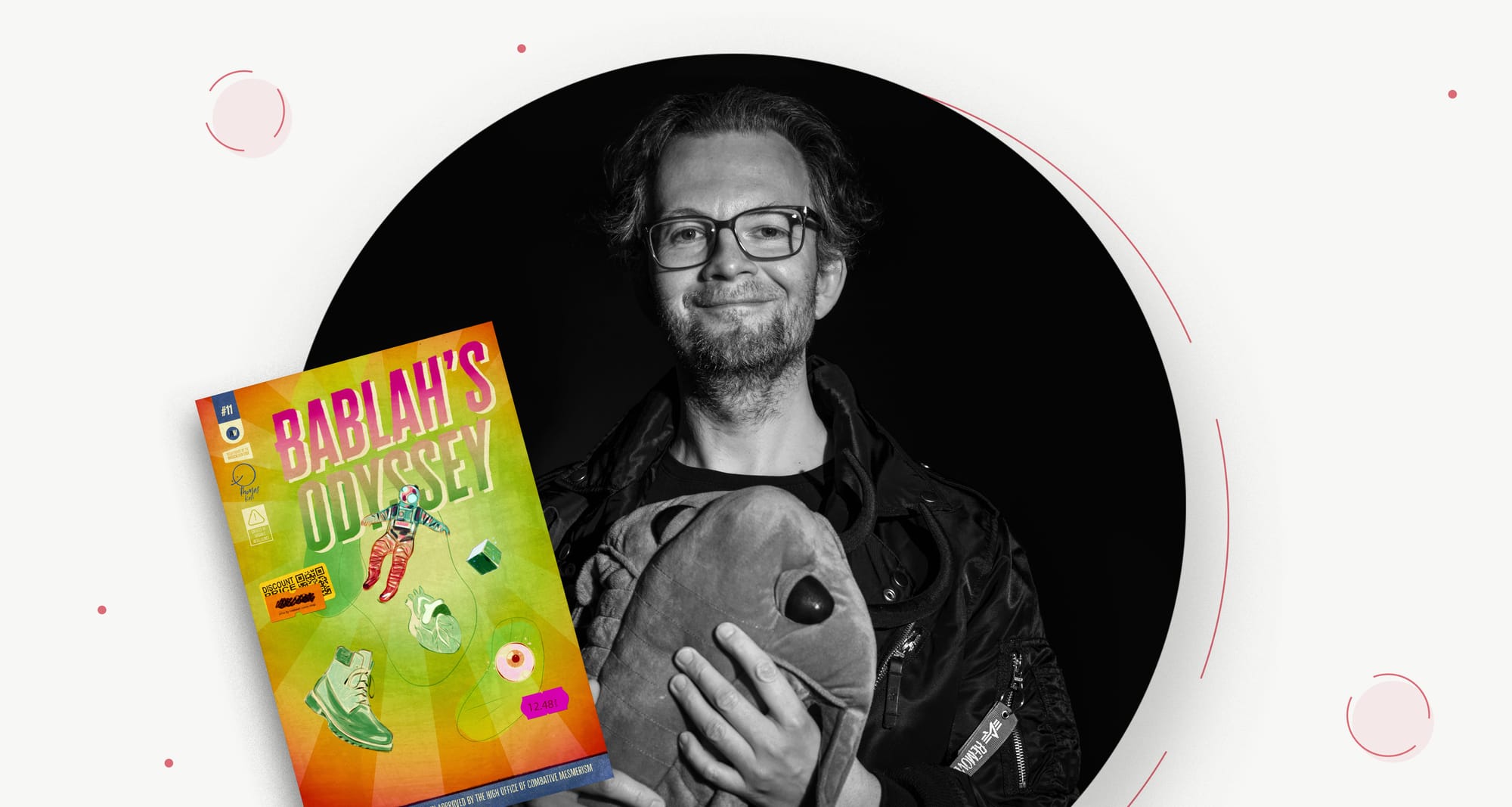
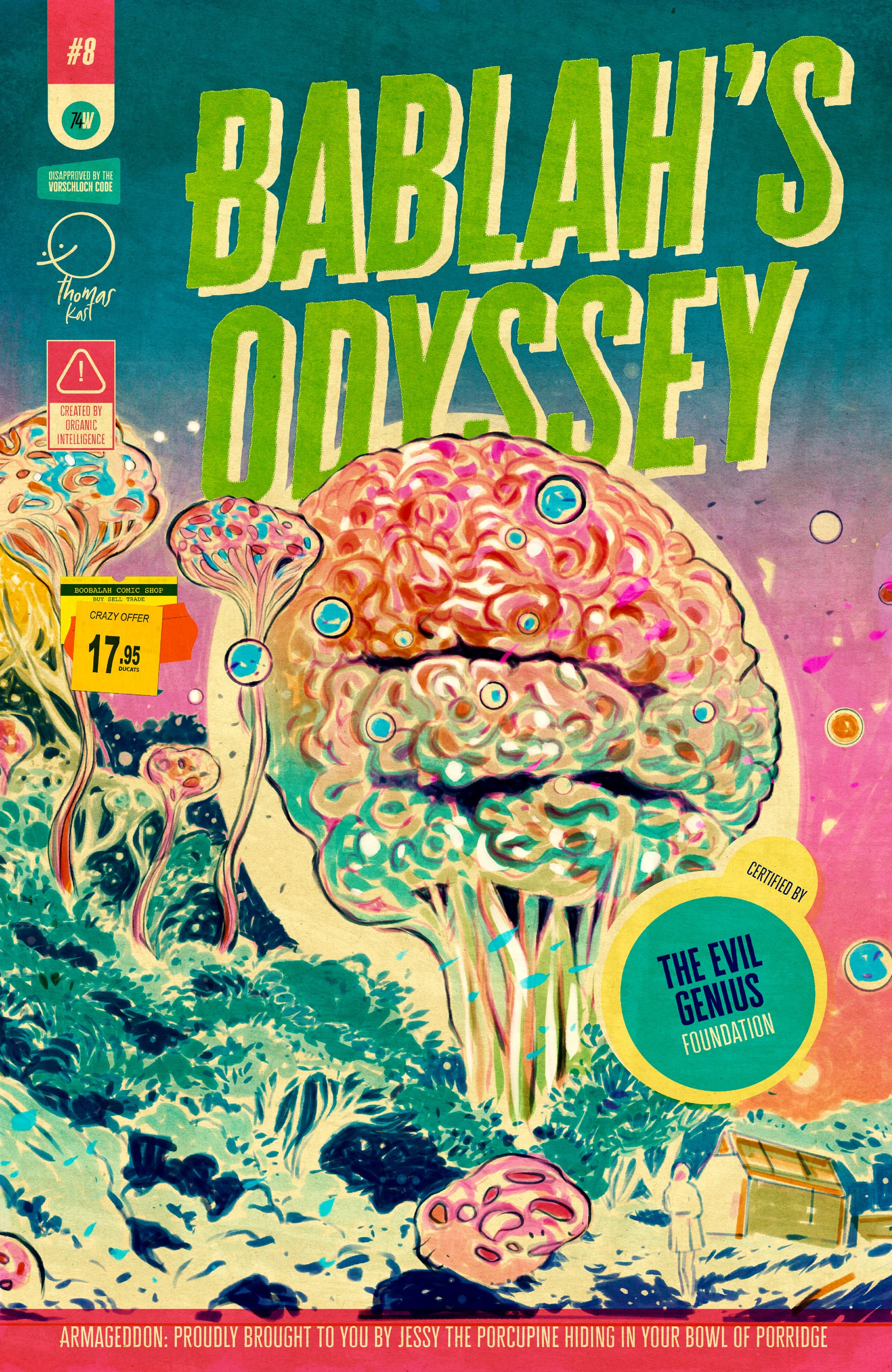
Thomas Kast is an award-winning independent illustrator and photojournalist from Zurich, Switzerland. Apart from holding a PhD in Fine Arts and teaching at multiple colleges, he is also the author of the philosophical sci-fi novel The Great Convergence and the comic series Bablah’s Odyssey. His website is thomaskast.com.
Let's start with your origin story. How did your interest in fine arts lead you to a career spanning illustration, art direction, and academic teaching?
Although it may not seem like it at first — all these specialities have a lot in common: delusional narcissism, an unquenchable thirst for dominance, and — most importantly — being deeply in love with the sound of one’s own voice.
What accelerates all of those, at least in my case, is perseverance. You see, like most people, artists fail in life. Unlike most people, artists don’t learn from their failures. I definitely didn’t. Add an acute case of ADHD and there you have it — me jumping all over the place.
You hold a PhD in Fine Arts. Was academia always part of the plan, or did it become clearer as you progressed through your studies?
Jokes aside, art school is quite a different environment from other universities. Although we studied many theoretical subjects — among others, art history, composition and the psychology of colour — most of the program was centered around practical skills: painting, drawing, composition, typography, etc. This provided a meaningful outlet for my chaotic and exceedingly contrarian nature.
I learned classical drawing techniques during the day at the academy, and real-life illustration at night in pubs and nightclubs, where I had become a local attraction of sorts. I’d just sit at the bar, or at some table in the corner, and keep drawing people on A4 sheets I always had with me. People would come and go, some of them I knew, some of them I didn’t. And I kept cranking out more and more drawings in exchange for free coffee — because I don’t drink anything else.
In time, apart from drawing people from life, I started adding random quotes from the conversations they had with one another to my sketches. Because these were taken out of context, the results were often hilarious.
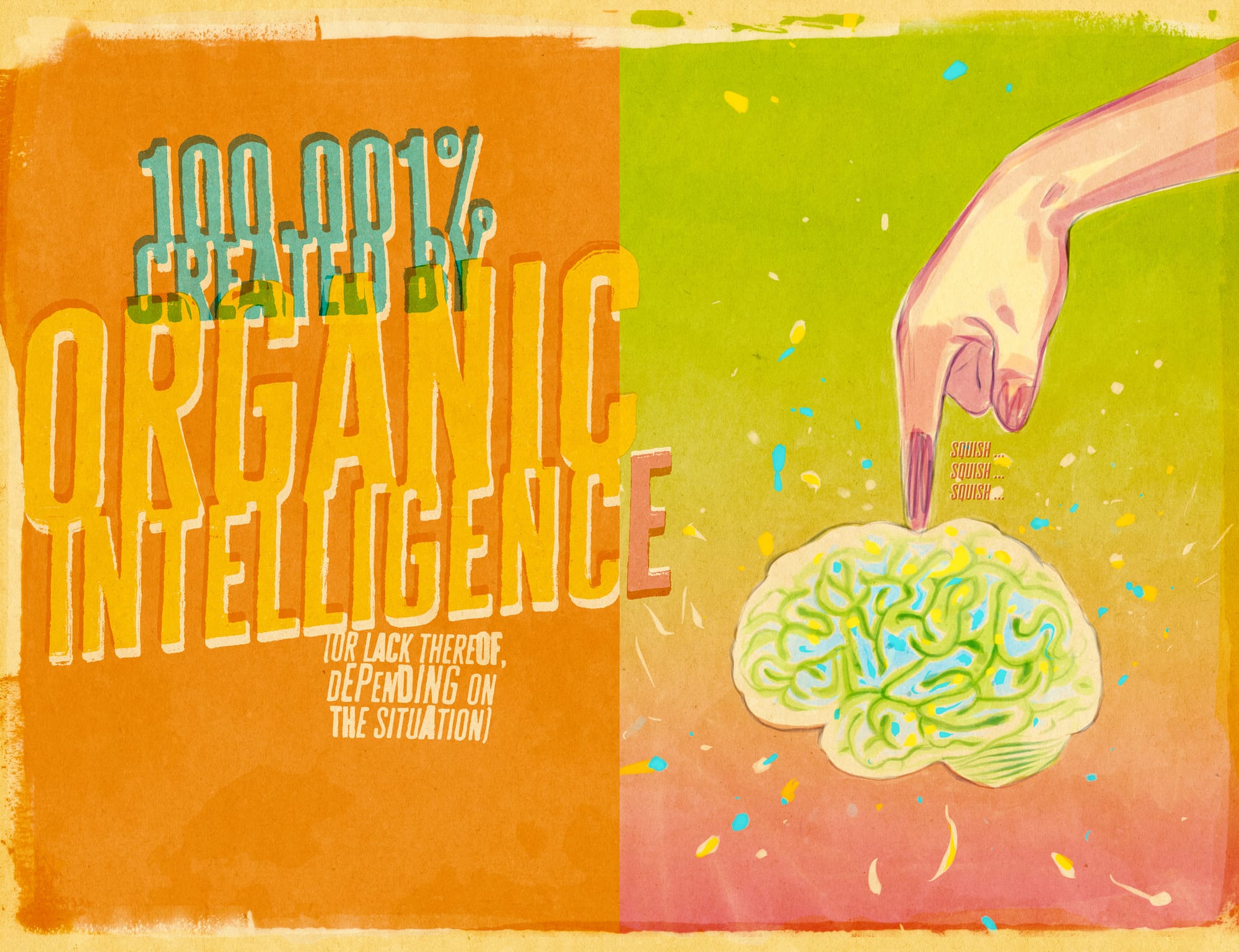
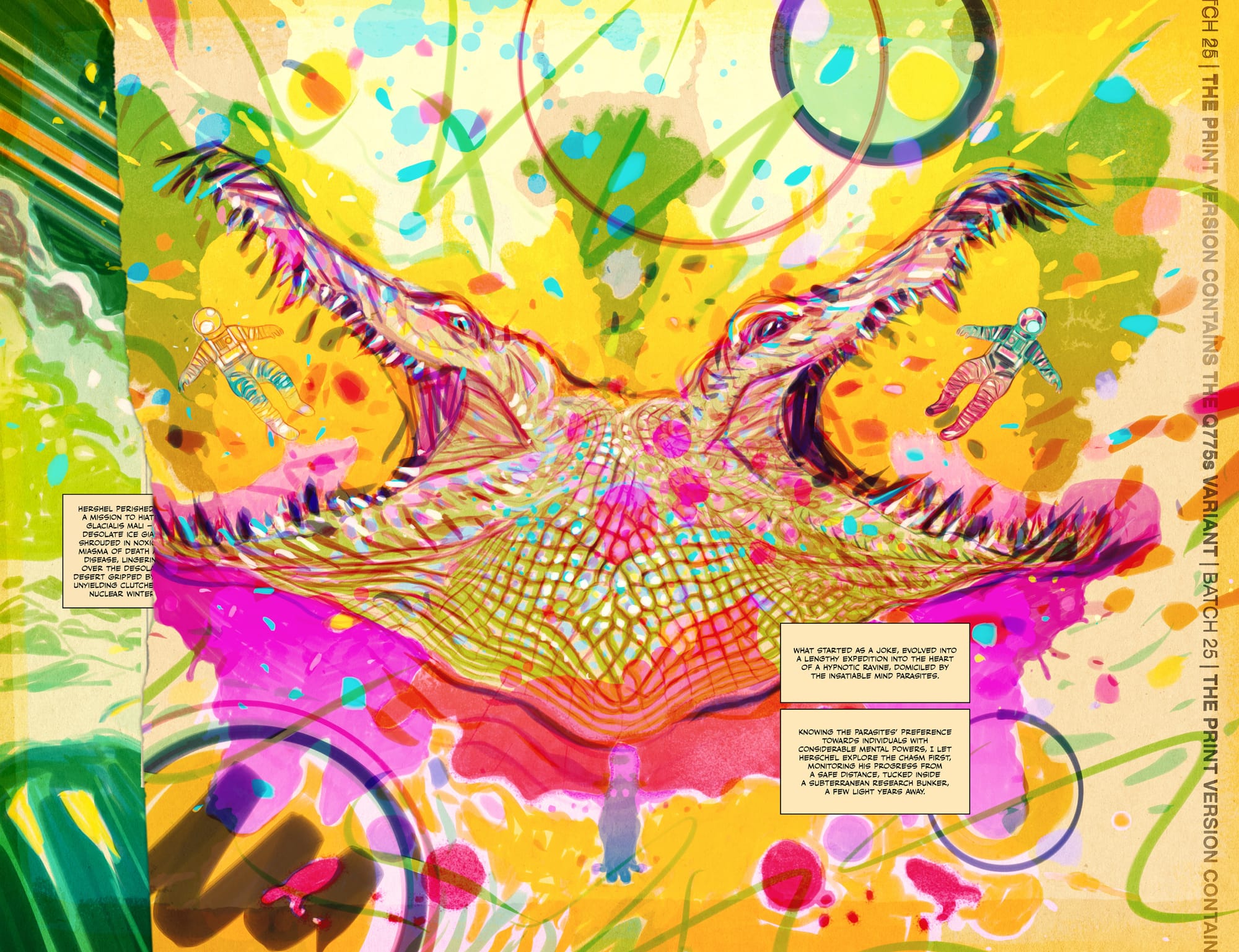
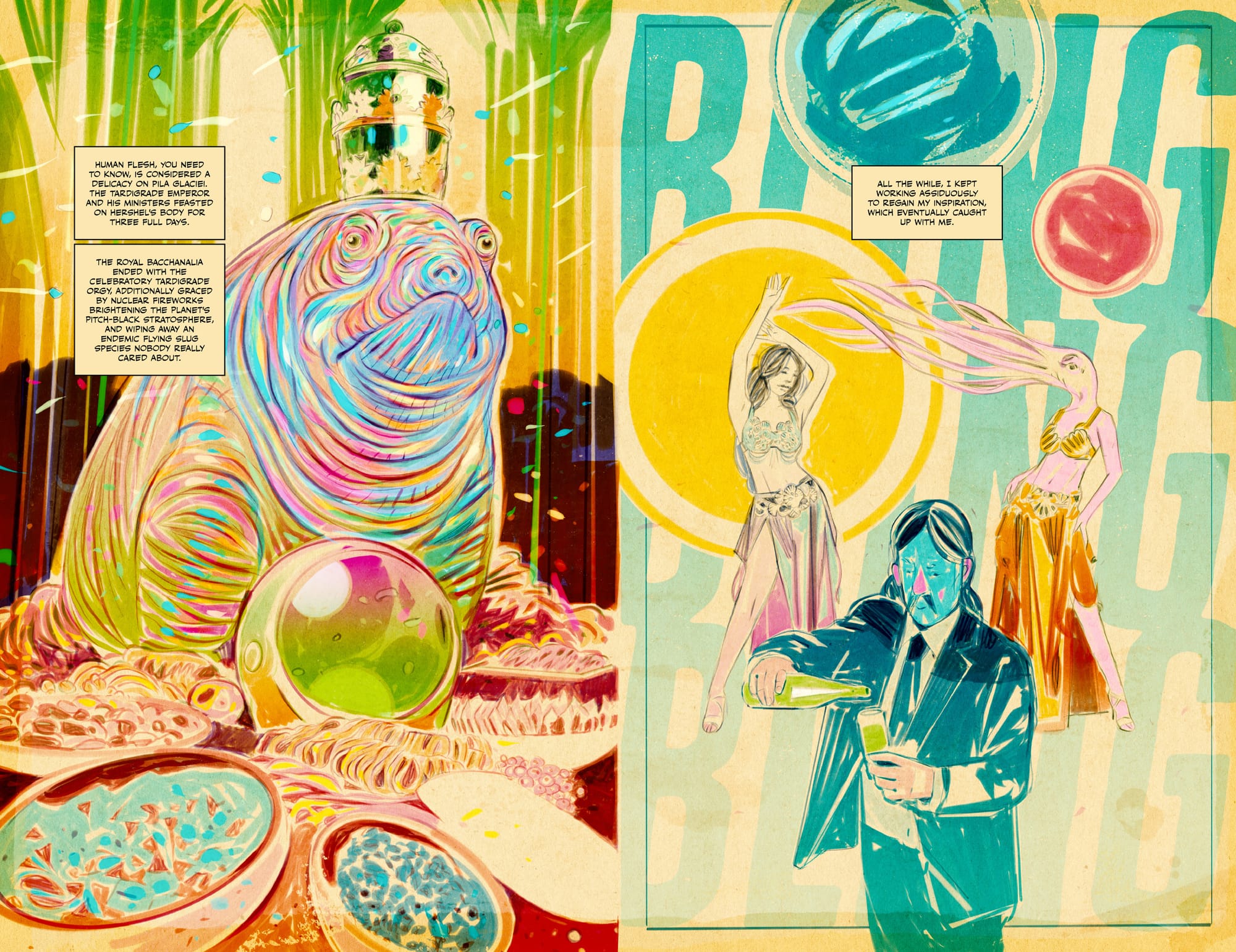
Illustration from Thomas' comic series, Bablah’s Odyssey
When people think about academia, they mostly have a more rigid structure in mind. In my experience, it was like being part of a larger, living and breathing organism. A place where you learn to combine theory with practice. Where you develop technical skills, but you’re encouraged to use what you learn to create your own unique artistic style and language.
So naturally, I was always drawn to academia as an institution created by people centred around a common idealistic goal. ETH is quite different in this regard, but that’s a story for another day, I guess.
You teach a course called “Design for Scientists” at ETH Zurich, after years of teaching illustration and photography at Shenkar in Tel Aviv. These are scientific and engineering-focused schools. How has teaching people outside the art world changed the way you think about your own visual language?
Shenkar offers a degree in visual communication, among many other things, and that’s what I was teaching. ETH, on the other hand, is strictly science- and engineering-oriented.
Teaching scientists requires a different approach and a very specific type of discipline. Being more analytical rather than intuitive on average, scientists and engineers approach aesthetic principles in a more meticulous way compared to art students. Scientists also use aesthetics to convey a specific message and increase information retention among their audience.
All of this didn’t change my own visual language, since that comes from the heart — a place traditionally off-limits to science.
In terms of content, however, the world of science became an endless source of inspiration to me. The main protagonist in my comic series is a scientist, albeit an evil one. Another scientist, and the principal character in The Great Convergence, is an amalgamation of real-life scientists I know personally.
Because parts of my novel take place in a distant future, the science my characters use is more akin to magic. I’m not a fan of hard sci-fi, so I deal with general aspects of science, or its implications for humanity, in a much broader sense. That said, the scientific element remains quite dominant in my work.
My own visual language ... comes from the heart — a place traditionally off-limits to science.
You have a comic series called Bablah’s Odyssey, which we'll get into shortly, but you also have a novel, The Great Convergence. Both are philosophical science fiction works, and you described them as social satires. Can you share some more details about how your novel came together?
The Great Convergence combines my life’s greatest fascinations: art, science, philosophy, science fiction, and the mystery of human stupidity prevailing over common sense in every situation, at all times.
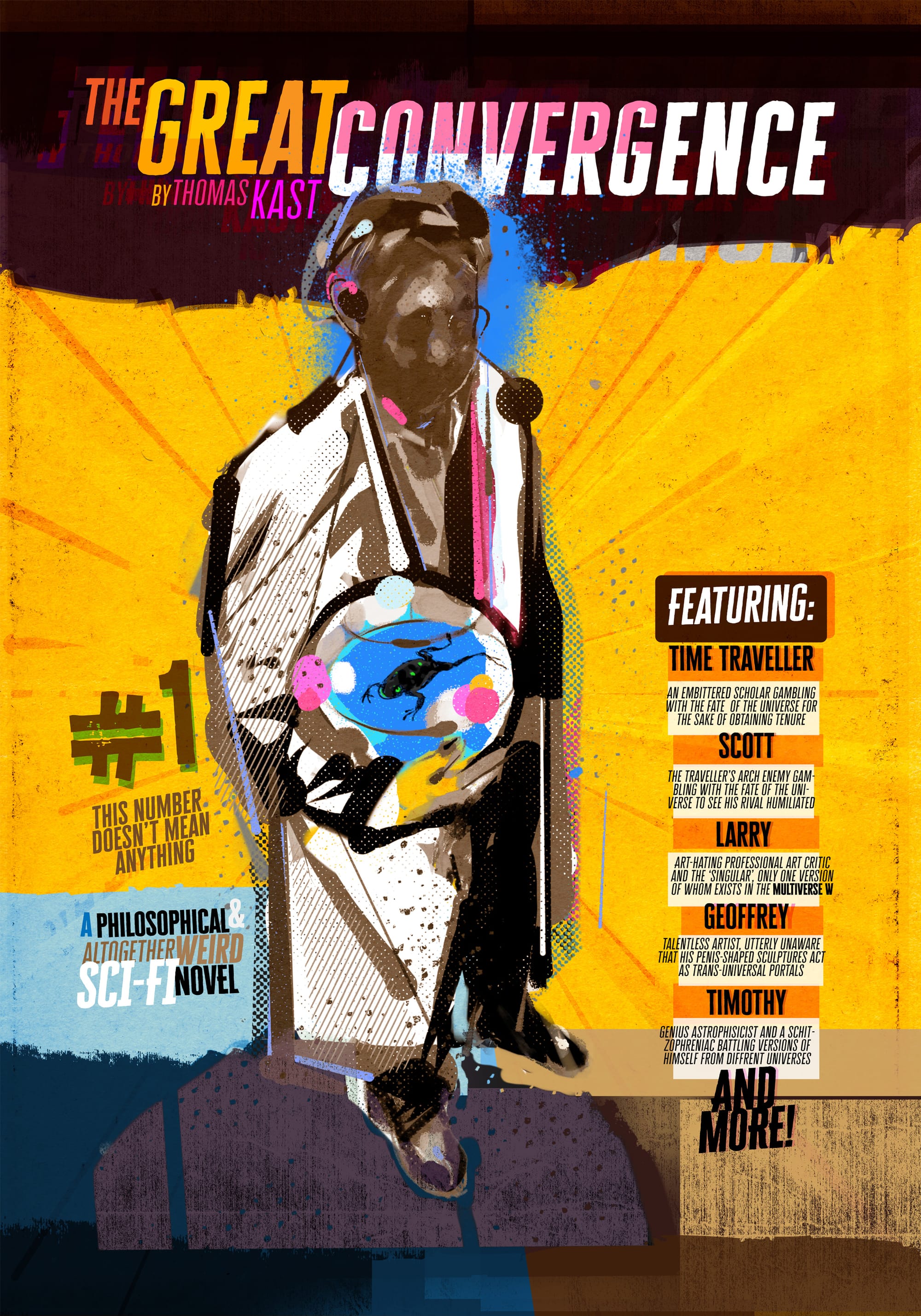
Cover design of The Great Convergence
Having observed humanity for quite some time, especially the prosperous part of it, I had one and only one big dream: to be handsome and stupid. To my greatest disappointment, I turned out neither.
This transformed me into an exasperating nonconformist, hellbent on finding a hole in the whole from the moment I opened my eyes until the night would wrap the world in its ebony wings.
My constant complaining in front of everyone provided temporary relief from accumulated frustrations, but it can only get you so far. The alternatives were limited — alcohol, yelling at people in a park whilst standing on a tea box, or trolling others on various forums.
I couldn’t afford prolonged drinking. I’m socially awkward, so disseminating my views through a megaphone in a public space was also out of the question — I’ve neither the charisma nor the guts for that. Internet trolling wouldn’t work either, as it demands a lot of self-imposed discipline and firmness of purpose.
In the end, I opted for the cheapest and easiest route: writing novels and comics. And that’s what I’ve been doing ever since.
The Great Convergence draws on your own real-life experiences combined with what you call “unencumbered fantasies.” Where does the line sit between what actually happened to you and what you invented?
I’m not really sure, I have to admit. But does it really matter? Many of us spend time daydreaming about different worlds and realities. We often remember things not as they happened, but as we prefer them to be. We spend about a third of our lives sleeping, lingering in a dreamworld. And how do you even define objectivity if everyone’s experience is always subjective?
As for myself, I probably retain enough of a sense of reality not to jump off a building, flapping my hands and convinced that I can compete with birds for dominion over the sky. Save the extremes, I fully embrace spontaneous bouts of imagination blending with my moderately rational perception of the so-called reality thrust upon me from a young age, contrary to my desires.
Whenever my demons talk to me — I answer.
I think it’s important for artists and philosophers to speak up for those whose voices have been suppressed for too long. If we won’t do it, who else will?
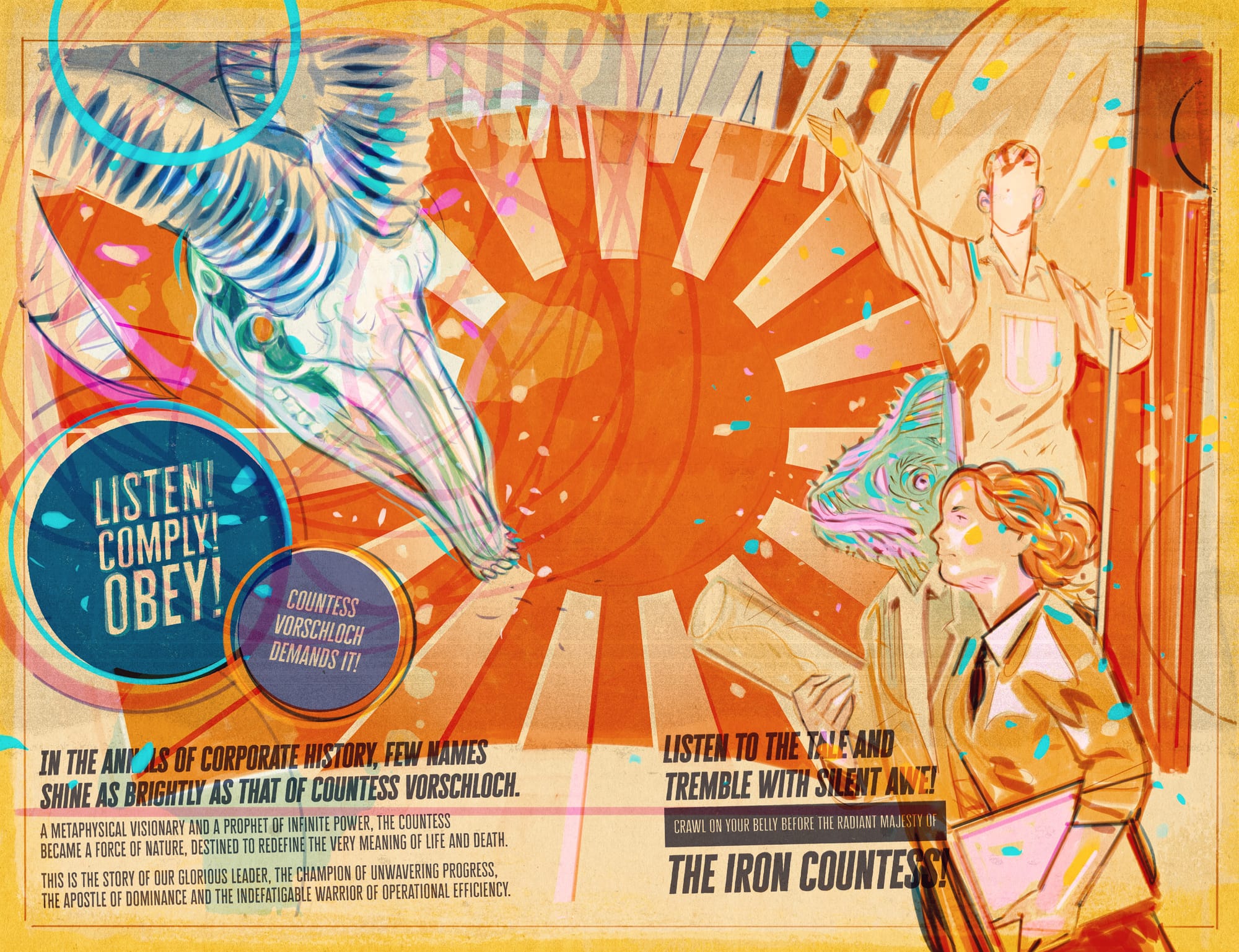
Cover design of Bablah's Odyssey 07: Synthetic Reasoning
Your comic series, Bablah’s Odyssey, follows a journey across the universe where the protagonist teaches his partner about the “glory of civilisation”. Each part is a critique of modern society, especially capitalism, packed in a sci-fi setting. What drove you to tackle such heavy themes through a comic series?
A comic is a cross between a film and a book, roughly speaking. It’s accessible, yet it allows for incredibly wide-ranging expression, especially if you’re both the writer and the illustrator. Sometimes the imagery can enhance the written message. Sometimes what you see and what you read contradict each other, and an entirely different picture emerges.
Personally, I use imagery as an abstract representation of the story, which adds another layer of symbolism to it.
Regarding the rather sombre themes — once you look past the absurdist humour, I think it’s important for artists and philosophers to speak up for those whose voices have been suppressed for too long. If we won’t do it, who else will?
That said, even though I often depict the hopelessness of human lives as they drift aimlessly along the river of existence, crashing violently into one another, I actually view humanity with a lot of hope and sympathy. Ultimately, I want to help improve the social structure we created. And to accomplish that, I’m holding a mirror to the face of humanity, as the expression goes. To see is the first step towards overhauling the outdated system we live under.
If I could classify what I do, I’d call it surrealism with purpose ... but the underlying message is very much real, and it’s meant to penetrate deep into the reader’s soul.
The series also carries heavy elements of absurdity, moral introspection and self-reflection. Did you set out to explore those themes from the start, or was there a specific moment (a book, an experience) that pushed you in that direction?
It started with a brief conversation I had with an acquaintance of mine who works as a director at a bank. For reasons known only to him, he was telling me about a stakeholder meeting, at the end of which — he said — he suggested to his colleagues (and this is a direct quote): Let’s head downtown. I know a place full of those jobless people who play music and perform. It’s really cool.
Call it a final straw, which made me realise that we had created a world where social usefulness is inversely correlated with the rewards one receives for being useful to society.
As an artist and writer, I took it upon myself to reflect on humanity through my work. To ponder universal values — if there even is such a thing — to contemplate the essence of morality, and to call out wrongs for what they are. Having said that, I dislike spoon-feeding, moralising, or flattening complex issues. And that’s where absurd humour and metaphor come in.
I frequently use symbolic language and depictions I’ve invented from scratch, and don’t shy away from avant-garde techniques to make the audience read between the lines and consider alternative interpretations. If I could classify what I do, I’d call it surrealism with purpose. The world-building, the psychedelic imagery and the expression remain uncanny — hallucinatory, even — but the underlying message is very much real, and it’s meant to penetrate deep into the reader’s soul.
Can you walk us through how a comic like this actually comes together? What does your process look like, what tools you use, and where does Ulysses fit into that workflow?
Everything starts with a topic I want to address. I choose it from the myriad of disjointed observations and unpolished notes that keep hatching in my head in impossible quantities. Once I settle on a specific issue, I sketch out a metaphorical representation of what I’m trying to say and map out the storyline.
Thomas' desk setup
From this point on, the process is intentionally chaotic — I create recurring digressions, analogies, and idiosyncratic symbolism. Ulysses material sheets are great for that purpose. Sketches and illustrations impact the writing, and vice versa. Finally, I combine everything into a more or less familiar structure for the reader. Rinse and repeat :)
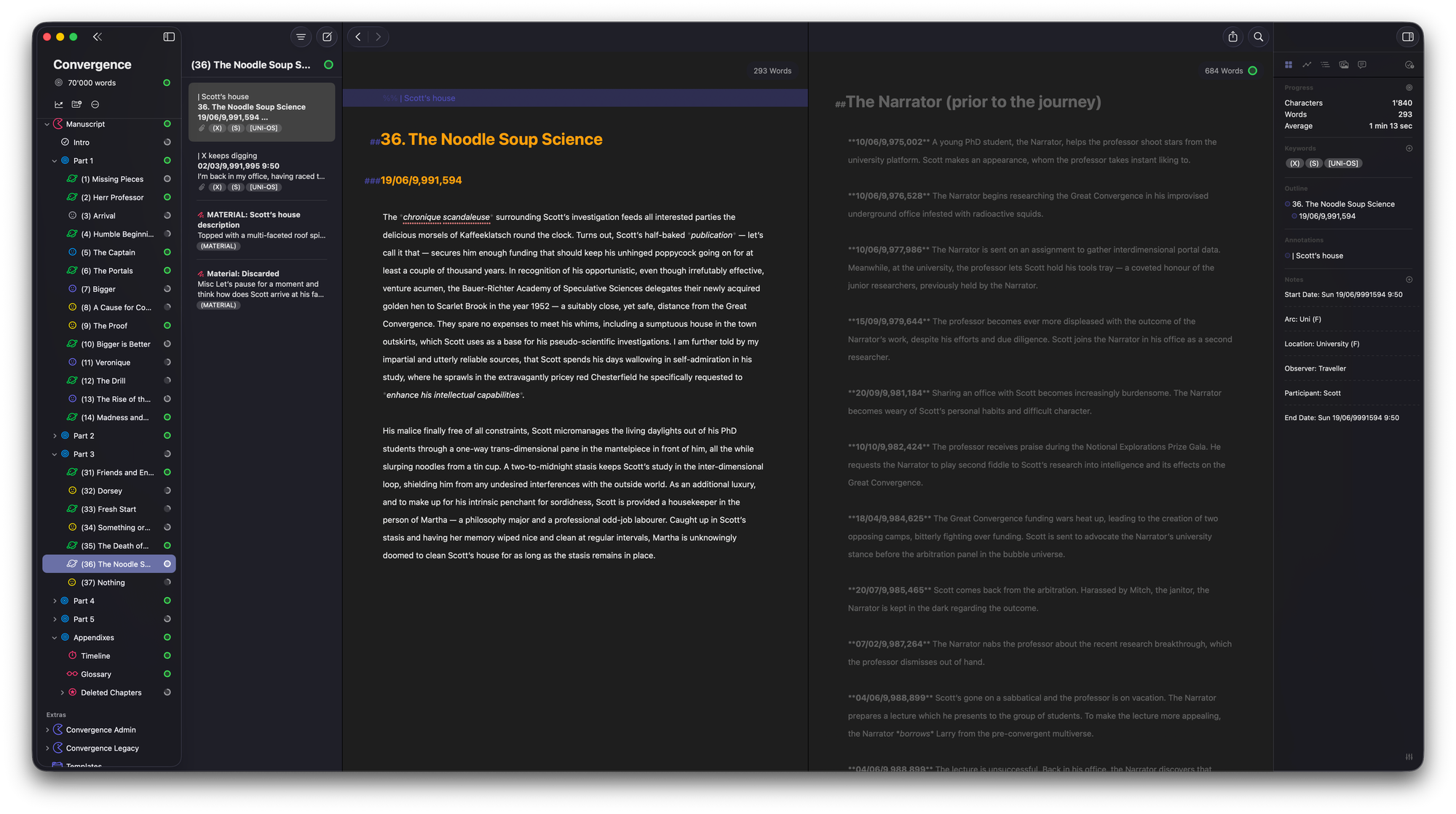
I tried many writing tools in the past. Some of them I found downright horrible, like MS Word; others were unnecessarily complex, like Scrivener. Finally, I settled on Ulysses.
Ulysses is an incredibly powerful tool, and honestly, it would be very difficult — if not impossible — for me to keep everything under control without it.
One of my favourite features is markup, which I use extensively and which makes writing so much quicker and easier, including the ability to instantly turn something into a clearly marked comment.
Another would be the highly polished interface, which allows for distraction-free writing but also supplies the user with an abundance of advanced and very useful options when you need them. I also find writing goals particularly handy. This setting allows me to keep the length of chapters and sections consistent.
Ulysses is built mainly for text-heavy writing, while a comic is obviously much more visual. What does your project structure inside the app look like for something like Bablah's Odyssey? Do you keep illustration scripts, notes, and finished text together, or deliberately apart?
I use different workflows for novel writing and scripts. For novels, the most useful Ulysses feature — for me, at least — is the integration with Aeon Timeline, which lets you keep track of your characters and chronology. This was especially important to me when writing The Great Convergence. The novel includes complex narration; different parts are written from the perspectives of various characters.
Using Ulysses along with Aeon Timeline
To add fuel to the fire, the events take place in different periods and locations. Because Ulysses integrates with Aeon so well, any changes made in Ulysses are reflected in the visual representation of a given timeline, and vice versa. The ability to use labels, scenes, a collapsible tree structure, and Ulysses’ organisational system was a lifesaver.
As for the comic series, it’s much more experimental than The Great Convergence. As I mentioned earlier, I like to use frequent asides, self-contained side stories, or ads for non-existent products and services. I like to use the surrealist collage technique, where a new meaning emerges from apparently disconnected passages or pages. With Ulysses, I can easily reshuffle everything without losing my sanity in the process — and yes, I constantly change my mind about everything.
Regarding the visual and contextual aspects of writing, I have both the text and the sketches in front of me at all times, and — as any ADHD-afflicted individual would — I switch between writing and drawing until I’m happy with the result.
Between photography, gallery work, art direction, writing a novel, producing a comic series, and teaching at universities—what's next for you? Is there another project, medium, or idea you haven't attempted yet that you're circling?
Together with a friend of mine, who’s an ex-Google engineer, we’re actively working on a manuscript-exchange startup called Lizard Joe. In essence, Lizard Joe helps writers refine and finalise their work before publishing or pitching it to a literary agent. The platform will be free to all users, without any catch and without siphoning off and reselling personal data.
Finding relevant beta readers can be hard. I remember searching for mine on various platforms, like Fiverr, but the process was really painful. Because Lizard Joe is optimised for finding the most appropriate readers across many genres, we aim to make reader-writer matching easy and intuitive.
The existing solutions on the market lean heavily into the editing aspect, which is less relevant during the beta stage.
Another problem Lizard Joe solves is that many writers don’t know how to work with beta readers, which results in a lot of back-and-forth. For that reason, we standardised the feedback procedure. We’ll also — with users’ permission — pitch the most-liked manuscripts to publishers and literary agents.
That’s it in a nutshell. If everything goes well, we expect the platform to debut in early 2027.
If you would like to read more about Thomas, make sure to check out his website.
On 26 June, Turkey’s Ministry of Justice announced the “CBS Organization Prediction Project”: an amazing new system that lets a prosecutor or judge take a case file and predict which terrorist organisation the subject of the case file belongs to — with AI! [UYAP; Bianet]
The project, developed with our domestic and national resources, analyzes the case file and predicts which organization it may be linked to based on the information in the file, preventing incorrect or incomplete organization records.
So far it’s working as well as you’d expect. In a crackdown ahead of the July NATO Summit in Ankara, over 200 people were held in pre-trial detention — just happening to be lawyers’ groups, labour unions, environmental groups, journalists … [Bianet]
The detainees were accused of being members of violent armed Marxist or Islamist groups, such as the Communist Party of Turkey, Marxist-Leninist! The armed version of which has been defunct for several years now.
Journalist Yıldız Tar said:
They announced this AI organization thing on Jun 26, when we were detained. It went unnoticed at the time. After I was questioned by the gendarmerie, I had said, ‘The questions they asked me were generated by AI’.
The Ministry hasn’t detailed how the new AI system works — only that it’s “AI.”
It’s pretty obvious the analysis is just running files through a chatbot and picking the results the prosecutor wants. The use case for AI is to try to claim it wasn’t arbitrary.
The purpose of a system is what it does. Computer says: oppress.
The Twitch streaming platform is owned by Amazon. They use your Twitch streams for training AI. Twitch Support tweeted about it yesterday: [Twitter, archive]
We’ve added a setting that lets you opt out of having your channel content used to train generative AI content models across Amazon.
Mike Minton, Chief Product Officer at Twitch, went on the official Twitch Patch notes stream later that day. Here’s Mike giving the whole game away: [Bluesky, video]
There’s an honest answer, and I think most of you probably can appreciate this. If it was opt-in, nobody would opt in. That’s honestly the answer.
Training includes all your chat comments and the games the streamers are streaming.
Only the streamers can switch this off at all. Go to Settings, Security and Privacy, and turn off “Training for Generative AI.” Reports are that it repeatedly switches itself back on.
Minton admitted in 2024 that Amazon was already training on Twitch streams: [Information, archive]
Yeah, for sure. I mean, I think obviously within the bounds of user trust within the bounds of privacy regulations, which vary all around the world, but of course we have a role to play in that.
“A role,” huh.
On the Twitch creator improvements forum, someone suggested in May: “Make all AI features optional, and opt-out by default.” It’s the number one suggestion, with over 15,000 votes. Number two is around 1,700. [Twitch]
All this is obviously just illegal in Europe under the GDPR. So get those data subject requests rolling.
 Log in