Resident of the world, traveling the road of life
68761 stories
·
21 followers

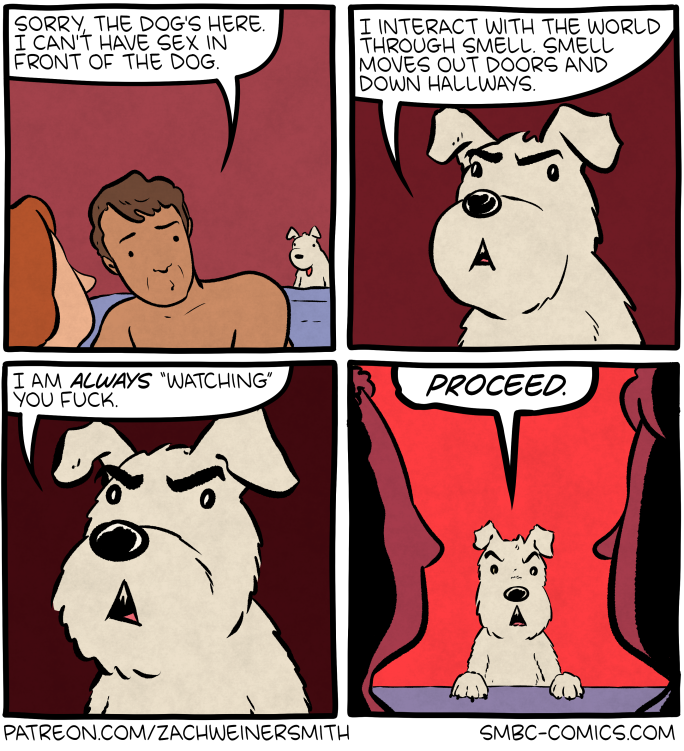
Saturday Morning Breakfast Cereal - Trad

2 Shares


Click here to go see the bonus panel!

Hovertext:
For the record, I am copyrighting this lifestyle. Anyone doing it owes me one (1) banjolele.


Today's News:
Read the whole story
mkalus
4 hours ago
reply
iPhone: 49.287476,-123.142136
Share this story
Delete

Scientists Discovered a Cow That Uses Tools Like a Chimpanzee

1 Share
Scientists Discovered a Cow That Uses Tools Like a Chimpanzee

Welcome back to the Abstract! Here are the studies this week that scratched the sweet spot, extended a hand, went over the hill, and ended up on Mercury.

First, a clever cow single-hoofedly upends assumptions about bovine intelligence. Next, we’ve got the oldest rock art ever discovered, the graying of modern zoos, and the delightfully named phenomena of bursty bulk flows.

As always, for more of my work, check out my book First Contact: The Story of Our Obsession with Aliens or subscribe to my personal newsletter the BeX Files

Cows use tools? You herd it here first 

Osuna-Mascaró, Antonio J. et al. “Flexible use of a multi-purpose tool by a cow.” Current Biology.

Veronika, a Swiss brown cow that lives in a rural mountain village in Austria, is the first cow to demonstrate tool use. How udderly amoosing!

Veronkia’s owner Witgar Wiegele, who keeps her as a pet companion, noticed years ago that she likes to pick up sticks with her mouth in order to reach hard-to-scratch places on her body. 

The hills were soon alive with word of Veronika’s tool-using prowess, attracting the attention of researchers Antonio Osuna-Mascaró and Alice Auersperg of the University of Veterinary Medicine Vienna. 

Tool use is a sign of advanced cognition that has been observed in many animals, including primates, orcas, and birds. But cows, with their vacant expressions and docile nature, have been overlooked as likely tool users, except as a joke in Gary Larson’s Far Side cartoons.  

In their new study, Osuna-Mascaró and Auersperg presented Veronika with a deck brush, which she proceeded to use as a scratching tool in a variety of configurations.

“We hypothesized that she would target difficult-to-reach body regions and use the more effective brushed end over the stick end,” the researchers said. “Veronika’s behavior went beyond these predictions, however, showing versatility, anticipation, and fine motor targeting.” 

“Unexpectedly and revealingly, Veronika’s tool-end use depended strongly on body region: she predominantly used the brush end for upper-body scratching and the stick end for lower areas, such as the udder and belly skin flaps,” they added. “Importantly, the differential use of both broom ends constitutes the use of a multipurpose tool, exploiting distinct properties of a single object for different functions. Comparable behavior has only been consistently documented in chimpanzees.”

I recommend reading the study in full, as it is not very long and contains ample video footage demonstrating Veronika’s mastery of the deck brush. The authors seem genuinely enraptured by her talents and, frankly, it’s hard to blame them for milking the discovery. Overall, the findings serves as a reminder not to cowtow to stereotypes of braindead bovines, a point made by the study’s bullish conclusion:

“Despite millennia of domestication for productivity, livestock have been almost entirely excluded from discussions of animal intelligence,” Osuna-Mascaró and Auersperg said. “Veronika’s case challenges this neglect, revealing that technical problem-solving is not confined to large-brained species with manipulative hands or beaks.” 

“She did not fashion tools like the cow in Gary Larson’s cartoon, but she selected, adjusted, and used one with notable dexterity and flexibility,” they concluded. “Perhaps the real absurdity lies not in imagining a tool-using cow, but in assuming such a thing could never exist.”

Now that’s something to ruminate on.

In other news…

Hands of ancients

Oktaviana, A.A., Joannes-Boyau, R., Hakim, B. et al. “Rock art from at least 67,800 years ago in Sulawesi.” Nature.

Archaeologists have discovered the oldest known rock art, which are very faint hand stencils made by humans 68,000 years ago on a cave wall on the Indonesian island of Sulawesi.

For comparison, the next oldest rock art, located in Spain and attributed to Neanderthals, is roughly 66,000 years old. The newly-dated hand stencils were made by a mysterious group of  people who eventually migrated across the lost landmass of Sahul, which is now submerged, and reached Australia.

https://youtu.be/PRNL329dZ9Y?si=GB669R7KajqivlzZ

The find supports a “growing view that Sulawesi was host to a vibrant and longstanding artistic culture,” said researchers co-led by Adhi Agus Oktaviana and Budianto Hakim of Indonesia's National Agency for Research and Innovation, and Renaud Joannes-Boyau of Southern Cross University. 

“The presence of this extremely old art in Sulawesi suggests that the initial peopling of Sahul about 65,000 years involved maritime journeys between Borneo and Papua, a region that remains poorly explored from an archaeological perspective,” the team added.

Though the stencils are extremely faint and obscured by younger paintings, it’s still eerie to see the contours of human hands from a long-lost era when dire wolves and Siberian unicorns still roamed our world.

Zoo animals get long in the tooth

Meireles, João Pedro et al. “Aging populations threaten conservation goals of zoos.” Proceedings of the National Academy of Sciences.

Speaking of really old stuff, there has been much consternation of late about falling birth rates and aging populations in many nations around the world. As it turns out, similar demographic anxieties are playing out in zoos across Europe and North America, where mammal populations “have, on average, become older and less reproductively active” according to a new study.  

On the one hand, this is good news because it signals improvements in the health and longevity of mammals in zoos, reflecting a long-term effort to transform zoos into conservation hubs as opposed to sites of spectacle. But it also “fundamentally jeopardizes the long-term capacity of zoos to harbor insurance populations, facilitate reintroductions of threatened species, and simply maintain a variety of self-sustaining species programs,” said researchers led by João Pedro Meireles of the University of Zurich. 

This story struck me because of my many childhood visits to see an Asian elephant named Lucy, who was the star of the Edmonton Valley Zoo when I was young (I am now old). I recently learned Lucy is still chilling there at the ripe old age of 50! This is positively Methuselan for a zoo elephant, though it is not an unusual age for them in the wild. Lucy is the perfect poster child (or rather, poster senior) for this broader aging effect. Long may she reign.

Bust out the bursty bulk flow

Williamson, Hayley N. et al. “BepiColombo at Mercury: Three Flybys, Three Magnetospheres.” Geophysical Research Letters.

We’ll close with a reminder that the planet Mercury exists. 

It can be easy to overlook this tiny rock, which is barely bigger than the Moon. But Mercury is dynamic and full of surprises, according to a study based on close flybys of the planet by BepiColombo, a collaborative space mission between Europe and Japan, which is tasked with cracking this mercurial nut.

BepiColombo zoomed just over 100 miles above Mercury’s surface in October 2021, June 2022, and June 2023, but each encounter revealed distinct portraits of the planet’s magnetosphere, which is a magnetic bubble that surrounds some planets, including Earth.

“These flybys all passed from dusk to dawn through the nightside equatorial region but were noticeably different from each other,” said researchers led by Hayley N. Williamson of the Swedish Institute of Space Physics. “Specifically, we see energetic ions in the second and third flybys that are not there in the first.”

“We conclude that these ions are part of a phenomenon called bursty bulk flow, which also happens at Earth,” the team concluded. Bursty bulk flow, in addition to being a fun phrase to say outloud, are intense, transient jets in a magnetosphere that drive energetic particles toward the planet, and are driven by solar activity. 

BepiColombo is on track to scooch into orbit around Mercury this November, where it will continue to study the planet up close for years, illuminating this world of extremes. In my hierarchy of Mercurys, the planet sits above the Ford brand, the 80th element, and the Roman god, with only Freddie surpassing it. So, it’s good to see it getting the attention it deserves.  

Thanks for reading! See you next week.

Read the whole story
mkalus
5 hours ago
reply
iPhone: 49.287476,-123.142136
Share this story
Delete

Steve Yegge’s Gas Town: Vibe coding goes crypto scam

1 Share

Steve Yegge is a renowned software developer. He’s done this for thirty-odd years. Senior engineer at Amazon then Google, blogger on the art of programming. Yegge was highly regarded.

Then he got his first hit of vibe code.

In March 2025, Yegge ran some old game code of his full of bugs and sections saying “TO DO” through an AI coding bot — and it fixed some of them! Steve was one-shotted.

The decline was sudden and incurable. He even cowrote a book with Gene Kim called Vibe Coding. Well, I say “wrote” — they used a chatbot for “draft generation and draft ranking”. They vibed the book text. [Amazon]

Yegge and Kim also worked on the DORA report on vibe coding That’s the one that took people’s self-reported feelings about AI coding and put the vibes on graphs. Complete with error bars. Vibe statistics.

In the book intro, Yegge straight-up says:

It’s like playing a slot machine with infinite payout but also infinite loss potential.

… I’m completely addicted to this new way of coding, and I’m having the time of my life.

Generative AI runs on creating an addiction. “Better living through chemistry” has become “better living through shooting up krokodil.” Let me tell you about Gas Town.

Gas leak

On New Year’s Day, Yegge posted to his blog: “Welcome to Gas Town”: [Medium]

Gas Town helps you with the tedium of running lots of Claude Code instances. Stuff gets lost, it’s hard to track who’s doing what, etc. Gas Town helps with all that yak shaving, and lets you focus on what your Claude Codes are working on.

Gas Town is a vibe coder orchestration tool. You get a whole bunch of Claude instances and you just set them to work on your verbal specification. Yegge’s described it as “Kubernetes for agents.” I’d say Kubernetes for sorcerer’s apprentices.

Gas Town is a machine for spending hundreds of dollars a day on Claude Code. All the money you’ve got? Gas Town wants it:

Gas Town is also expensive as hell. You won’t like Gas Town if you ever have to think, even for a moment, about where money comes from.

Yegge’s an extremely experienced professional engineer. So he put care into Gas Town, right?

I’ve never seen the code, and I never care to, which might give you pause.

Yegge uses his own made-up jargon for things that already exist. This is to get you into the mindset of Gas Town, where everything is different now. Especially when it isn’t. A workspace becomes a “town”. A project becomes a “rig”. A worker agent is a “polecat”. [blog post]

You might think making up new words for existing things is what a cult does.

Gas Town is the AI dream of CEOs — a machine that generates code and doesn’t have a human involved at all. And the venture capitalists are waving fistfuls of bucks at Yegge.

It’s going to be the AI dream of some other people. Yegge is proud to say he hasn’t looked at the code — but if you put your Gas Town vibed app online, other humans will be very happy to look over your vibe-coded mess for you. And find every possible way to pwn it.

Pivot back to crypto

Remember that the “pivot to AI” was from cryptocurrency. Literally the same actual guys.

So it’s a slight surprise, but zero shock, that Gas Town is now a crypto scam. Scammers came calling, and Yegge, being terminally far gone, embraced them.

BAGS — all in capital letters — is a platform that issues crypto tokens. (“Holding the bag” is how a crypto buyer’s left when the price crashes.) The BAGS promoters make up “meme coins”, which use some famous name for publicity that they have no connection to. This one was a Gas Town coin. And they set it up to send transaction fees to Yegge.

Crypto bros have been pulling this scam for years. They say “please publicise our thing about you.” Then the scammer runs away with everyone’s money.

Developers consistently tell these scoundrels: “get outa here.” But not Steve Yegge, ’cos his brain is completely vibed: [Medium]

Woah, what am I, some sorta dumbass? Well yeah, actually. So I went for it.

… I’m not endorsing buying crypto, though I am very happy that people are doing it.

I bet you are.

The GAS token was released 13 January at 1pm UTC. Yegge posted about it on 15 January at 2:45am UTC.

By the morning of 16 January, the price peaked at 4 cents a GAS coin! Then the scammer started dumping the tokens and taking money from the suckers. By 7am on 19 January, the GAS token had been fully pumped and dumped.

A couple of hours before the final dump, Yegge posted to his blog: [Medium]

Gas Town itself needs my full attention … So I had to step back from the community.

That and all the money’s gone. Vibe finance.


Anthropic’s last chance

Gas Town is a mechanism to spend more money on Claude than ever before. Maybe Anthropic can do the mobile game model, where you just rip off a few whales with tons of money and no self-control. Gas Town users are those whales. Enthusiastic, and not the least bit price sensitive.

Claude Code sells via gambling addiction. You need to move to higher and higher tiers to keep getting your fix. It’s almost working! Just a few hundred dollars more!

This is why you get previously accomplished engineers who get into vibe coding, and if anyone says “you know, generative AI might be less than perfect,” they act like someone’s trying to take away their cocaine.

Gas Town is an addict telling you how cool addiction is. One vibe coder who tried Gas Town said: “You will become bloodthirsty for tokens.” [Medium]

You will pay and pay more and more to Anthropic to get the high you remember. If you feel that need for more Claude Code: Stop it. Get some help.

Read the whole story
mkalus
17 hours ago
reply
iPhone: 49.287476,-123.142136
Share this story
Delete

Fog

1 Share

Michael Kalus posted a photo:

Fog


Read the whole story
mkalus
17 hours ago
reply
iPhone: 49.287476,-123.142136
Share this story
Delete

Into the woods

1 Share

Michael Kalus posted a photo:

Into the woods


Read the whole story
mkalus
17 hours ago
reply
iPhone: 49.287476,-123.142136
Share this story
Delete

Before Sunrise

1 Share

Michael Kalus posted a photo:

Before Sunrise


Read the whole story
mkalus
17 hours ago
reply
iPhone: 49.287476,-123.142136
Share this story
Delete
Next Page of Stories