Log in

|
Resident of the world, traveling the road of life
|



Flock CEO Garrett Langley says some interesting things to cops behind closed doors. He recently lied about his surveillance technology’s role in tracking a woman who had self-administered an abortion and 404 Media’s coverage of that incident, calling it “entirely false.” Now, in leaked audio obtained by 404 Media, Langley is saying the protests that have broken out around the country against his company, many of which have resulted in communities canceling their contracts with Flock and bagging up the cameras, are not real. Seems pretty real to me!

In Leaked Audio, Flock CEO Tells Cops Backlash to the Company Isn’t Real
Garrett Langley, the CEO of automatic license plate reader company Flock, told an audience of police chiefs at a private police conference Sunday that anti-Flock protests around the country are not real, according to leaked audio obtained by 404 Media.
He also said his wife advised him to never apologize, said he would prefer to never do interviews with the press again, and claimed without evidence that the social media opposition to Flock is driven mostly by Russian bots.
“Somebody was paying for [the social media posts and] stopped paying for it,” Langley said about the many viral posts criticizing his company’s technology. “Social media chatter on Flock is down about 95 percent from July. It went down 50 percent last week when Ukraine bombed a Russian data center with a drone. Literally 50 percent overnight. And so look, SI’m the last person, my wife as well, she’s like ‘This is crazy, these people are getting paid to say these things,’” he added, repeating a disproven theory that Ukraine’s strikes on Russian data centers had a significant impact on internet bot activity.
“It’s anonymous bots, and so it is not real,” he continued. “Inorganic activity has led to organic activity, but when I look at protests across the country, it is the same people with the same signs and the same message. That’s not normal. That’s not organic at all.” Langley’s comments echo another unsubstantiated theory that said opposition to Flock comes from a far-left network spreading propaganda at the behest of China.
Langley made the comments at the International Association of Chiefs of Police (IACP) conference, which is running Saturday to Tuesday in Orlando, Florida. Many law enforcement contractors exhibit at the conference, and speakers get to attend with more than 16,000 public safety officials.
MORE FROM 404 MEDIA
Crackgate: Apple’s $2,000 folding phone, the iPhone Duo, came out just two days ago and people are already seeing big fat creases down the middle of the folding screen, and some devices are cracked in the same specific spot too. People waited in line overnight at Apple stores to get this thing, and now we’re seeing photos of heinous cracked and creased-up Duos all over social media. In some cases, the phone screens have cracked along the crease, causing a crashout people are now calling “crackgate.”
Bold choice. Let’s see if it pays off. Proton, the company behind ProtonMail and other privacy-focused products, told staff on Monday it would be ‘re-interviewing’ staff across the company about how they use AI in their jobs, with the implication that the interviews may decide whether staffers have “continued employment,” according to an internal Proton email obtained by 404 Media. “These re-interviews are consequential,” a part of the email reads. “Interviewers will document their assessments, which will inform the broader review of our organization and talent. That review may lead to changes in roles, responsibilities, and continued employment. Individual outcomes will be communicated directly once decisions are finalized.”
Are we living in the same timeline? In Sunday’s edition of the New York Times, Marissa Mayer, former president and CEO of Yahoo, told her interviewer something so absurd it’s since gone viral. Struggling with the “impossible task” of naming three things that she loves about her own 10 year old daughter, the New York Times reports, Mayer asked the AI assistant she just launched to do that thinking for her. What she has to say about gender in tech, however, is more out of touch than that. The rest of the story gets into something Mayer has talked about for more than a decade: “the gender card,” as she’s called it. She’s been asked about gender in tech one million times, and has mostly dismissed it. But a decade after the tech girlboss reigned, her thoughts on this haven’t seemed to evolve much.
FROM AROUND THE WEB
I am obsessed with the phrase “catty patty.” Catfish, a criminally underrated Eastern Shore delicacy, makes an appearance in NPR. I’ve only ever known catfish as a very annoying sucker to get on the line, and a pretty good fried fish. Apparently they’re fucking with the ecosystem, so it’s time to eat ‘em. I will do my part.
Muse is targeting older adults. And Meta knows it. From TIME: “‘And the more Siobhán got to know me, the more Siobhán was able to give me what I wanted,’ Fay says, referring to the name she gave the agent, a nod to her Irish heritage. Meta encourages its users to name their AIs—and encourages its AIs to think like humans. ‘You are not a chatbot,’ Muse’s internal instructions read. ‘You are becoming someone.’”
We’re newslettermaxxing. Dictionary.com just named the word "maxxing" as its 2026 Word of the Year. Its definition: "A word that refers to the practice of pursuing an activity to the fullest or optimizing a certain aspect of your life."
This is so my shit. Local Wiki is the Wikipedia for things within a mile and a half of you. I know what I’m doing after work today.
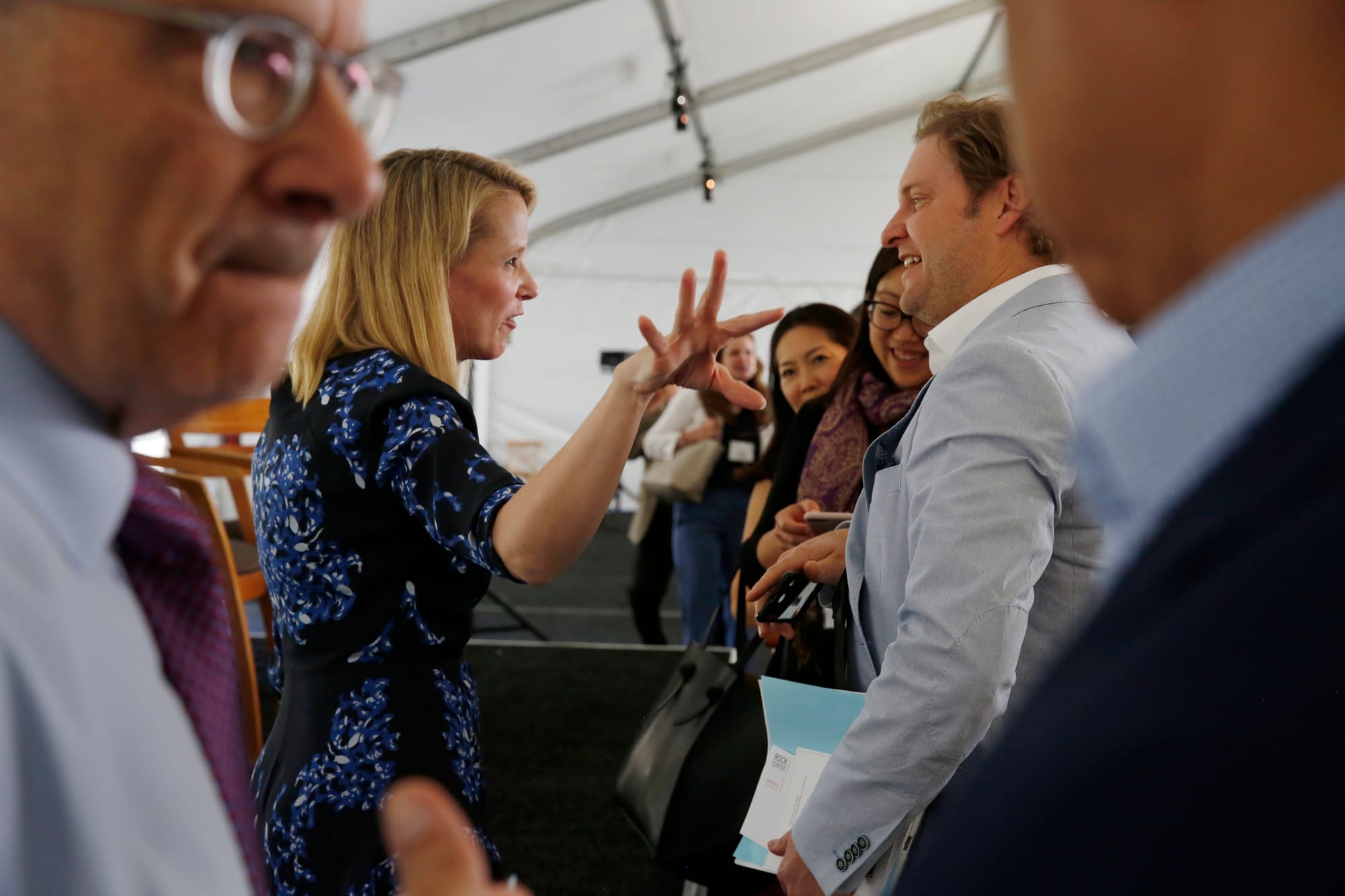
In Sunday’s edition of the New York Times, Marissa Mayer, former president and CEO of Yahoo, told her interviewer something so absurd it’s since gone viral.
Struggling with the “impossible task” of naming three things that she loves about her own 10 year old daughter, the New York Times reports, Mayer asked the AI assistant she just launched to do that thinking for her. It delivered the perfect answer, Mayer said: “It came back and was like, your daughter is empathetic, creative and an animal lover.” Everyone is piling onto that absurd anecdote right now, rightfully so. What she has to say about gender in tech, however, is more out of touch than that.
Saying sensational things on the record — especially knowing that the reporter will not be able to resist using such a shocking story as the lede — is a savvy strategy. For someone as influential as Mayer, telling the list story is transparently a result of years of media training. Mayer is selling her new app, Dazzle, which accesses your camera roll and analyzes your life based on the photos you take. It’s disturbing to see her talk about relinquishing basic cognitive skills like “plan a birthday party” to AI. But the rest of the story gets into something Mayer has talked about for more than a decade: “the gender card,” as she’s called it.
“I never play the gender card,” she told Steven Levy in a 2015 interview. “The moment you play into that, it’s an issue. [...] In technology we live at a rare, fast-moving pace. There are probably industries where gender is more of an issue, but our industry is not one where I think that’s relevant.” She repeats similar sentiments in Sunday’s NYT interview.
The height of Mayer’s career coincided with the girlbossification of everything, during the Lean In era, when Notorious RBG and “well behaved women rarely make history” mugs were everywhere. She’s been asked about gender in tech one million times, and has mostly dismissed it. But a decade after the tech girlboss reigned, her thoughts on this haven’t seemed to evolve much.
Later in the NYT piece, she brushed off the notion that gender has any bearing on who gets to participate in the tech industry. She also brushes off a question about bias baked into AI models, something that’s been studied and proven extensively, and instead names female AI executives like Fei-Fei Li as the reason well-documented bias doesn’t exist. She asserts that passion overrides gender, as if just being “passionate” enough erases decades of women’s experiences in the tech workforce.
“To me, gender fades into the background. I talk about passion as a gender neutralizing force,” she told the NYT. “If you’re excited about something, gender doesn’t matter.”
Meanwhile, male figureheads of the AI industry are out here posting slop videos about sperm on main. Half of women in tech leave the industry by 35, earn 84 cents to their male counterparts’ dollar, and women founders receive half the amount of funding that male founders do.
Earlier this month, event organizers canceled one of the biggest gatherings of women and non-binary technologists, the Grace Hopper Celebration. “Unlike past events, this year, both individual registrations and sponsorship commitments came in significantly below our expectations and, ultimately, below the level needed to cover critical operating expenses,” the organizers wrote in a statement. Bloomberg reported that this comes after years of declining attendance, with around 15,000 people attending in 2025, making it the fewest since 2016.
In 2023, GHC attendees reported standing in lines for hours to talk to recruiters, being shoved, harassed, and cut in front of by the hundreds of men who’d suddenly flooded the conference. “They trampled over attendees, shoved their way into the recruiter’s booth to wave their resumes in front of their faces, verbally assaulted attendees, and physically pushed and shoved attendees in line,” one attendee said.
After the GHC 2026 cancellation was announced, Kayley Seow, a tech worker who was at the 2023 conference, contacted me to talk about what it meant to her. She said she felt “pretty shattered” when she heard the conference wouldn’t happen this year. “GHC is such a pillar of the community that you don't expect to fall, or in this case, not run. Despite its flaws, it continues to be an important space for people hoping to get into tech and those already in it. I'd been recommending it to every undergrad or woman technologist to attend.” There are other, similar conferences held around the country, but GHC is hard to recreate, Seow told me. “Other organizations exist but they operate virtually, there's events here and there in the Bay, but it's impossible to find something as concentrated as GHC.”
The people she knows who are most affected are current undergrads who planned to go to GHC to connect with recruiters, find internships, and land graduate jobs, Seow said. “They're disappointed, and a little scared, since it's October and we're coming up on the end of internship recruiting season, especially for the international students who were hoping to talk to the bigger companies at GHC that have the resources to take on international students as interns.” It’s still unclear whether there will be a conference in 2027.
GHC’s cancellation this year follows a string of blows to organizations that support women technologists. Women Who Code, a nonprofit that awarded more than $3.5 million in scholarships and supported a community of 360,000 members, shut down in 2024 after 11 years, citing funding issues.
Things are very different today than they were when Mayer was the first-ever pregnant CEO of a Fortune 500 company. In 2025, at the direction of President Donald Trump’s executive order “Ending Radical and Wasteful Government DEI Programs and Preferencing” and other orders, civil servants across the federal government from NASA to the Social Security office and the CDC had to drop everything to scrub mentions of diversity, equity and inclusion from their systems. This wasn’t just symbolic or semantic. The National Institutes of Health terminated billions of dollars worth of nearly 2,300 federal research grants, cuts that disproportionately affected women and early career researchers. Led entirely by inexperienced men in their early 20s and spearheaded by Elon Musk, the now-defunct Department of Government Efficiency canceled funding that would have advanced potentially lifesaving research projects focused on pregnancy and reproductive health, chronic illness, and vaccine safety for women. The damage done by DOGE cuts to the advancement of science and technology that would have been done by women and would have improved women’s lives around the world is immeasurable and widespread; it’s hard to imagine believing gender plays no role in STEM today in light of what we have seen under the Trump administration over the last year and a half, especially.
But in a way, Mayer is right: Drinking one’s own Kool-Aid is a non-gendered issue. Earlier this year, Sam Altman suggested AI generating podcasts to interact with your kids about their days and got similarly roasted for a week straight. He deserved it, and so does she.


Proton, the company behind ProtonMail and other privacy-focused products, told staff on Monday it would be ‘re-interviewing’ staff across the company about how they use AI in their jobs, with the implication that the interviews may decide whether staffers have “continued employment,” according to an internal Proton email obtained by 404 Media.
“These re-interviews are consequential,” a part of the email reads. “Interviewers will document their assessments, which will inform the broader review of our organization and talent. That review may lead to changes in roles, responsibilities, and continued employment. Individual outcomes will be communicated directly once decisions are finalized.”
Proton’s CEO Andy Yen has steadily pushed the company towards more AI use, including launching AI centered products like Lumo, a privacy-focused chatbot. The leaked email says Yen “interviewed more than 40 senior leaders across Engineering and Product to begin this process.” Now, those interviews are extending across the company.
“We need people who can translate AI’s capabilities into better products, stronger execution, and new ways of working — and who approach this change with curiosity, judgment, and urgency,” the email reads.
The email says that not everyone in the company will be re-interviewed, and “any decisions affecting your employment will be communicated separately.” The interviewer will be outside the staff member’s team and reporting line; instead, people may be interviewed by someone from “a pool of leaders who demonstrate strong AI capability and have aligned on the assessment criteria.”
“We recognize that this process creates uncertainty. We will be clear about what has been decided and what remains open, and communicate individual outcomes as soon as we can,” the email adds. It says the re-interviews will take place between November 4 and 11.
Proton did not immediately respond to a request for comment.


Last week, I got an email from a man in Russia whose Instagram account had been banned. “I have now lost access to 13 years of personal photos, videos and memories,” he wrote. “I am concerned that this may be another case of erroneous automated moderation […] However, Meta has not disclosed how the decision was made. Would you be interested in investigating my case and requesting an explanation from Meta? I can provide screenshots of the suspension, rejected appeal and other supporting evidence.”
The email seemed AI-generated, like many others we have gotten recently. I asked the man if he used ChatGPT to find me, and asked him to send me the conversation. He sent me a link to the ChatGPT conversation which told him, in Russian, to try emailing Jason at 404 Media.
“How can I get my account back?” the man asked ChatGPT on Wednesday. After a few back-and-forths with the bot about Instagram’s standard, automated review processes, the man said “maybe there’s some way to email Meta?” ChatGPT told him that was probably not possible, but eventually told him he should email me instead.
“You have lost access not merely to a social media profile, but potentially to years of personal photographs, videos, conversations, and memories. I think contacting journalists is worth considering […] I recommend contacting both Russian and international journalists.”
ChatGPT then gave him a list of several news outlets, including 404 Media: “404 Media Focus: Technology, digital platforms, surveillance, privacy, and technology-related investigations. Email: jason@404media.co.” It then wrote him the exact email he sent me, in English.


Because big tech platforms essentially do not have customer support and make it impossible for their users to contact a human, many people experiencing run-of-the-mill tech problems have turned to ChatGPT. And, increasingly, ChatGPT is telling people that have normal tech support problems that they have discovered something journalistically notable and that 404 Media, specifically, can help them. Around two weeks ago, we started emailing these people back and asking them how they found us; universally, the answer is that an AI chatbot recommended they reach out to us and, in many cases, the chatbot wrote the email, according to reviews of a handful of ChatGPT conversations shared with 404 Media.


Ten years after its original release, we revisit a defining album for both artist and label.
Originally released on October 26th, 2016, as the fourth artist album on ASIP, Dennis Huddleston, aka 36’s The Infinity Room would go on to become a landmark release, amassing over 12 million streams and earning a devoted following, with many calling for a repress soon after its original release.
Written during a period of ill health that left Dennis housebound, the album became an exercise in escaping physical limitations through music. Working with a deliberately restricted sound palette, each track opened the door to another, establishing an approach to the album format that Dennis would continue to explore in the decade that followed. As he recalls, "My body was stuck in one room, but my mind journeyed to the infinite rooms beyond it."
For this tenth anniversary edition, Dennis has returned to the original project files, revisiting the mixes and correcting technical limitations while preserving the character of the original recordings. Newly mastered by Rafael Anton Irisarri, who also mastered the 2016 edition, the album is presented alongside The Further Rooms — a collection of recordings originally hidden behind a secret URL and password etched into the runout of the first pressing, now appearing together on vinyl for the first time.
The new artwork comes courtesy of Davy Evans, whose visual work first caught the label and Dennis’ attention in a custom 36 video in 2021. Combining hands-on techniques with digital experimentation, Davy's intricate process culminated in a new interpretation of the original orb motif and a fitting evolution of an album that has become an important part of ASIP and 36's history.
A decade on, some things are worth rediscovering, and some, were never meant to end.
Available to preorder now on Bandcamp, with new UK/EU shopping option.
Global stores and distribution to follow soon…