Resident of the world, traveling the road of life
69447 stories
·
21 followers

LEGO’s Olivia Rodrigo Collection Hides Easter Eggs in Every Brick

1 Share

LEGO’s Olivia Rodrigo Collection Hides Easter Eggs in Every Brick

The best fan merch doesn’t simply recreate a familiar image—it rewards the people who know the work best. That’s the idea behind the new LEGO Editions Olivia Rodrigo collection, a five-set collaboration that invites fans to build their way through the Grammy-winning artist’s world one Easter egg at a time. Rather than focusing on a single album or performance, the collection pulls from across SOUR, GUTS, and you seem pretty sad for a girl so in love albums to translate recurring symbols, iconic stage moments, and deeply personal references into brick-built objects designed to be explored as much as displayed.
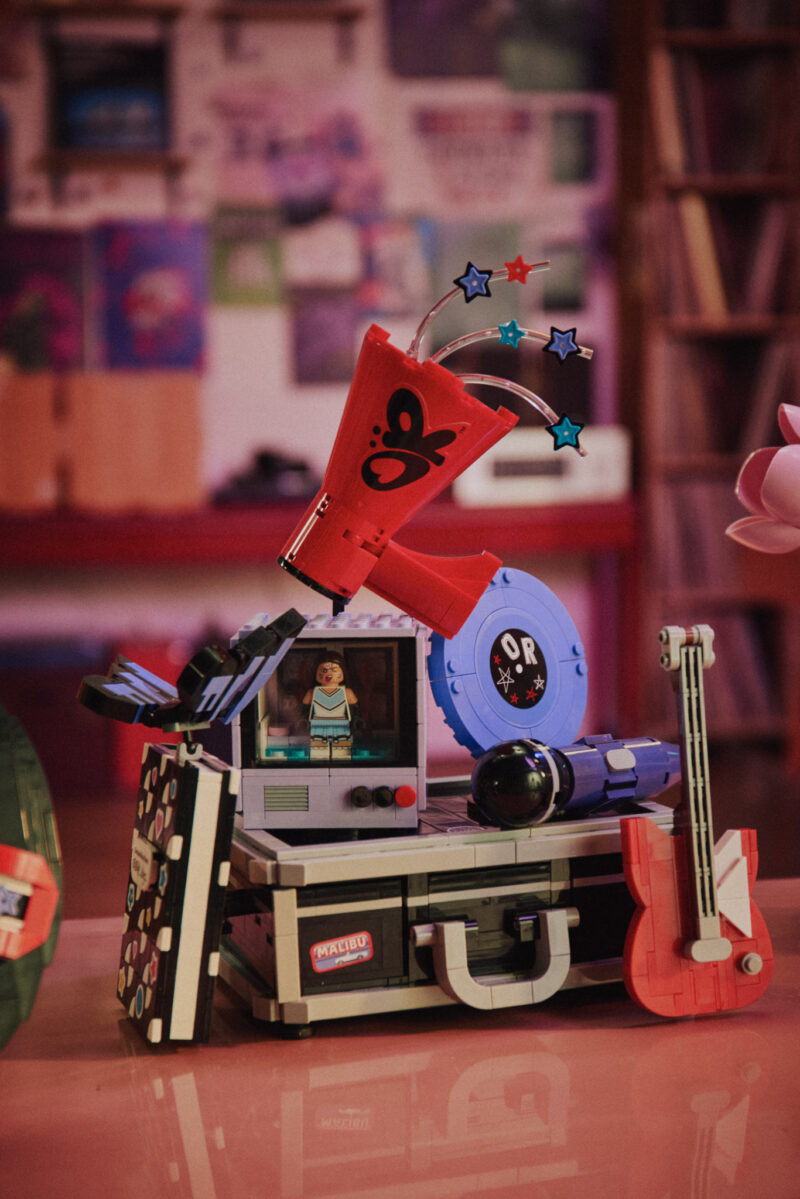
A LEGO model featuring a suitcase, a red guitar, a blue record player, a TV screen with a figure, and a large red megaphone with stars on springs.

The LEGO Editions Olivia Rodrigo Secret Storage set is filled with hidden references to the artist’s music and career. Photography courtesy of the LEGO Group.

The lineup includes a collectible Vinyl display, a Concert Moon inspired by Rodrigo’s GUTS World Tour, Secret Storage, a Dual Guitar, and the first-ever personalized LEGO Botanicals collaboration, a Flower Bouquet that swaps traditional blooms for playful musical references. Each set is packed with details ranging from handwritten notebooks and red megaphones to butterflies, stars, backstage spaces, and hidden compartments waiting to be uncovered.

What makes the collection particularly interesting is that it wasn’t designed solely by LEGO and Rodrigo: According to Amy Corbett, Senior Design Manager and Product Lead at the LEGO Group, fans became an integral part of the creative process from the earliest concepts.

“One of my favorite things about working on this project was the three-party collaboration,” Corbett says. “Not only did we work closely with Olivia and her team, but we also connected with her fans during the design phase, from initial ideas to sketches and eventually brick-built concepts. This allowed us not only to get hidden details and secrets from Olivia about her music, but also an idea of how her songs make her fans feel and how we might translate that into bricks.”

That feedback shaped a collection that balances collectible appeal with LEGO’s signature sense of play. While the finished models are designed to look at home on a shelf, they’re far from static objects.

Olivia Rodrigo sits at a wooden counter in a record store, smiling at the camera, with vinyl records and a small decorative turntable in front of her.

Olivia Rodrigo with her LEGO Editions Vinyl set. Photography courtesy of the LEGO Group.

“At first glance, the models may look like they are for display,” Corbett explains, “but take a closer look, and they are packed full of playful details.” Among those surprises are secret stages and dressing rooms tucked inside the Dual Guitar, a pop-out star hidden within the Vinyl set, and even miniature guitars forming the petals of a flower.

Instead of treating each set as an isolated object, the designers approached the collection as a cohesive visual system. Corbett says the team imagined how fans might display all five pieces together and searched for elements that could unify them without sacrificing individuality.

Olivia Rodrigo’s signature purple became the common thread throughout the collection, including the use of a new purple LEGO color introduced this year. Butterflies and stars appear across multiple builds, while each set interprets those recurring motifs differently. Like Rodrigo’s songwriting, the designers also leaned into layered storytelling, embedding hidden references that reveal themselves over time. “We wanted to pack each set full of hidden Easter eggs and surprises for fans to find,” Corbett explains.

That emphasis on discovery also helped solve one of the project’s biggest creative challenges: translating the emotional resonance of Rodrigo’s music into LEGO’s inherently geometric design language.

“Much of the magic is in the hidden details and clues that you don’t see at first,” Corbett says. “We really leaned into that common ground and had a lot of fun interpreting the details of her music into brick form that the fans would also be excited to discover.”
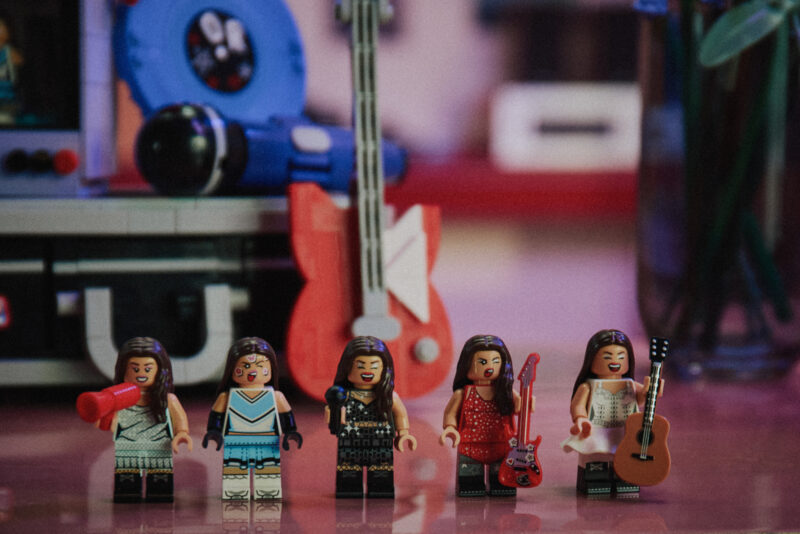
Five LEGO minifigures dressed as Olivia Rodrigo stand in a row, with various musical instruments and equipment in the background.

LEGO Minifigures of Olivia Rodrigo in various concert looks. Photo courtesy of the LEGO Group.

The minifigures required their own careful balancing act. Rodrigo’s performance looks have become instantly recognizable, but recreating them within the limitations of the LEGO minifigure meant distilling each outfit down to its essential details.

“The team worked closely with Olivia to capture the essence of her style,” Corbett says, “and pack in as many details as possible to bring the minifigure to life.”

The result is a collection that feels less like traditional celebrity merch and more like interactive storytelling. Rather than asking fans to simply recognize familiar imagery, the sets encourage them to hunt for clues, decode references, and discover new details long after the final brick has been placed—an experience that mirrors the layered storytelling Rodrigo has built into her music from the very beginning.

The LEGO Editions Olivia Rodrigo collection launches globally on Aug. 1, with select sets available for pre-order now.

Editorial Transparency: This article was developed with the assistance of AI tools, which may have been used for research, outlining, editing, or copy refinement. Reporting, fact-checking, and editorial decisions were made by the Design Milk editorial team.

Read the whole story
mkalus
1 minute ago
reply
iPhone: 49.287476,-123.142136
Share this story
Delete

Episode 1: Illinois

1 Share

There’s no easy way to put this, other than to just come out and say it. As I’ve began working on this podcast, I’ve learned that I’m not good at doing things that seem to come naturally to pretty much every one else.

For example, I think most folks these days are pretty good at taking pictures of things, particularly when they’re on road trips or visiting some kind of point of interest. Foolishly, I assumed that I was built the same as everyone else, and just gathered media kind of consciously but also very casually on the trips that ended up comprising my first few episodes.

Now that it’s time to get this thing off the ground, I sat down to post some pictures from my travels, expecting to find a thousand shots. I’ll have to sort through so much clutter to find the good ones to share. It’ll be a veritable visual buffet, plates and cups overflowing with pictures.

And this is not the situation I find myself in. The multimedia aspect of the first few episodes will be a little thin, but this may end up being a blessing in disguise. Through realizing that my instinct is not to take pictures or videos of interesting things, I now know that I have to be proactive on that front in future adventures. It’s all about figuring out the stuff you don’t know you don’t know, as far as I know.

With the launch of the show today, I do want to share some of the things I captured. To give you a sense of how underwhelming this is going to be, I forgot to take any pictures of The Big Tree, but to be fair, the internet is full of pictures of that tree.

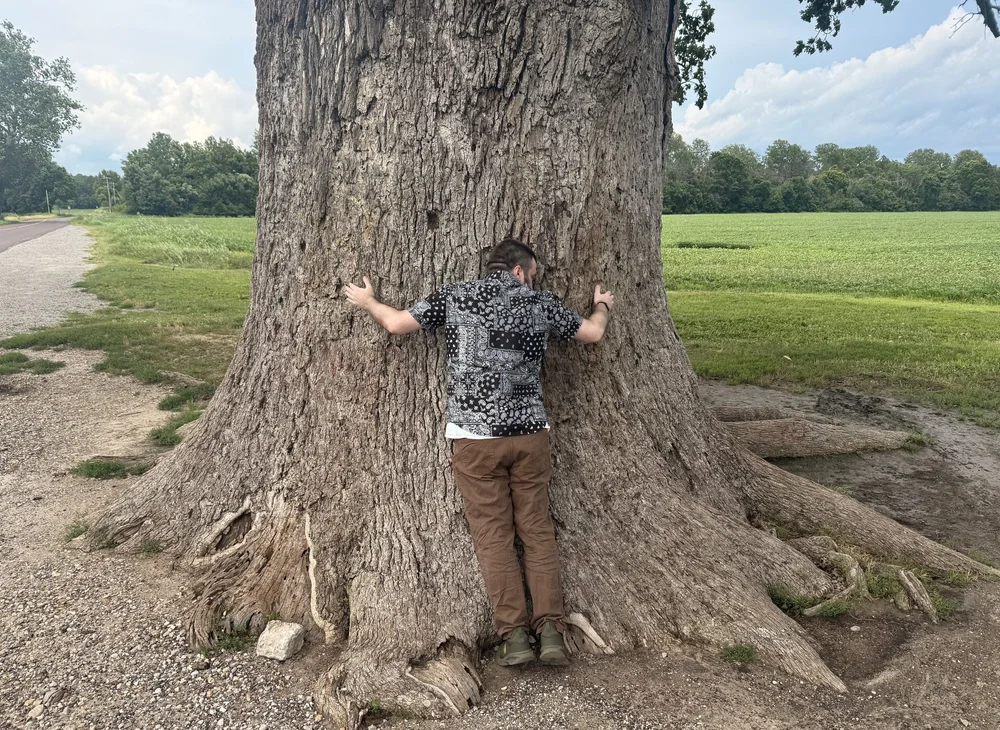
My buddy Burger did take one picture of me hugging the Big Tree, so that can give you some scale. Please ignore the untucked undershirt.

The Humansville water-tower stands mightily over the local Phillips 66 station, where the price of gas may have timestamped when I rolled through town.

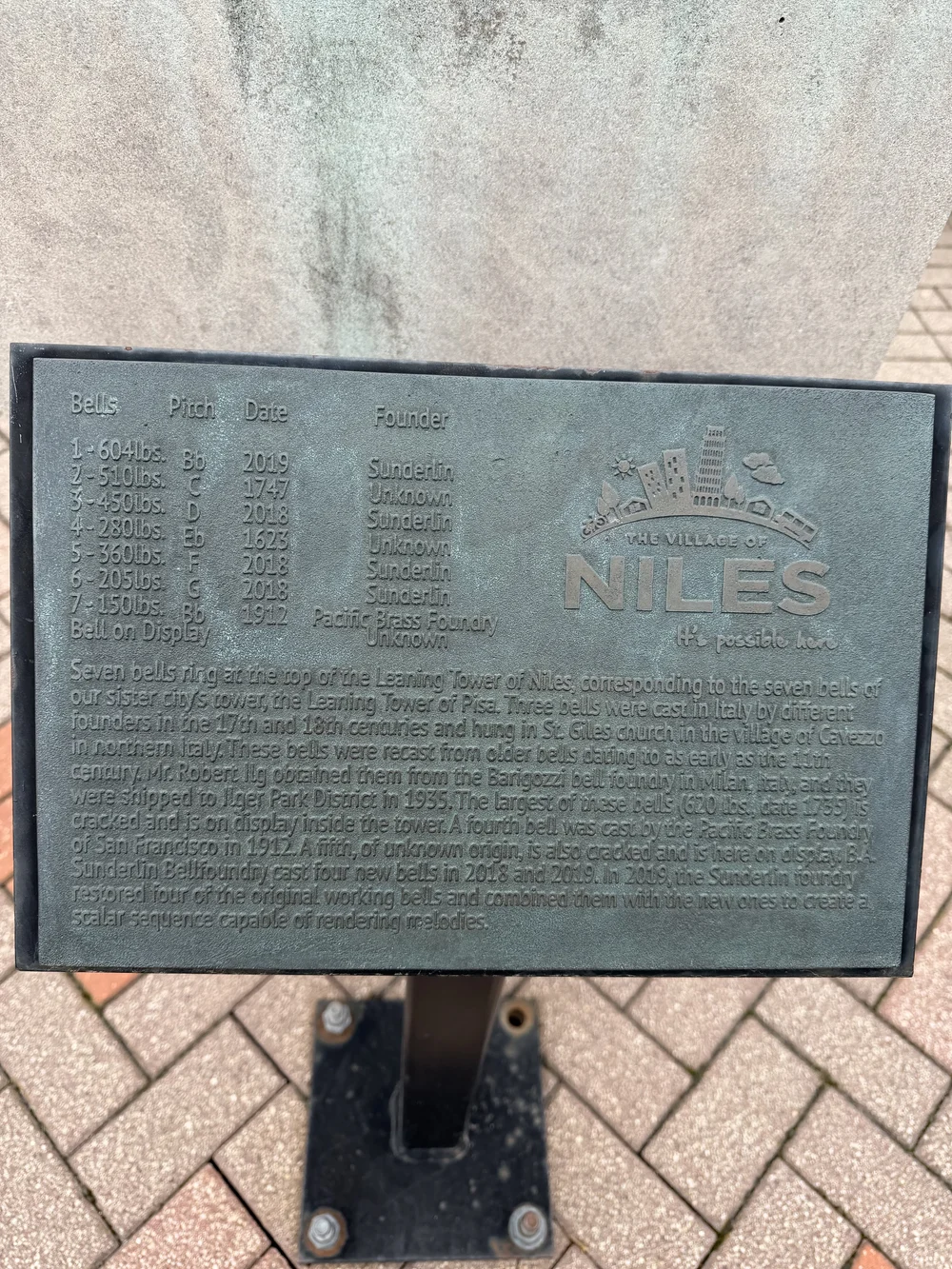
The Leaning Tower of Niles stands mightily over the reflecting pool, which I would have called “shabby” until very recently. The bar has been lowered for reflecting pools. Also visible in the picture is the plaque that claims that the tower contains very old bells, which I chose to trust.

A closer look at the plaque that claims one of their bells was made in 1623. A plaque has no clear motivation to lie to me, but it seems so impossible that this tower would have a 400 year-old bell in it and no one would care.

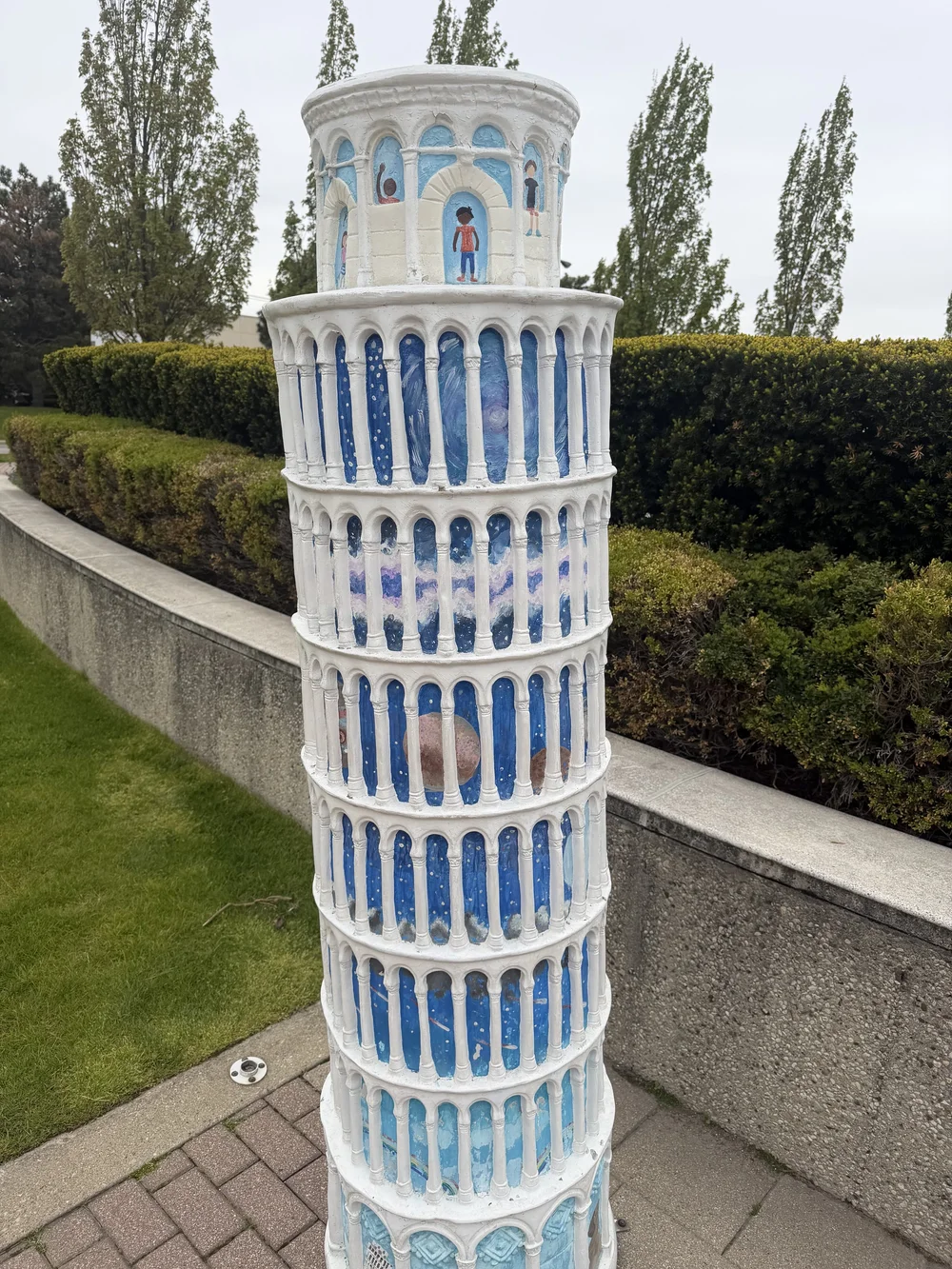
A mini Leaning Tower that someone decided to build right near the larger mini Leaning Tower. A “hat on a hat?” Definitely, but one of the rare instances where two hats feels right.

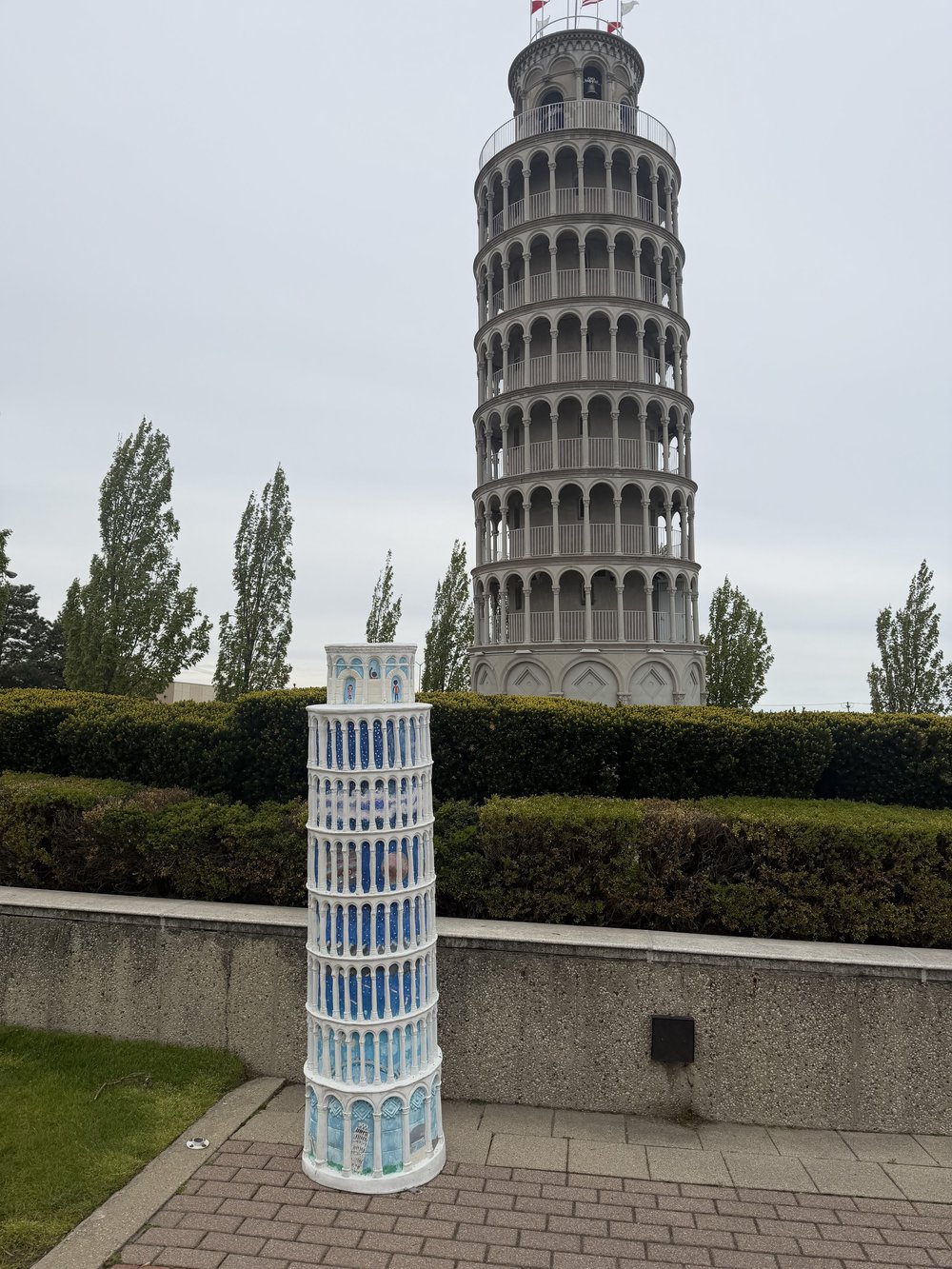
The Leaning Tower of Niles stands mightily over the mini Leaning Tower of Niles, in a display that really drives home the strangeness of this place. Five feet to the left is a CTA bus stop.

Alternate angle of the Tower. In the background you can see the sign for the hot dog joint across the street, and on the left side of the picture, you may notice fencing behind which was the empty lot that may have formerly been The Y. I am not certain if the Do Not Enter sign is intentionally slightly leaning, or if that is just a coincidence.


Read the whole story
mkalus
1 hour ago
reply
iPhone: 49.287476,-123.142136
Share this story
Delete

Frontiers forces AI onto academic journal editors

1 Share

Frontiers is an academic publisher that keeps showing up on lists of predatory open-access publishers, whose business model certainly appears to be to accept any old rubbish and charge a swingeing fee to the author.

Frontiers does try to keep a slight scientific gloss by recruiting proper scientists as editors. Note that journal jobs aren’t paid positions. They’re volunteer jobs for the prestige and the sake of the science. Frontiers keeps all the money.

Michael Okun resigned as associate editor of Frontiers in Systems Neuroscience in early June — because Frontiers’ AI-powered editing system kept forcing reviewers for papers onto him who weren’t even in the field. Worse yet: [Bluesky thread, archive]

the AI began actively revoking the invitations I manually sent out to actual, qualified experts.

I emailed and met with the editorial office to ask for the AI assistant to be turned off. I was told this is not possible.

Okun spoke to neuroscience news site Transmitter: [Transmitter]

It’s just inconceivable that a manual invitation to someone who is actually an expert in the field is revoked just a few hours after it is sent.

The journal wants to publish as many submissions as possible and doesn’t care too much about quality. These are not bugs but intentional features, designed to essentially remove the human editors as much as possible.

Frontiers chief executive editor Frederick Fenter told Transmitter he would be delighted to discuss Okun’s concerns. Just as if Okun hadn’t already spoken to Frontiers and been told the bot was staying.

Transmitter spoke to several other Frontiers editors:

Even after I decided to reject a manuscript, the system invited another reviewer without my permission.

Frontiers has always been sort of terrible. It’s previously been happy to run blatant pseudoscience, such as HIV denialism or vaccine denialism. Hey, as long as the authors keep paying to play. [Retraction Watch; ScienceBlogs]

This sort of thing is how Frontiers ended up as the number two entry on Wikipedia CiteWatch — the Wikipedia editor list of academic journals that are: [Wikipedia]

potentially cargo cult, conspiracist, denialist, fake, junk, not even wrong, obsolete, predatory, pseudoscientific, quack, or otherwise unreliable.


Frontiers published the infamous “rat dck” picture in February 2024. It’s an AI-generated image of a rat with a cutaway diagram of four enormous testicles and a giant penis. The text labels are gibberish. At least the authors disclosed they’d made the picture with Midjourney. [Science Integrity Digest]

Frontiers was eventually shamed into retracting the paper. But, somehow, this image had made it past the editor and two reviewers. The paper was published just two weeks after it was sent in. But I bet the payment cleared.


Read the whole story
mkalus
2 hours ago
reply
iPhone: 49.287476,-123.142136
Share this story
Delete

AI leaks your company’s code secrets faster than ever

1 Share

When you write a computer program, you will often want it to access private things, like a database or a service you’re paying for. A human, you could ask for a password. But a program needs an access secret so a human doesn’t have to press a button each time.

There are ways to do this without just putting the password into the program code. They’re sort of convoluted, but any competent programmer should be experienced in them.

Chatbots aren’t competent programmers. So the way coding bots keep doing this is to put the access secret right there in the code!

And if your program’s code repository is public, you’ve just told the world!

GitGuardian published its “State of Secrets Sprawl” report in March, summarising credential leaks in 2025. AI secret security is a trash fire: [GitGuardian, PDF]

In 2025, we found 28.65 million new hardcoded secrets in new public GitHub commits. This is not cumulative. That was just the number of secrets added in 2025. This marks a 34% increase from our previous report, which covered 2024, marking the largest single‑year jump we have ever recorded.

GitGuardian firmly blames AI coding:

Eight of the ten types of leaked secrets showing the sharpest increase year over year are tied to AI services. LLM infrastructure … is leaking 5x faster than core model providers. Despite AI guardrails, developers who rely on Claude Code to produce code and co‑author commits leak secrets at 2x the baseline rate.

The greatest quantity of leaks came from Claude Code and OpenClaw.

Internal repositories, private to your company, have about six times as many secrets as public repos. That’s tolerable until something leaks — say, you pull a malwared NPM package onto your developer laptop.

Worse yet is when you get a consultant in. When Red Hat was hit by the Crimson Collective hacking group last September and they got access to the Red Hat Consulting GitLab instance, Red Hat didn’t mention in their disclosure that the attackers got a pile of credentials and secrets belonging to Red Hat’s customers. Because Red Hat Consulting had just committed the customer secrets to the repository. [Red Hat]

Detecting the leaked secrets isn’t enough. Nobody seems to fix the leaks:

64% of secrets leaked in 2022 remain valid and vulnerable today.

What do you do about this? First, you understand the local problem. Then you set up your processes to make it hard to commit secrets and make sure the developers understand the problem.

Trouble is, AI coding is breeding so-called developers who literally can’t work without the bot. The chatbot is a magic box. When Claude had a day-long outage, these were the guys who couldn’t do any work at all.

You can make the devs sign something taking full responsibility for all commits, but that piece of paper doesn’t do any security work.

The only actual fix I can see coming is that AI coding becomes too expensive and the AI devs have to learn to code again.

But also, your company has to give a hoot about security over convenience. Good luck with that.

Read the whole story
mkalus
1 day ago
reply
iPhone: 49.287476,-123.142136
Share this story
Delete

Sam Altman movie blocked by AI partner distributors

1 Share

Last year, director Luca Guadagnino signed up for “Artificial,” a movie about Sam Altman and that weekend in late 2023 when the OpenAI board kicked Sam out for being a serial liar. [Deadline, 2025]

It was going great! This was going to be a good movie! Then Amazon abruptly pulled the plug in mid-June: [Variety]

We believe that ‘Artificial’ will be better served if it were released by a different studio and are working closely with the filmmaking team to find the film a new home.

Amazon weren’t suddenly surprised  or something:

“Artificial” already had several test screenings, which went down very positively, and screened for other studios on Thursday.

Mike Hopkins, head of Prime Video and Amazon MGM, dropped the film after he watched an early cut. This also undercut Amazon’s head of film Courtenay Valenti, whose project it was. [Puck, archive]

Nobody at Amazon would say why they pulled the plug. But Variety headlined the obvious reason — Amazon’s funding deal with OpenAI in February. And Altman attended Jeff Bezos’s wedding last year.

According to an insider who has seen the movie, the characters of Altman and Musk are the least sympathetic and the ones audiences would “like the least.”

Guadagnino is shopping the nearly-finished film around other distributors — but so far, several, including Netflix and A24, have said no. [Variety]

A24 just happened to announce a $75 million AI video deal with Google a few days later — to the disgust of their directors and the fans. [WSJ; Reddit]

UPDATE: Neon has acquired “Artificial.” [World of Reel]

Read the whole story
mkalus
1 day ago
reply
iPhone: 49.287476,-123.142136
Share this story
Delete

Companies Are Throttling Employees’ AI Use Because It’s Too Expensive

1 Comment
Companies Are Throttling Employees’ AI Use Because It’s Too Expensive

Companies across tech, entertainment, banking, and many other industries are throttling their employees’ use of AI and pleading with workers to use less powerful models to stop AI costs from spiraling out of control, according to leaked Slack chats, screenshots of internal dashboards, emails, and more material obtained by 404 Media from half a dozen companies including Atlassian, Adobe, and Amazon. In at least one case, AI spending has tripled to more than $15 million a month.

The news shows the looming fallout from companies adopting AI as quickly as possible, and AI providers’ moves to charge enterprises based on how much they use AI rather than a flat fee. Emails obtained by 404 Media even show some companies cutting off access to some AI models altogether in an attempt to stop burning through their AI tokens, and big tech companies like Adobe are ending unlimited access to Claude.

Read the whole story
mkalus
1 day ago
reply
And that’s before the actual pricing is applied.
iPhone: 49.287476,-123.142136
Share this story
Delete
Next Page of Stories