Resident of the world, traveling the road of life
69512 stories
·
21 followers

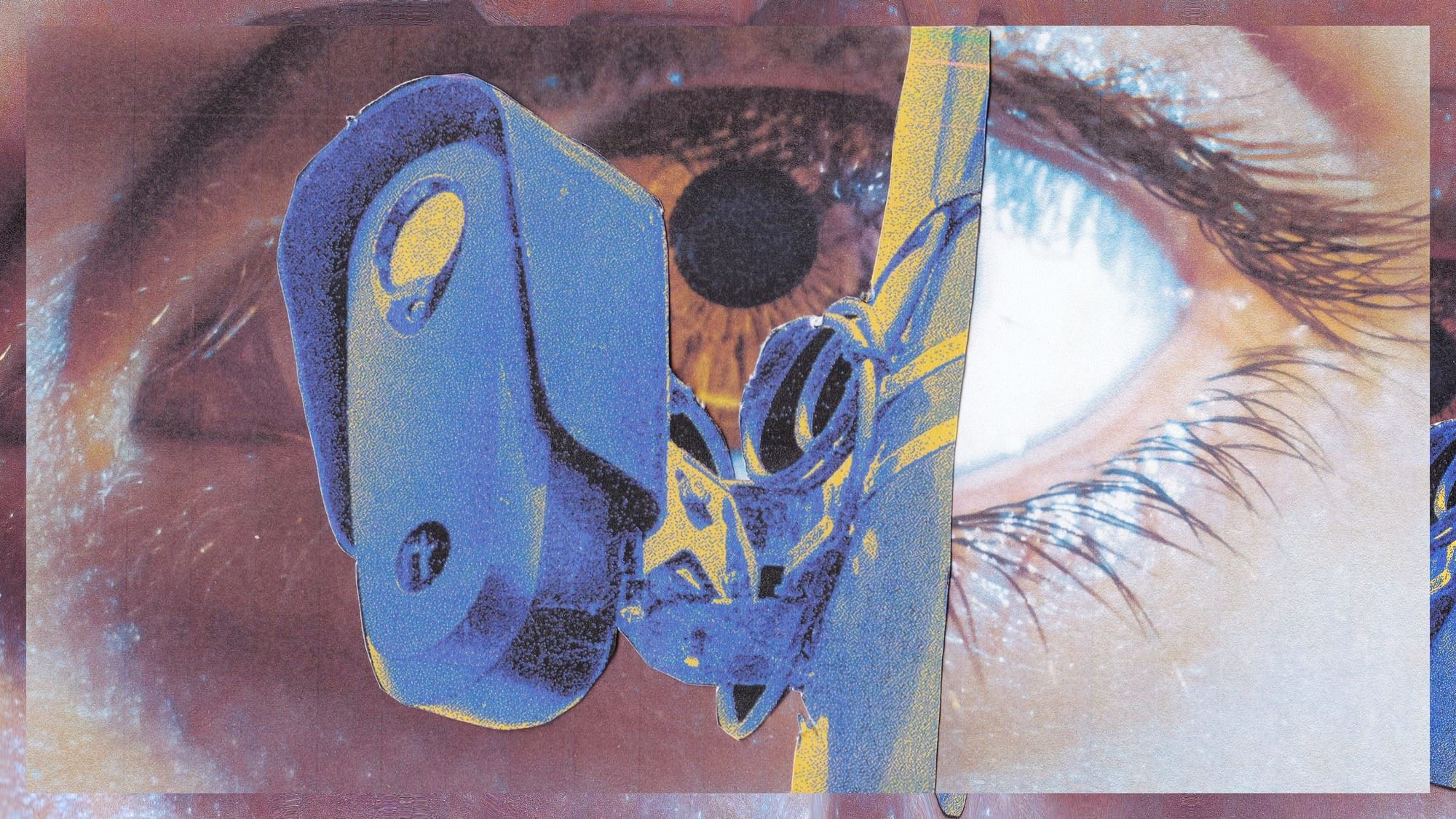
'I Would Never Do This To You:' Protesting Flock, Arizona Man Presents Plan to Surveil Government Officials

1 Comment and 2 Shares
'I Would Never Do This To You:' Protesting Flock, Arizona Man Presents Plan to Surveil Government Officials

On July 20, Jacob Petrosky stood in front of the Casa Grande, Arizona City Council during a public comment session and made an announcement.

“I've spent the last several months talking to people all over Casa Grande, and one thing keeps coming up: Safety. So, today I'm excited to announce a new company called Shepherd Safety,” he said. “Our mission is simple. Keep government officials and their families safe.” It would be no different than how the city monitors its citizens using Flock cameras, he said; he planned to launch satellites that would use AI to monitor “where government officials go, where they stop, who they meet with, and when they return home.” 

He said he’d already started compiling profiles on their vehicles, spouses vehicles, children's vehicles, and planned to combine that data with Bluetooth signals, advertising IDs, and commercial data sources, “so our authorized users can replay the movements of every government official and their immediate family,” he said. Local businesses would be invited to join the network, to “protect” officials while they shop, eat at restaurants, and move around the city. 

After laying out his plan and its benefits for the government officials before him, Petrosky revealed that it was all satire. “I would never do this to you,” he said to the council members. “Could I? Probably. But I wouldn't because it's wrong. Just like what you guys are doing to us is wrong.” 

Petrosky told me he never expected or intended to be the face of opposition to Flock cameras in his small town. And the clip, which has since gone viral on social media, only shows one angle of one moment that’s part of a much longer fight.  

Casa Grande City Council unanimously approved a 10 year, $10 million contract with Flock last year, and since then, Petrosky has spoken against the partnership several times at city council meetings. “You know, I'm actually a little bit embarrassed by the video. I did not feel good about it,” he told me. “The looks... You don't get to see the looks on [council members’] faces. They didn't understand it was satire in the beginning until the end, and the looks on their faces were like, we hate you and we're gonna get you. They were not happy, they were very upset.”  

What Happened When Flock Came to My Town
My small town in South Carolina will soon have more Flock cameras than police officers.

Casa Grande City Council members did not immediately respond to 404 Media’s request for comment.

Petrosky said he’s not trying to be “a troll,” but after asking the council to consider the invasion of privacy they were inflicting on constituents, including asking them to consider putting Flock data behind a warrant, his patience was wearing thin. “So it didn't feel great, but I wanted it to sink in,” he said. “I'm not looking to go viral. I don't want to be an online personality, but what I really just want is maybe just a little bit of privacy.” 

Petrosky said he first noticed Flock cameras going up in Casa Grande last year. It wasn’t until then that he started getting civically involved. “I registered to vote this year. I'm very transparent about that. I could care less about city council or politics or any of that. I'm very much a nerd,” he said. “They did this deal last year, and then all of a sudden, like 200 cameras appeared in our city, pretty much almost overnight. It was really crazy. In fact, they deployed them so quickly that it freaked me out.” He realized that he couldn’t enter or leave his neighborhood on a paved road without being tracked on a Flock camera. 

Petrosky launched a website, DeFlockCG, along with a petition that asks Casa Grande residents to voice specific demands, from limited third-party access to camera data and repercussions for abuse of the system, to removal of Flock from the city altogether. Almost 900 people have signed the petition so far.

Local news outlet Pinal Central reported earlier this month that a public records request revealed that the city has installed about 140 of the planned 200 cameras as of late June, with half being license plate reader cameras while the other half are pan-tilt-zoom cameras. 

The city’s website about its Safe Cities Initiative says that in addition to assisting in solving crimes and increasing transparency for the public, the initiative and cameras are intended to “prevent crime before it occurs.” The website only mentions Flock in reference to using the Flock OS system to connect cameras and technologies, but links to a “transparency portal” and how to register privately-owned cameras into the network go directly to Flock’s own web pages. On Flock’s website highlighting the Casa Grande partnership, the company quotes Casa Grande Police Chief Mark McCrory: "In the past, investigators relied on slow, manual efforts to gather video evidence. Now, with registered cameras securely integrated into our Real Time Information Center, we can access vital footage faster—turning information into actionable intelligence when it matters most."

Flock ‘Objects to Our Removing Their Equipment’: Emails Reveal Why a Town Put Bags Over Its Flock Cameras
“For the time being, if you or someone on your crew has availability to secure black plastic bags (or something else) over the cameras, that would be great.”

In May, Casa Grande City Council voted unanimously to give police access to elementary school cameras through the Flock partnership. 

Last week, a 404 Media investigation revealed that police departments around the country have used Flock cameras at least hundreds of times to search for specific people with specific characteristics, like “heavy-set male with a black and white hat” or “person on skateboard,” and these searches sometimes reference people’s race or signs of their political affiliation.

Several cities and small communities around the country have canceled their contracts with Flock, citing privacy concerns and the potential for abuse. Petrosky said he primarily wants the city to require a warrant for accessing the data collected by cameras. 

Petrosky knows his “announcement” at the council meeting was absurd, but the absurdity was the point. “It's incredibly stupid, and then it's also just incredibly inappropriate. The thought of tracking and associating them with their children and their spouses and all of it,” he said. He would prefer to keep to himself, and doesn’t relish these moments in front of the council, the entire town, the police department, and now, the whole internet. “Never in my wildest imagination would I ever be in a position like this. I don't want to be famous. I just want this to go away. I want these things to at least just be put behind a warrant.”

Read the whole story
mkalus
7 hours ago
reply
Oh boy, how ahead of the times “Watch Dogs” was.
iPhone: 49.287476,-123.142136
Share this story
Delete

Substackers Say New AI Detection Tool Is a ‘Witch Hunt’

1 Share
Substackers Say New AI Detection Tool Is a ‘Witch Hunt’

Substack contributors are rejecting the company’s decision to flag AI generated writing on the newsletter publishing platform, with several creators saying the new AI detection features are a “witch hunt.” Some Substack users who use AI to help them write or edit articles say the new policy unfairly discriminates against them, while other users who don’t use AI in their writing at all are worried that Substack will mistakenly flag their writing as being AI generated and tarnish their reputation. 

“I’m not going to apologize for using AI in the creation process. I wrote for 20 years without AI, I could do it again if I wanted to,” Mack Collier, who has a small Substack called Backstage Pass, wrote. “My output would fall, my posts would be less structured, and it would be more obvious that they needed a good editor. Using AI improves the overall quality of my writing. That’s why I use it.”

“These detectors are notoriously, wildly inaccurate,” Alice Lemee, a ghostwriter and digital writing coach, said in a video she made about Substack’s new AI detection features. “All it takes is one false accusation for a writer to have their reputation almost irreversibly tarnished.”

Substack announced the AI detection features on Tuesday in a post from CEO Christ Best, who said that “It’s getting harder to tell what’s real on the internet” and that “when content made by no one takes over parts of the internet that are supposed to be human, it pollutes the commons and makes it hard to discover and hear human voices.”

Best explained that Substack has partnered with the AI detection tool Pangram, which is now built in to Substack and allows any user to scan a piece of writing. Pangram then produces a percentage-based score determining how much of the writing was AI or human generated. (Disclosure: Pangram previously bought an ad on 404 Media). We’ve covered research from Pangram, or research that relies on its AI detector before, showing how AI generated writing is flooding every corner of the internet. 

As we’ve previously reported, AI detectors are not perfect, and Pangram itself is not immune to labeling human content as being AI, and labeling AI as human. Max Spero, the CEO of Pangram, recently told us that the company is constantly working on minimizing errors, and that it estimates its false positive rate at roughly one in 10,000.  

“We have now built the mirror image. Pangram is a real machine, trained on vast amounts of text to make a probabilistic guess, and we have pointed it at your writing to work out whether a person is hidden inside,” Sam Illingworth, a professor and the author of Slow AI, said on his Substack in a post titled “Substack’s AI Detector and the Return of the Witch Hunt.” “To decide if there is a human on the other end, Substack asks a machine.”

Substack also added a way for users to add a “How I make this” statement, where they can explain their writing process and disclose if they use AI. 

“We’re not against people using AI to assist their work, and we think people should be free to choose which tools they use to express themselves,” Best said. “Some on the platform are human-writing maximalists, others are publicly exploring the frontier of using AI tools while sweating the details to make work they stand behind. We use AI all the time at Substack to write software, do research, and build product features like clipping, translations, and more. But people should know what they’re getting.”

“I think the best way for Substack to address this is to invite further dialogue,” Illingworth told me. “I actually really like the new feature that lets authors tell their readers how they construct their newsletters using AI, and this is the kind of dialogue they should encourage rather than ascribing a score that we know to be incorrect. My worry is that not only do these AI detectors generate false flags for non-native English speakers and neurodiverse writers, but they also remove any opportunity for dialogue because they start from a position of suspicion. Whereas what we need to be doing is developing opportunities for trust between readers and authors.”

"The tools we've introduced today are intended to increase transparency and give readers more context, not to prohibit or penalize AI-assisted writing. They do not impact discovery on the platform,” a Substack spokesperson told me. “We're also encouraging Substack publishers to add a ‘How I make this’ statement, where they can explain their process directly, including how they use (or don't use) AI, and set expectations for readers. Creators can disable detection on their posts pre- and post-publication, as well as report and remove scans on their own work that they believe are mistaken. Find more information on how the features work here.”

Substack’s attempt to detect and label AI generated content was also celebrated by many readers who are exhausted by AI slop and other internet platforms that can’t or don’t want to label it. I just published story about how there is so much unlabeled AI slop on Spotify that people are now creating their own sites to detect and label it without the company’s help.  

But the backlash from some Substack users shows that companies can’t just flip a switch if they want to ban or give users the ability to filter out AI content from their feeds. As the flood of AI writing and images we see online and the real world every day makes clear, generating slop is easy. What we’re going to do about it is still an unsolved problem.

Read the whole story
mkalus
8 hours ago
reply
iPhone: 49.287476,-123.142136
Share this story
Delete

Chrome forces Gemini global shortcut onto your Mac

1 Share

Everyone wants Gemini, right? Google already made the power switch on Android phones into a Gemini button. Everyone wants that!

Google doesn’t have the same control over desktop computers. But in MacOS on the Apple Macintosh, any application can set a keyboard shortcut that works globally — in any other app.

If you install the Chrome web browser, pressing control-G — and in one report, shift-command-G — in any app brings up a Gemini window. Even if the app was already using that key combination. Chrome doesn’t ask first, or tell you when it takes the key.

Marcin Wichary discovered this while he was using the Nova code editor. He wanted to go to a particular line of code, he hit ctrl-G, and up popped Gemini! [Mastodon; blog post]

This actually conflicts with control-G in Chrome’s own dev tools! Google changed it so if you have the Gemini shortcut switched on, the dev tools shortcut helpfully switches to alt-G. Muscle memory is nothing to the necessity of Gemini. [Chromium]

Marcin filed a bug. Google locked the bug report from view! [Chromium]

This behaviour’s been around a while — the earliest report I found is from November. It doesn’t seem to happen on every Chrome installation. [Reddit]

Part of the problem is that MacOS lets apps do this at all. But it’s still Google doing it without asking or even telling.

At Google, user consent is for “maybe later.” But someone’s quarterly marketing numbers went up. And isn’t that what counts?

Read the whole story
mkalus
8 hours ago
reply
iPhone: 49.287476,-123.142136
Share this story
Delete

Apple’s iMessage Scanning Flagged a Video of My Friend's Dog as Nudity

1 Share
Apple’s iMessage Scanning Flagged a Video of My Friend's Dog as Nudity

In a video my friend’s dog is laying on her back, her little paws in the air, while my friend rubs the dog’s chest. You can see most of the dog — who I’m not naming for very important privacy reasons — from her head to her belly. On closer inspection, you’ll notice the picture includes some dog nipples. 

Apple’s iMessage thought this video was so inappropriate that it flagged the video as potentially containing nudity and blurred it. When someone else received the video over iMessage, the app displayed the message “This may be sensitive.” They had to purposefully tap to reveal the video of a dog laying on her back being petted.

This, obviously, is not the intended use case for iMessage’s nudity detection features. They are designed to let people protect themselves against receiving unwanted or unsolicited nude photos and videos. But the case of my friend’s dog shows how this feature can sometimes misclassify videos.

Apple’s iMessage Scanning Flagged a Video of My Friend's Dog as Nudity
A screenshot of the blurred image.

“Sensitive Content Warning lets you receive warnings about photos or videos that might contain nudity before viewing them,” Apple’s website reads. Apple introduced the feature in iOS 17 a few years ago. Obviously, scanning the content of messages and content is controversial, but Apple says it performs the scan on the device. Users can also turn the feature off in the settings. “Sensitive Content Warning uses on-device machine learning to analyze photos and videos. Because they're analyzed on your device, Apple doesn't receive an indication that nudity was detected and doesn't get access to the photos or videos as a result,” its website adds.

The dog video isn’t an isolated incident either. Here’s another I found on an Apple forum from May 2025: “Why did a photo of my dog trigger a sensitive content warning on iMessage?” the title reads.

💡
Have you come across similar issues? I would love to hear from you. Using a non-work device, you can message me securely on Signal at joseph.404 or send me an email at joseph@404media.co.

“So I was going to send 3 photos to a group chat I had on iMessage. After I pressed the send button, I got a sensitive content warning… the photo was one of my dog’s body, the other two were fine though. I’m confused and I wanted to report this problem. Just so you all know I’m just looking to report this problem. I think it was just a false and mistaken sensitive content warning,” the poster wrote.

There is also this one from October 2024: “A picture of a deer was flagged as sensetive [sic].”

“This was flagged as possibly sensitive, and a pop-up appeared asking me If I wanted to send it. That is a picture of a deer from a trail camera,” the poster wrote.

Apple did not respond to a request for comment.

Read the whole story
mkalus
11 hours ago
reply
iPhone: 49.287476,-123.142136
Share this story
Delete

Person Opposing Data Center Arrested for Clapping at City Meeting

1 Share
Person Opposing Data Center Arrested for Clapping at City Meeting

Police arrested a high school physics teacher for clapping during a city council meeting last Wednesday. Teacher Lux Claridge went to a meeting of the Emporia, Kansas City Commission on July 22 with their spouse and brother. All three were there to speak out against a proposed hyperscale data center that would sit on 1,000 acres of rural land in Emporia. They left the meeting in handcuffs, dragged out by police on the orders of a city commissioner.

Emporia PD denied 404 Media’s request for a copy of Claridge’s arrest report. “The requested record is part of an active criminal investigation. As such, it is considered a criminal investigative record,” Emporia PD told 404 Media. “At this time, the Emporia Police Department is denying your request, as disclosure of the requested report could interfere with ongoing investigative efforts. Therefore, the record will not be released.” 404 Media has formally appealed this decision.

The Emporia City Council met on July 22 and planned to vote on zoning ordinances that would pave the way for the massive Flint Hills Digital Campus data center. Dozens of people from Emporia showed up to speak out against the project. The meeting went on almost five hours — much of it over community concerns about the data center. The small room where the council met could only fit around 30 people. Others waited to speak in a hallway outside or in two nearby overflow rooms.

The overwhelming majority of Emporia’s residents did not want it. There was a strict two minute time limit on public comments and the commissioners repeatedly warned people in the room not to clap or make noise. Attendees clapped anyway, though usually quickly and politely. Again, there were not many people in the room and it was not a rowdy meeting.

But the clapping upset the commissioners. “It was very clear at the beginning that everyone was given their two minutes and we’re trying to be respectful of that. Snapping, clapping, rude comments or anything, and we’ll ask you to leave. You’ve been finally warned and we’re done,” city commissioner Monica Duncan said about 50 minutes into the meeting.

Claridge clapped a few minutes later as a speaker finished and their spouse—Jessica Danford—took the podium. 

“Chief, will you take the next person out who claps or anything? Please.” Duncan said. “Sorry, I’m done.”

Emporia’s police chief approached Claridge and asked them to leave. “I have a right to speak,” they said. 

“Come on,” the police said.

“Drag me out,” Claridge said. “Drag me out.”Then the police physically raised Claridge up, handcuffed them, and dragged them out. They were later charged with disorderly conduct and interference with police.

Danford panicked as she watched police arrest Claridge. “Take a breath,” Emporia mayor Becky Smith said.“That’s my spouse down there,” Danford said.

“I know. I know. Take a breath,” Smith said.“Please don’t hurt them,” Danford said.

“Let him stay!” People begin to shout in the room.“They can all leave,” commissioner Duncan said, pointing her finger at the room. Then the commissioners shut down the camera feed for the meeting. It resumed about 10 minutes later. Danford was back at the podium and delivered her prepared remarks speaking out against the data center.

A few minutes later, Claridge’s brother David — who is running for state representative — took the podium. “I really look forward to making life hard for you when I get to the statehouse,” he said. “Because you removed my older sibling against their constitutional first amendment rights. This is ridiculous. I have never seen politicians so abundantly terrible at their PR. It is insane. You had someone from the opposition removed for clapping because they enjoyed a speech another member made.”

David told 404 Media that they were angry when police removed his brother. “I was enraged and had to consistently remind myself that a felony battery charge would disqualify me from office,” David told 404 Media. “I don't understand how the commission could think it was a good idea when they are already being so heavily scrutinized. I'm running for office obviously, and I cannot imagine how they thought this political theater would paint them as anything other than a mustache twirling fascist.”

At the end of the evening the commissioners voted 5 - 0 to approve the data center zoning measure.

Emporia, Kansas is like many other towns and cities that are fighting against data centers. It’s small, with a population of around 20,000, and the details around the data center development are shrouded in mystery. The Flint Hills Digital Campus is supposedly the brainchild of developer Gary Pinkston. He penned an op-ed published in the local paper the Emporia Gazette about the importance of the data center for the future of the area. The op-ed was also posted on the website for the Flint HIlls Digital Campus.

Pinkston has also recently declared federal bankruptcy and in public testimony revealed by related to that, he told his creditors that he wasn't involved with the Flint Hills Digital Campus at all. It was, he said, his daughter’s project. “I did not write this,” Pinkston told his creditors when questioned about the op-ed. The Flint HIlls Digital Campus website is now offline. The Emporia Gazette published recordings from Pinkston’s bankruptcy hearing on July 20, two days before an Emporia City Commission meeting where police arrested Claridge.

The police posted a comment about the incident on Facebook. “During the course of the meeting, several individuals in attendance were issued verbal warnings by the City Commission regarding disruptive conduct that was interrupting the proceedings,” the Emporia Police Department said in a statement on Facebook. “One individual, Lux Claridge [...] continued this behavior and was directed to leave the meeting. Claridge did not comply with law enforcement's efforts to remove [them] from the premises, requiring officers to physically carry [them] out of the meeting.”

According to Emporia PD, Claridge was booked at the Lyon County Jail on charges of interference with law enforcement and disorderly conduct. “The Emporia Police Department remains committed to ensuring public meetings are conducted safely and in an orderly manner, while also respecting the rights of all citizens to participate in the civic process,” it said in its Facebook statement.

Read the whole story
mkalus
1 day ago
reply
iPhone: 49.287476,-123.142136
Share this story
Delete

Tons of Peoples’ Claude Chats and Creations are Exposed on Google

1 Share
Tons of Peoples’ Claude Chats and Creations are Exposed on Google

Claude is exposing a wealth of users’ chats and creations in Google search results, meaning anyone can dig through conversations or other material that people used Claude to make but may not have realized were publicly available for strangers to see.

Read the whole story
mkalus
1 day ago
reply
iPhone: 49.287476,-123.142136
Share this story
Delete
Next Page of Stories