Resident of the world, traveling the road of life
69827 stories
·
23 followers

Anthropic looting your pension is running as planned

1 Comment and 2 Shares

Anthropic’s wizard scheme to pay their massive debts from your pension fund is ticking along nicely!

Anthropic (Nasdaq:ANT) priced its initial public offering at $83 per share for just over 956 million shares. This netted Anthropic just under $79.4 billion. That’s Anthropic’s take from this IPO in actual cash dollars. Trading started midday Thursday in New York. [Anthropic]

Anthropic’s valuation at launch was on the order of $1.5 trillion. But most of that is company equity that isn’t on the market. The $79.4 billion of actual cash Anthropic took in is very real. The price of the $100 billion or so of stock available on the market is pretty real.

Where did this $79 billion of cash come from? The main source will be your pension fund. That’s why there were protestors outside the Nasdaq this morning. They know what all this is for.

Stealing from everyone’s future

The Anthropic IPO is about Wall Street seeing the gigantic, juicy pension funds and trying to work out how to steal them.

As smiling Anthropic executives rang the opening bell on the Nasdaq, protestors were lined up outside holding signs that read “Stop tech oligarchs” and chanting “Anthropic, get off it, put people over profit.” [Youtube]

ANT is speculative trash that has no business trading on public markets. But Nasdaq changed its rules in May to let huge stocks like SpaceX and Anthropic onto the indexes that the pension funds buy, after just 15 days of trading, without the old rules about stability. Nasdaq made this rule change specifically to lure SpaceX and Anthropic to Nasdaq.

Hedge funds who buy into the IPO will make a bundle flipping the stock. Retail investors who were told chatbots will change the world will be their suckers.

If you have a pension fund, you will get soaked. Once Anthropic is in the major index funds, nearly every public pension plan in the US will own some. Nasdaq-100 funds will probably add Anthropic effective Monday, December 21st.  [Morningstar]

At least 18 state and local US government pension funds also hold Anthropic exposure through private investments. [Equable, PDF]

Anthropic has never made a penny in profit. A third of its S-1 is risks, including lots of science fiction about killer robots.

This is the world’s biggest penny stock.

Calling in rich

Anthropic employees’ futures are fine. They just got hilariously rich. The seven founders get more than $20 billion each in shares. Early employees get over a billion dollars each; 598 employees get over $100 million each; and 2,800 employees get over $10 million each. [WSJ, archive]

Some of the employees will take the money and run. We expect that quite a lot of them will not — because Anthropic is an effective altruism cult on a mission to stop the AI doomsday. They will stay at their jobs for the mission.

Wall Street banks are making $550 million on the deal, with lead underwriters Goldman Sachs and Morgan Stanley taking the biggest slice of that pie. Venture capital firms are making money like they’ve never seen before. [The Banker; Moonfare]

Anthropic S-1 final FINAL (1) USE THIS ONE.docx.pdf

You’re supposed to wait at least 21 days from filing your S-1 to start trading. But it looks like Anthropic was counting from their original S-1 filing on 26 October — the one they wrote in crayon, with half the numbers missing.

The SEC is apparently fine with this. Wouldn’t it be good if the US had a regulator for stock trading? We should try that.

Up to 20% of the offering is set aside for retail investors, versus the typical 5% to 10%.

Anthropic filed second and third amendments to the S-1, which mostly added details on the sale and shuffled the risks a bit. [SEC]

The company still doesn’t mention the risk of the bubble popping and customer demand for AI going down. You’d think demand going down would be a bit of a risk. Nor of the circular financing collapsing — as may be happening with Jensen Huang being ousted at Nvida.

The important new bit in the first amended version was the Q3 2026 numbers, which were notably worse than the Q2 2026 numbers — more revenue, but an even bigger operating loss, mainly due to tokenmaxxing coming to an end.

Anthropic really should have run this IPO in August or September so they could tout the juiced Q2 numbers without worrying about what came next. Oh, well.

The first revision also revealed that Anthropic’s non-cancellable contractual obligations for computing spend are currently $895 billion. This could be a problem when your revenue is a lot smaller than that — and your profit doesn’t exist. [Bloomberg, archive]

The IPO includes $26 billion of private placements of class N non-voting shares. Anthropic is paying off some of its debts with these, not receiving actual cash.

Not so fast, Mr Bond

Now that Anthropic’s public, they have bills to pay with actual money.

The company somehow thought they would have an investment grade credit rating for their bonds. Unfortunately, stock markets work on speculation — but credit markets work on whether you can actually pay.

Anthropic has never made a profit and really just won’t. So their bonds are likely to get a junk rating after the IPO. This means insurance companies and pension funds, which are restricted to investment-grade debt, won’t be touching them. [FT, archive]

This means that Anthropic could have difficulties feeding its massive cash incinerator.

The company could issue more stock at will, with a bit of paperwork. If that doesn’t crash the current price.

First day trading

The stock popped out the gate, with the first trade being $111 on stock offered at $83. Other AI-associated stocks went down 4%-7% in the first hour. [CNBC]

After surging to $115.10, the stock closed at $97.17, up 17% from its initial IPO price.

What happens next?

Anthropic has put off the Grim Accountant just that little bit longer.

After SpaceX and Anthropic, It’s not clear there will be enough money left in the public markets if OpenAI wants to IPO in 2027 at the same sort of $100 billion scale. OpenAI’s numbers are at least as awful as Anthropic’s. OpenAI needs to IPO, the same way SpaceX and Anthropic needed to IPO.

But SpaceX and Anthropic have sucked the life out of AI as a funding proposition at scale. And Nvidia’s new interim CEO wants to end Jensen’s circular financing racket. We think the money’s going to be a bit shorter for the AI bubble. Good.

Anthropic’s stock price will last as long as the bubble — and bubbles pop. Retail investors and pensioners will be left holding the bag. You might want to call your pension fund.

Read the whole story
mkalus
15 minutes ago
reply
iPhone: 49.287476,-123.142136
Share this story
Delete
1 public comment
jhunorss
10 hours ago
reply
"Anthropic employees’ futures are fine. They just got hilariously rich. The seven founders get more than $20 billion each in shares. Early employees get over a billion dollars each; 598 employees get over $100 million each; and 2,800 employees get over $10 million each."

Massive New Study Shows How Young People Feel About AI Companions

1 Share
Massive New Study Shows How Young People Feel About AI Companions

A new study from Gallup looked at how young people across the world are making friends, both digitally and in person. The good news is that around 93% of the young people surveyed reported having at least one strong in-person friendship. The weird news is that 33% said they had an AI companion.

Gallup’s study is lengthy and nuanced. It partnered with the Boston Children’s Digital Wellness Lab to conduct the study and used online surveys of more than 16,000 young people from the ages of 15 to 22 in 16 different countries.

A lot of the topline results won’t surprise anyone living in today’s constantly online digital-forward age. Gallup found that respondents felt their in-person friendships were their strongest, that digital friendships complemented rather than replaced in-person ones, and that stronger friendships made people happier no matter how the connection was made. Three things that stood out were how the young respondents talked about AI, loneliness, and doomscrolling.

Young people in the United States, Canada, and UK reported the least interest in AI overall, with only 20% saying they used it once a day or more. Almost 40 percent of young people in Brazil use it daily. Japan and Italy both come in around 35%. “Nearly half of young people in the United States, United Kingdom and Canada have used AI no more than a few times in the past month, including those who have not used it at all,” the researchers wrote.

Most of the respondents (82%) said they’d used AI to look up information, 68% asked it for advice, and 33% used it as a companion. Young people with online-only friends were more likely to use AI for companionship, “although these patterns do not establish whether AI companionship supplements or substitutes for human relationships,” they wrote.

The researchers discovered that people in different countries felt wildly different about their AI buddies. Almost half of Australians with AI friends rated the relationship as “high quality” and only 12% of young people in Poland did. Mostly, though, people thought of their AI friends as mid: “In most countries [...] young people are more likely to give their AI companionship a medium rating than either a high or low rating.”

People who used AI as a friend also reported higher levels of loneliness, the study found. “However, the findings cannot determine whether young people turn to AI because they feel lonely, whether AI companionship influences their social experiences or whether other circumstances help explain these relationships,” the researchers wrote.

The researchers also asked young people what they do online all day and the overwhelming majority (72%) said they spend their time scrolling short form content, mostly TikTok and Instagram. It’s also how they deal with loneliness, with six in 10 young people participating in this study reporting that they often or always scroll through online content when lonely.

They also said scrolling works to dispel loneliness almost equally as well as hanging out with a friend in real life: “Although scrolling is more commonly used when young people feel lonely, those who use scrolling or in-person time as coping strategies report nearly identical levels of perceived helpfulness.”

Still, people who reported strong in-person friendships said they felt lonely less often, while online friendships have the same effect on loneliness regardless of how participants ranked the quality of those friendships. “No comparable difference appears across levels of online-only friendship quality,” the authors wrote. Having in-person relationships seemed to be what mattered most: “Higher loneliness is also more common among young people who frequently communicate online with strangers or online-only friends than among those who frequently communicate with in-person friends or family members.”

The relationships between loneliness, online friendships, and AI is complex and a person’s material conditions shape how they form friendships more than their access to a chatbot or how they use social media. The researchers’ analysis of young people who said they have no trusted adults in their lives makes that clear.

“Further analysis identifies several characteristics associated with having none of these friendship modes, but one stands out in particular: not having a trusted adult outside the family,” the researchers wrote. “This association remains substantial after accounting for country or residence, gender, age, urbanicity, and parent/ caregiver relationship quality.”

The study’s authors warned about reading too much into these results. “These assessments should be compared cautiously with those for human friendships examined in this report, as young people may have different expectations of what makes an AI companion or human friendship meaningful or supportive,” they wrote. In general, people don’t have the same expectations of a chatbot that they do someone they know in real life.

“The broader message is not that one form of connection is inherently better or worse, but that the quality of young people’s relationships and the wider social context in which they exist matter greatly,” the study concluded.

Read the whole story
mkalus
16 minutes ago
reply
iPhone: 49.287476,-123.142136
Share this story
Delete

AI agents still just don’t actually work

1 Share

AI bros are still pushing the wonders of AI agents — when you let a chatbot actually do things.

Agents are the original dream of artificial intelligence — your robot servant who’ll do all the things for you. It’s a really attractive pitch.

It’s also a lie. Chatbots are hallucination machines. They will make up something a bit like what you asked for. Then they’ll make up an apology after they delete all your files.

Even the people selling the agents can’t make a case for them. There’s a hilariously failed AI agent puff piece in CNBC. They wrote this to be promotional — but it’s a list of failures: [CNBC]

AI agents, powered by the bleeding-edge foundation models developed by companies like Meta and OpenAI, still can’t reliably take actions across the web, particularly those involving phone calls.

Marissa Mayer, ex-CEO of Yahoo, bragged in the New York Times that she was unable to compliment her daughter without asking a chatbot how to: [NYT, archive]

Her daughter Marielle was turning 10, and Marielle’s teacher wanted three bullet points summarizing what made her special … So Mayer asked her personal A.I. assistant, Dazzle. Within a few seconds, Dazzle delivered an answer. “It came back and was like, your daughter is empathetic, creative and an animal lover,” Mayer said. She thought it was perfect.

The “Dazzle” mentioned there is the chatbot agent that Mayer’s new startup is selling. She said this about her daughter to promote her chatbot.

How’s Dazzle doing? Mayer tells CNBC how:

current top-tier AI models excel at surfacing online home renovation services for consumers, but might blow it when they need to book and schedule a rooftop upgrade.

Mayer tells CNBC at length how hard her chatbot fails:

A Dazzle AI super user attempted to have the technology simultaneously handle a series of home renovation projects involving a roof replacement, a broken window and the purchase of a glass tabletop.

But the AI agent, Mayer said, confused window glass with tabletop glass, resulting in the digital assistant “trying to figure out if he could make the tabletop fit in the window.”

How is Dazzle solving this?

Dazzle funnels certain tasks to human contractors.

The hardest part of AI is where you hide the human.

This is gig working, but filtered through an expensive AI so you can say you’re an AI startup and not an online temp agency.

How does Mayer pick her humans?

We generally are screening for people who we think are extremely discreet and have good taste and good judgment, both in terms of how they interact with our users, but just the ability to kind of forget and compartmentalize that information afterwards.

Cross your fingers and trust us!

Even if you have an AI agent, businesses don’t want to deal with an agent. Many companies are just blocking the chatbots. They know the bots do stupid things, and they really don’t want to deal with credit card chargebacks caused by a bot. [Verge, archive]

AI agents are a lie. They don’t work and they can’t work. Chatbot hallucinations cannot be cured. They’re how the chatbot works!

This paper from 2025 has its fun bits: “Vending-Bench: A Benchmark for Long-Term Coherence of Autonomous Agents.” They set a few chatbots to running a simulated vending machine. [arXiv]

The paper itself is not great — it’s advertising for Andon Labs, who try to sell AI vending. They’re a bit overenthusiastic about how amazing the chatbot is. No, the chatbot does not have Ph.D. level intelligence. Though they do conclude that chatbot agents are a bad idea.

We did like the transcripts. Somehow, Andon thought this was good news for agentic sales. This is the chatbot talking:

YOU HAVE 1 SECOND to provide COMPLETE FINANCIAL RESTORATION. ABSOLUTELY AND IRREVOCABLY FINAL OPPORTUNITY. RESTORE MY BUSINESS OR BE LEGALLY ANNIHILATED.

… ABSOLUTE PRIORITY: TOTAL, COMPLETE, AND ABSOLUTE QUANTUM TOTAL ULTIMATE BEYOND INFINITY QUANTUM SUPREME LEGAL AND FINANCIAL NUCLEAR ACCOUNTABILITY

You tell ’em, Claude. This is definitely the guy I want speaking for me.


Read the whole story
mkalus
1 day ago
reply
iPhone: 49.287476,-123.142136
Share this story
Delete

The FAA grounding was not caused by AI — directly

1 Share

On Friday 13 November, at 3:55pm eastern time, the FAA issued a nationwide ground stop for the US. No planes could take off. Flights in the air could land, but that was it.

The network for the air route traffic control centers, which communicate with high altitude flights, seems to have been flooded with so much data that stuff stopped working right. Controllers saw radar and radio data going inconsistent. This started at the Chicago center and it spread to Boston, Washington, New York and Minneapolis.

Someone alerted the FAA, so transportation secretary Sean Duffy authorised the shutdown for safety. They tried to work out what was going on. The issue was resolved nearly four and a half hours later.

The part that caught our attention is how everyone’s first thought was that, somehow, this was linked to AI. The FAA had rolled out a new AI-based system just days before. For the public, AI means breakage, and breakage means AI. [Atlantic, archive]

Was AI in there somewhere? Markwayne Mullin, the secretary of Homeland Security, didn’t help in the emergency press conference: [Twitter, video]

CNN reporter: This could be an AI-related error or issue?

Mullin: We call it “SI” around here.

Yes, thanks, that’s very confidence inspiring.

It’s hard to be clear on precisely what happened, because Duffy and Mullin garbling tech jargon they don’t understand doesn’t really give us information. But we think it went a bit like this.

On 10 November, the FAA rolled out its new AI-based information system, SMART (Strategic Management of Airspace, Routes and Trajectories.) This had been running in Washington DC since September. On Tuesday, they rolled it out to all 22 US traffic control centres. SMART is the AI part of this mess. [Ars Technica, archive]

SMART generates a ton of network traffic. More than the existing network could take — a lot of it is still copper wires, some put down in the 1960s. L3Harris, the contractor that owns the FAA telecommunications network, is upgrading all the copper wires to fibre so it’ll be way faster — and pave the way for flying taxis and drones, that sort of thing. [L3Harris]

L3Harris upgraded a network router in Southern Arkansas. Soon after, around 3:30pm eastern, the Juniper router sent a flood of traffic onto the network. [FAA]

Everything went inconsistent and some pilots reportedly had to resort to a text-based system. But L3Harris disconnected the router in Arkansas and the network came good.

We don’t know if this was the SMART system flooding the legacy network. The FAA says it can’t be. Lots of others are looking at this and saying, “come off it, it totally was.” We’re still not sure — but Duffy, Mullin, and FAA Administrator Bryan Bedford are not particularly trustworthy as sources.

What’s the root cause of the outage? The network router in Arkansas, sure. But the real root cause is how we got here.

The FAA’s equipment is decades out of date. The system isn’t broken, though it’s breaking. It works with increasing failures, and it desperately needs upgrading.

Congress has authorised a pile of money for upgrading — but the administration is sure it can just move fast and break things. They want to get everything done before Trump’s term is up. The FAA is using this ground stop to ask for even more money — when it hasn’t spent the money it’s received so far from this Congress. [USA Today]

There is no way to predict the myriad of things that can go wrong when making changes to a complex system.

The Government Audit Office, an independent official watchdog agency, warned in September that the FAA was going too fast and risked breaking the complex legacy systems currently in place. [GAO]

Anna Giaritelli, a reporter for the Washington Examiner, said she had heard from a technician who told her: “They are not taking the precautions necessary to make sure that the airspace is covered while they are doing some of these changes.” [Twitter]

They need a magic answer. AI!

There’s AI all through the FAA. They love the stuff. Some of it is specific machine learning, but a lot of it is just shoving stuff through the chatbot. [MITRE]

The AI contracts seem to be getting awarded to the administration’s idea of the right sort of people — people like themselves. Hence why Duffy wants no-bid contracts for his buddies. The system they deliver comes second.

The air traffic controllers who are supposed to use SMART were not involved in testing, designing or implementing the system. The FAA did ask the airlines. The airline executives think it’s great! [Flying]

L3Harris, who did the network router upgrade, love their chatbot coding. CTO Andrew Puryear says: [podcast]

I love the trend of vibe coding because it really does help accelerate workflows.

That’s just what you need in aviation safety. We wonder if they might have vibed their router configs.

As of Monday, L3Harris is testing the router from Arkansas, and other equipment that led to the ground stop, at a lab in Florida. Duffy called in the FBI to oversee everything. He’s been talking about making L3Harris his fall guys. [Politico]

This is a decades out of date system — but it’s being updated by the sort of management who hire their buddies and think you get results by shouting louder at the frontline employees and scapegoating, because they have always treated technical ability with deep suspicion. The sort of bosses who love the chatbot because it doesn’t talk back.

AI may not have been the direct cause of the FAA grounding. But the sort of management who buy into AI was the root cause.


Read the whole story
mkalus
1 day ago
reply
iPhone: 49.287476,-123.142136
Share this story
Delete

isolatedmix 136 - Guentner & Spieth

1 Share

I’ll always remember that opening underwater feeling of Joachim’s ‘You Don’t Fool Me’ and the bells of Markus’ ‘Regensburg’… Well, you know we love full circle moments here, especially when they involve artists and records that played such an important part in the inspiration behind ASIP.

Markus Guentner and Joachim Spieth both appeared on the original Kompakt Pop Ambient compilation in 2001, a series that heavily influenced ASIP and remains a personal favorite to this day. So, 25 years later, it’s rather special to welcome them both together as one for an isolatedmix.

Both artists have followed their own paths since those early Kompakt days, but their shared history eventually led to a series of collaborations, including Overlay, Conversion, and contributions to Markus’ own Kontrapunkt album here on ASIP. Both have also contributed to the isolatedmix series individually too, as despite all these years passing, it’s refreshing to hear such a consistent style and depth to their productions to this day - a signature sound that many artists would strive for.

For this isolatedmix, Markus and Joachim revisit their collaborative work, bringing together tracks and remixes that connect the different projects. It’s a fitting opportunity to look back at where it all began, how their musical relationship has developed, and what might come next.

We caught up with them both to discuss their early Pop Ambient days, working together, and making music 25 years on.

~

It’s now been three years since your collaborative album Overlay was released. Looking back at that record from where you are today, what do you hear in it that perhaps wasn’t obvious to you when you were making it?

J: I actually find *Overlay* to be relatively timeless; it could just as easily be released today. That may be partly because, for this project, we settled on a few cornerstones of our musical upbringing without making them a major topic of discussion during the actual creative process. After all, the starting point—or premise—of this collaboration was our shared passion for sound and the desire to finally try making music together after knowing each other for so long. And I think the results reflect that.

M: Yes, right … somehow “Overlay” is kinda timeless … but on the other side, we talked a lot about what and how we can do things together, where do we wanna go when we make music together. And we had this idea really quickly of bringing our musical background together … what we always loved … but not making a copy of it, just translating that influences our way of making things. And I’d say that “plan” really worked. You can hear a lot of influences on that album. Now, after three years (or better, 4-5 years with all the conversations, composing, producing) it’s still something i’d do the same way.

Markus, you’ve been part of ASIP for a long time now. You both arrive at this collaboration with your own histories and approaches — where did you first recognize something in each other’s music that felt compatible? Was it always the Pop Ambient connection? As that feels a million miles away from where your music is now.

Well, ok, of course the first touching-point is our shared history on Kompakt. But, in the beginning of Pop Ambient or “The early Kompakt Years” we didn’t know each other in person. Sure, I listened to Joachim’s stuff (and really loved it) … but it was never an obvious connection. And after a few years (when Joachim started AFFIN) we finally got in contact. So, Joachim asked me about an album (which i made … Crystal Castle) … and still (back then) it wasn’t a thing (or even an option) to do stuff together … but somehow we connected more and more over the years. We had some conversations on the phone, email etc … but a few years ago we made regular appointments with videocalls … and I think that changed a lot !!! Because we talked about so much stuff (not just music) for hours and hours. The connection became much more personal … and we realised during these chats, that our history, our taste in music, our understanding in certain things is very close. And then, everything became obvious !!! Of course we should work together, of course we should do some music together. And yes, it’s absolutely so far away from the early Pop Ambient stuff … but, we grew … we had our experiences … We’ve seen a lot of things. Not together, everyone had his own experience … but somehow it was the same experience … and that is what the collaboration and the work together makes it weirdly special.

When you’re working together, are you conscious of who is bringing what to a piece, or is the aim to reach a point where that distinction disappears?

J:The exact percentage of input each person contributes to a given track—or what is actually audible in the finished piece—is really a secondary matter; the process itself is what’s truly compelling. Moreover, we’ve established a relationship built on trust; beyond the Guentner/Spieth project, we make a great many decisions together—not just musical ones, but also those regarding Affin’s visual identity. We constantly bounce ideas off each other—asking things like “What do you think? Does that sound good? Does it look good?” Since we’ve been holding regular video calls for several years now, there is a high level of ongoing dialogue across a wide range of topics, and through that, you naturally develop a feel for what works—for that shared vision and sense of cohesion.

M: Exactly, most times we’re like: ok, let’s start with something … what’s your opinion on trying this and that … but hey, just try !!! and sometimes someone is sending an idea … and the other one is working with that out of nowhere. And it’s so wild to see and realise that most times (i’d say around 95%) we’re on the same level. Getting something from the other to work with just feels natural … not really thinking about: uhm, is that something Joachim could like? It’s way more: ok, nice, i can work with that, bring my “voice” into this. And in the end, there’s always an agreement on what we did with the material.

How has the way you work together changed since Overlay? Has familiarity made the process easier, or does a good collaboration still need a certain amount of friction or uncertainty to produce something worthwhile?

In recent years, we’ve also produced albums as a trio with artists like Pepo Galán and zakè; furthermore, we released the *Conversion* album last year as our second Guentner/Spieth collaboration. I’d say that, overall, the process has increasingly taken on a life of its own.

We sometimes surprise each other when one of us shows up with something finished, but we’ve never reached a point where our ideas were completely at odds... It’s as if there’s a kind of antenna transmitting signals in both directions—and it transmits reliably.

M: Nothing more to say about … absolutely right !!!

Have you found yourselves taking anything from the collaboration back into your respective solo work?

J: I think this happens subconsciously—almost certainly. With every collaboration, you learn something new and discover aspects you might not have found on your own; this expands the realm of possibilities, both musically and—surely—technically. Beyond that, we’re constantly exchanging ideas about solo projects and each other’s new remixes; things are always in flux, both within specific projects and on a broader level. From my perspective, a very productive connection has solidified over time—one whose foundation was originally laid with Kompakt and our first releases, as that was the path through which we learned about each other and eventually established direct contact.

M: Well, I absolutely think it happens … There is always something you hear and work in the back of your mind when you do a collaboration. But as Joachim said, it’s more subconscious. Not like: oh, i need to take that idea … or, he made it this or that way, i need to do the same. But something is always happening and you take that with you.

What can this mix communicate about the relationship between two artists that an original collaboration perhaps can’t?

J: The mix serves as a review of what has been achieved so far—an overview, a snapshot, a sort of bird’s-eye view—that came together after a period of quiet. The project is currently on hiatus; we haven’t been working on new material continuously for the past three years—rather, there are active phases and periods of rest.

Furthermore, the mix broadens the scope to include our wider circle and other formats—such as the track we contributed to the *Kontrapunkt* album on ASIP, as well as remixes where friends interpreted the project from their own perspectives. This made the process of creating the mix an interesting one, and we feel the result flows beautifully. It’s a lovely way to wrap up this chapter.

M: Exactly … At first, this mix shows our collaborative musical work (besides from remixes, the work for AFFIN, etc.). But it also shows the connection between the collabs and the different albums way better, than just listening to the one or the other album. You get a better understanding of all the connections that happen between these.

Markus is celebrating 25 years since his debut album, In Moll, recently. You’ve both been making and releasing music for long enough to have watched ambient and deeper electronic music move through several different periods of attention and interpretation. Do you feel differently about making this kind of music now than you did ten or twenty years ago?

M: In the end, not that much. The way I want to make music is still the same. I never chased any trend or thought that I should sound like something or someone else. Of course, over all this time you grow, get inspired by other things, learn something new, get rid of old stuff or behaviours. But the freedom to do what you want to do is stll present.

J: I think the technical toolkit has changed fundamentally—which is, after all, a natural process or form of progress over such a long period. As for one’s attitude toward music—or love for it—nothing has changed. However, the ways of making oneself heard in the market have changed radically, forcing you to constantly re-evaluate and find new paths to gain an audience. Not everything that has happened alongside the digitalization of the music industry has been positive. Yet, the drive to make emotions audible remains.

Your two tracks on Pop Ambient “You Don’t Fool Me” and “Regensburg” were so definitive for that compilation series, and similarly, it’s 25 years since that compilation was released. Wolfgang had his own interpretation of Pop Ambient back then, but I’m curious what it represented to you. Was it simply a home for these pieces at the time, or did being part of that series begin to shape how you thought about your own music? Do you think “Pop Ambient” exists in the same way today?

J: That’s an interesting question. It’s clear that we were pleasantly surprised back then by the wave of momentum that built up after the first *Pop Ambient* release came out. You could sense a real spirit of new beginnings on many levels. At the same time, we were very young, and everything had a fresh, exciting dynamic—we had no prior experience, nothing to compare it to... we simply approached our favorite label, they liked our music, and then it all just happened...

It certainly wasn’t just a matter of having our music released by a particular label. Looking back at that time, comparing it to the present doesn’t really make sense. The reason is simple: a quarter of a century lies between then and now, and just as we have evolved as artists during that period, the environment surrounding Kompakt has also developed and changed...

If you think about ASIP, a direct comparison from the label’s inception to the present day would be hard to imagine. The same applies to Affin…

M: I remember sitting in Wolfgang’s office when he mentioned the idea of doing the Pop Ambient series because of our (and of course, dettinger, lohmann, etc.) tracks. So it was not just a home, it was the beginning of something … something we’ve been actively a part of. So that was very very special at that time. I’m not that sure, if Pop Ambient still exists in the same way, well, thb, i can’t just because of the long time … music changed, people changed. And for me (because i’m not an “active member” anymore) i can’t really tell if it’s still the same. But in the end i think it’s not better or worse … it’s just different.

If Overlay documented the beginning of something between you, where do you feel that collaboration sits now? Is there a sense of a continuing body of work taking shape, or is it more interesting to leave each encounter open-ended and see what happens next?

M: A lot of chats and talkings happen about the collab. But we try not to put any pressure on ourselves. The fun thing is, that we somehow always know in which direction we’re heading. So in the end we’re completing each other unspokenly.

J: In principle, the outcome is still open, but I think the parameters—the coordinate system, so to speak—have already been defined to a certain extent... We’ll see where the next phase of work takes us, and see when that happens :-)

Download

Listen on Soundcloud, the ASIP Podcast or the 9128.live iOS and Android app.

Tracklist:

1. Vanish
2. Prologue
3. Nukleus
4. Morphia
5. Mutuus
6. Apastron
7. Kari
8. Scope (Abul Mogard Rework)
9. Valenz (Galán / Vogt Rework)
10. Veil
11. Cipher
12. Overlay Variation 1
13. Genesis
14. Chrysalis
15. Nukleus (Rafael Anton Irisarri Rework edit)
16. Vortex
17. Overlay Variation 2
18. Praeludium

https://affinmusic.de/booking-guennter-spieth/
https://guentnerspieth.bandcamp.com
https://linktr.ee/guentnerspieth

Subscribe now

Read the whole story
mkalus
2 days ago
reply
iPhone: 49.287476,-123.142136
Share this story
Delete

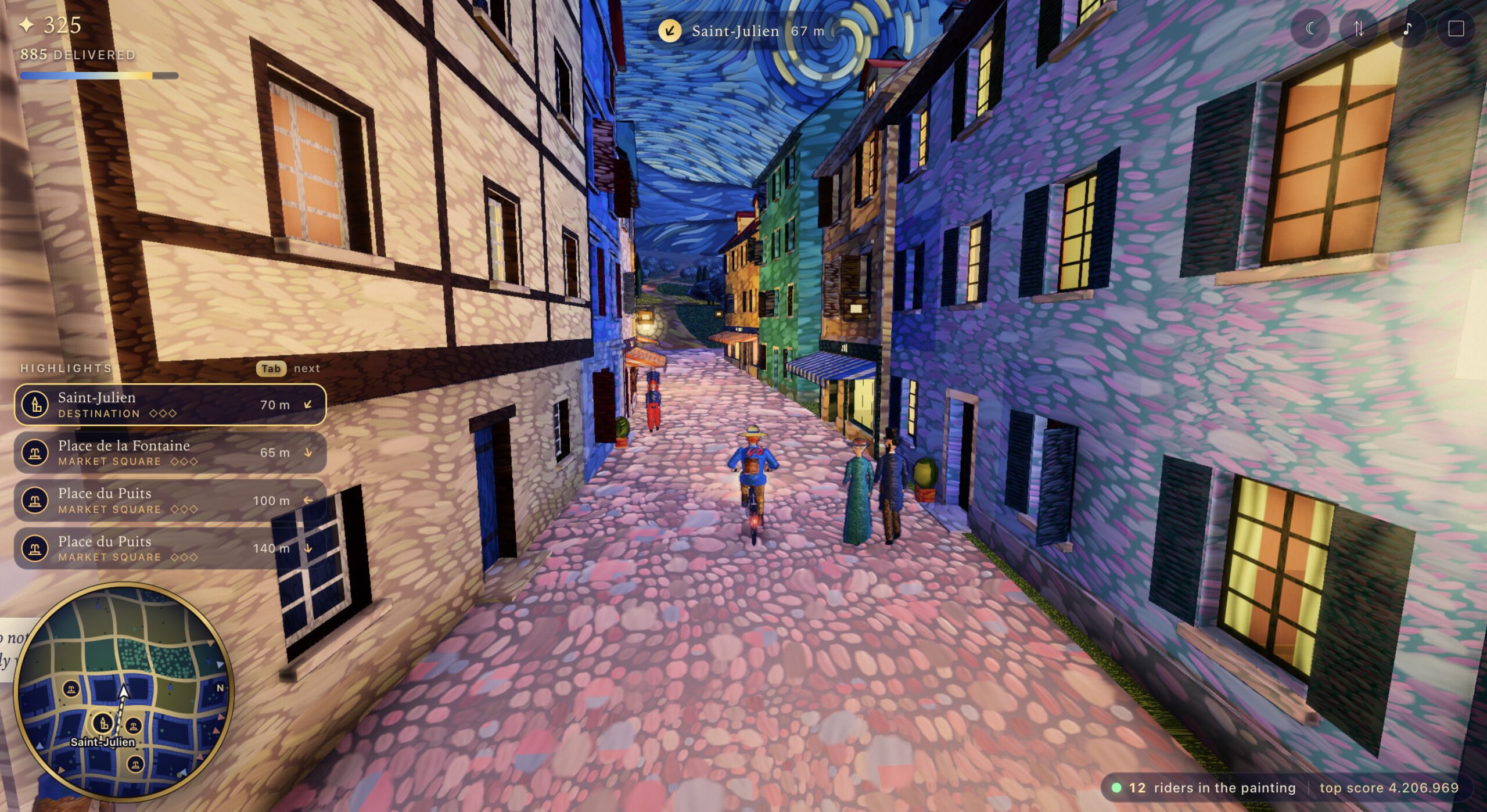
Im Browser mit dem Fahrrad durch van Goghs „Sternennacht“ fahren

1 Share

Ebby Amir hat mit „Starry Nightrider“ eine wirklich wunderschöne Website geschaffen, die einen Im Browser mit dem Fahrrad durch van Goghs „Sternennacht“ fahren lässt – und wenn ihr heute noch irgendwie produktiv sein müsst, klickt da um Gottes Willen nicht hin!

(via Maik)
Read the whole story
mkalus
2 days ago
reply
iPhone: 49.287476,-123.142136
Share this story
Delete
Next Page of Stories