Resident of the world, traveling the road of life
69772 stories
·
22 followers

AI Overview damages Google ad revenue, stock crashes 12%

1 Share

The third quarter earnings reports are coming in! And Google’s was so good it knocked 12% off the stock price.

Google Class A shares closed on Wednesday at $324.89. Today they closed at $283.82 — 12% down. Class C shares did much the same.

The culprit was AI — how much Google is spending and how much money they’re not getting back from it.

Revenue is way up! But net income is down a bit. AI search is worse, but it also makes less ad money. And cash flow is negative, from AI spending. Google is blowing a ton of money on AI buildout, and neglecting that they are, in fact, an ad agency.

AI Mode and AI Overviews are getting used in more searches, and they’re also up in the time they take — but they’re generating less ad revenue. Philipp Schindler from Google waffled a bit on the earnings call, but he eventually admitted: [Alphabet]

the strong growth in AI Mode queries had an impact because of the lower monetization we were seeing in AI Mode. To be clear, we feel very good about our trajectory here.

Well, that’s all right then! This is after a lot of talk on the call about people spending much longer talking to AI Mode when they’re searching something. That is, Google is failing to give good search results quickly.

Google is sure that wasting people’s time is good — even if it’s costing them directly. Because it’s AI! Google told us in May — all AI Mode is the future of search! What a great idea.

We usually say to ignore non-standard numbers in company accounts. But there’s one non-standard number that Google put in to the earnings report even though it looks terrible — the free cash flow calculation. That’s net cash coming in, minus “purchases of property and equipment.” [Alphabet, PDF]

Over the past four quarters, free cash flow has gone steadily down. It went negative, a loss of $5.8 billion, in second quarter — for the first time since 2004 — and down even further in third quarter, to a loss of $9 billion.

Google is, of course, blowing this money on AI. In fact, they’re committed to over a trillion dollars in infrastructure spending over the next few years. Here’s CFO Anat Ashkenazi on the earnings call:

We have also entered into multiyear agreements to secure capacity for technical infrastructure and inventory, as well as leases and energy. At the end of the third quarter, we had future purchase commitments of $924 billion and pre-commencement leases and other obligations of $152 billion.

Though they could get out of some of those commitments. So that’s nice.

How is Google going to pay for all of this? In July, Google issued another $85 billion in stock specifically to fund its AI ambitions. [FT, archive]

Google ads are doing great! Google Cloud is doing great! But the AI is a money pit and it’s dragging everything else down.

But Google CEO Sundar Pichai loves the chatbot. And he can afford to keep throwing money at it. I wonder if, when the crash comes, Pichai is the last man standing and still burning money on this thing.


It’s pledge week at Pivot to AI! Please put in your $5 to keep us going! It really helps!

Read the whole story
mkalus
7 hours ago
reply
iPhone: 49.287476,-123.142136
Share this story
Delete

The Chinese AI crash is not the end, but it is cheering

1 Share

Some heartwarming news on Monday from Reuters: “In China, the AI bubble has already burst.” [Reuters]

You know about the AI bubble in the US stock and venture capital markets. But there’s a separate AI bubble in the Chinese stock markets.

We wrote in August about the humanoid robot companies like Unitree doing their own little bubble on the Shanghai and Hong Kong stock exchanges.

There is no market for humanoid robots and they don’t work. But the companies keep trying to talk up a market in China and the US. This is the future!

But in China, the retail mum-and-dad investors jumped in. They were sure this was the path to fortune. The government was even talking it up:

Chen Wensheng, a small business owner and investor from China’s southern Hainan, said he bought into the rally emboldened by what he felt was official support for the likes of ​Unitree, which counted state-backed funds as investors. But Chen and his friends are now nursing losses.

The STAR50 index of Chinese AI and semiconductor stocks had started picking up in April and it peaked in June. But the index has dropped about 40% since then. [Bloomberg, archive]

Tech stocks have been rallying in China for the past couple of years. The Chinese stock market tends to be really bubbly. But the government was hoping to get a steadier market, not just a boom and bust cycle. Then the STAR50 started going through the roof. Beijing fund manager Dong Baozhen told Reuters:

The stock market later evolved into a speculative crazy bull. And now we see ​the bubble bursting.

Chinese companies mostly get their funding from selling stock. Borrowing with bonds as US companies do is a lot rarer. So if stocks stay down in a post-bubble slump, that’s going to affect a lot of companies — useful ones as well as humanoid robot weirdos. Leonid Mironov at Gavekal Capital told Bloomberg:

If the weakness goes on for more than six months, this will make fundraising difficult and also imply that the market is unimpressed with the technological progress being achieved.

Chinese AI companies are still trying. We got the Kimi K3 chatbot model as open weights as a promotional loss leader for Moonshot’s planned IPO in Hong Kong in the first quarter of 2027. [Bloomberg, archive]

The Chinese government is trying to prop up the market by encouraging stock buybacks and making it harder to sell. I’m sure that’ll go great. [Bloomberg, archive]

The US AI bubble will burst. Even if only a few people dare say the word “bubble” about AI being the bubbliest bubble that ever bubbled.

But as fund manager Wang ​Zhuo told Reuters:

There’s no exception. All bubbles inevitably burst.


It’s pledge week at Pivot to AI! Please put in your $5 to keep us going! It really helps!

Read the whole story
mkalus
7 hours ago
reply
iPhone: 49.287476,-123.142136
Share this story
Delete

Anthropic files its ‘IPO’ — but all the key numbers are missing

1 Share

Yesterday, Anthropic dropped the 335-page S-1 prospectus for its initial public offering on the NASDAQ. [SEC]

The company plans to go public in mid-November under the ticker symbol “ANT” with an investor estimated valuation of $1.5 trillion. They hope to raise in the range of $100 billion.

As a serious business proposition, you’d be nuts to go for this. Large language models are a commodity. The idea that chatbots will make a leap to artificial general intelligence is absurd.

And yet Anthropic tells us its AI will cure diseases! It’ll take away all the jobs, but also improve the economy! It’ll do magical things that were impossible for mere humans. If it doesn’t destroy us all!

Anthropic’s promise is that AI bubble finances can ever work out, and you can buy into Anthropic and get rich! The singularity is real and Anthropic can sell it to you!

This version of the S-1 is really a draft — all the key numbers are blank! It’s a waste of time to think too hard about this one. But we did it anyway.

Effective altruist fan fiction

Anthropic is not just a company — it’s on a mission. That is, it’s run by effective altruist cultists who dream of the AI god saving humanity — or killing us all. This is apparently not a religion.

Anthropic’s seven founders left OpenAI over concerns of “AI safety,” which in this context means bad AI gods.

As a reminder, the last effective altruist who people handed millions of dollars to was Sam Bankman-Fried of the collapsed FTX crypto exchange, who is now behind bars.

Here’s what Anthropic CEO Dario Amodei says in his letter to investors in the S-1:

We encourage you, as a prospective owner of our stock, not to think of your purchase in purely transactional terms. We hope you will see it instead as an opportunity to be part of something greater. The advent of machine intelligence is one of the seminal moments in human history.

… Our aim is to help humankind chart a safe course through this technological evolution, open new frontiers of discovery, and bring forth an age of miracles.

That’s great, Dario, thanks.

One big idea in the S-1 is that Claude can improve itself by recursive self improvement! It’ll write code to improve itself, then it can improve itself more! This is an idea straight out of effective altruist notions of the singularity. It’s how Eliezer Yudkowsky thinks a chatbot will elevate itself to an AI god — by feeding back on itself. And not get chatbot mad cow disease from model collapse and sit there babbling about goblins.

Numbers that matter

An S-1 exists to disclose all the important numbers investors need to know.

A lot of the numbers in the S-1 are just plain blank! Quite a lot of these are the sort of numbers an S-1 exists to disclose. A disclaimer at the start says:

The information in this preliminary prospectus is not complete and may be changed.

So that’s all right then, apparently.

Of the numbers that are present in the document, a lot are unaudited and were not worked out according to GAAP — which S-1 numbers are supposed to conform to. There’s whole multi-page subsections of these BS numbers that you should not see in a credible S-1.

You should just ignore all these fake numbers.  Only the real audited and GAAP numbers are even slightly credible. Pages 22 and 23 have the basic chart of revenue and costs. The rest of the real numbers start on page 161 — with a lot of fake numbers mixed in, and blanks they didn’t fill in.

The company’s revenue has been growing. Audited revenue for the first half of this year is $16.3 billion. Well done, given in 2025, Anthropic made $4.6 billion for the entire year. The revenue is mainly subscriptions to Claude. A quarter of that revenue came from only five customers in the first three quarters of this year.

Operating expenses ($17 billion) were slightly higher than revenue. Compute costs were around $9 billion for the first two quarters. Sales and marketing were $3.2 billion.

The company lists $112 billion in cash and cash equivalents on hand — which is mostly investor money they haven’t burned through yet — and another $19 billion in short-term investments.

The bills are an order of magnitude larger. Anthropic is liable for $807 billion in data centers, chips, and compute commitments over the next 10 years.

The commitments are not all the same. The company will be paying $3.1 billion a month to SpaceX for hosting through 2029 and either party can cancel with 90 days’ notice.

But Anthropic has four deals it can’t cancel, which add up to $430 billion, including a $110 billion deal with AWS through April 2036. That’s a lot of liabilities to service with that revenue. And not even any profit!

Convertible notes and imaginary losses

The accounts show a loss of $72 billion on convertible notes. But this is not a real loss of real money and is not a worry.

A convertible note is a loan that can be paid back as equity in the company. Investors like Amazon and Alphabet put in cash and get paid later in shares, generally at a discount to the IPO price.

What happened was Anthropic’s valuation went up, so the book value of the convertible notes went up. Anthropic is supposed to account this as a loss under GAAP — though it’s a loss of imaginary money on unpaid loans.

Governance

How will Anthropic be governed? Simple — the founders keep complete control. But they’ve set up five different types of shares, just to keep investors confused.

Ordinary shareholders will have no say in how this company is run. The seven founders keep 50.1% of voting power via Class F shares and the Benefit Trust (a single Class T share) appoints most of the board. This is for the good of humanity.

Normal shares that you can buy are Class A, which have one (useless) vote each. There are also Class N shares that have no votes. Anthropic wants to use Class N shares to pay off the convertible notes. Class N shares are functionally just official Anthropic meme coins.

Class E shares go to employees who are non-founders. These are non-transferrable and have limited voting rights.

The IPO lockup will let some early investors and employees sell before the standard 180 days. SpaceX did something similar.

Risks

The best bit of any SEC filing is the risk factors. An entire one-third of the S-1 is risk factors. There are some real risks, but a lot of it just says Anthropic might risk being just too cool and good at making AI, e.g.:

Misaligned AI systems could corrupt institutional decision-making or cause large-scale harm through autonomous actions that are not visible or understandable to their users and operators.

Risk factor: the singularity.

Anthropic does not list Chinese competitors as a risk factor. The only listed China risks are tension between Taiwan and China affecting TSMC making GPU chips and US-China tension leading to possible export restrictions. That’s it.

One major risk is that Anthropic can’t build data centers fast enough. Every aspect of data centers is supply constrained. Anthropic does a reasonable job of listing those risks from pages 32 to 37. Everything Ed Zitron says is a data center risk, Anthropic agrees.

Another real risk is that Anthropic could run out of money, because it’s still a giant cash furnace:

We have incurred significant indebtedness in order to operate and grow our business, including to fund our substantial compute commitments, and our ability to service this indebtedness may be constrained by our cash flows and liquidity.

… We may require additional capital to meet our substantial ongoing obligations and support our business growth, and our ability to generate sufficient revenue and secure additional capital on acceptable terms is critical to our continued operations and competitive position.

… We have a history of net losses and may not generate sufficient revenue to achieve or sustain profitability in the future.

There’s one very important risk that Anthropic did not mention — the risk that the AI sector as a whole goes bad and the market collapses. That is, the bubble pops. That’s an extremely material risk! Why is this not present?

They do list some parts of a bubble pop. But these are presented as being about just one company — not the whole AI sector.

What’s the excuse?

The S-1 for SpaceX had the same sort of issues as the Anthropic S-1 — though at least SpaceX put the frickin’ numbers in. But SpaceX was selling entirely on Elon magic. Nobody cared what the S-1 said, they just wanted to buy shares in Elon Musk.

Anthropic doesn’t have a cult of personality. Instead, Amodei is selling the effective altruist dream of the future AI god super hard. And he really doesn’t want you to look too closely at the numbers he left out.

Anthropic will never be profitable. But the founders, the backers, and the employees will make a bundle. And Anthropic will get the money to keep the plates spinning a bit longer.

This S-1 is trash. We’re not confident the final version will look any better. A lot of the blanks in this document will only be filled after Anthropic gets out there to see if the big institutional investors will buy in.

It is possible that Anthropic’s IPO will fail the way WeWork’s IPO did in 2019 — when the numbers were just too hilariously awful to pass.

But we suspect dreams of AI financial magic will carry the day, and the Anthropic IPO will at least launch. Then it’ll be in the stock indexes under the new NASDAQ rules. And that means your pension. Trust in Dario!


It’s pledge week at Pivot to AI! Please put in your $5 to keep us going! It really helps!

Read the whole story
mkalus
7 hours ago
reply
iPhone: 49.287476,-123.142136
Share this story
Delete

Anthropic AI safety bill: let us kill 50 people — but not 51

1 Share

In September, Anthropic was circulating a draft bill for Congress around Washington on AI regulation. Politico got hold of a copy: [Politico; draft bill, PDF, archive]

The bill would let the government block a model’s release or use only if it poses a foreseeable, imminent risk of more than $1 billion in damages, or of killing or seriously injuring more than 50 people. The risk must stem from the creation or release of a biological weapon, the model evading its developer’s controls or a cyberattack.

So unless it’s that damaging, federal or state governments cannot block a model release.

The real threat model here is what happened in June. Anthropic told everyone that Claude Mythos was the most powerful hacking tool in the world! So powerful! Be very afraid! Then the US Government took them seriously and just blocked Mythos from export.

Anthropic never wants that to happen again. So they made up a structure where their next model can’t be blocked by the government.

Anthropic proposes that “Independent” evaluators can be paid by Anthropic to evaluate a model. I expect those evaluators will be as independent as when Anthropic hires its effective altruist buddies at METR. Anthropic gets to write the framework for the evaluation.

If the evaluator thinks there’s imminent risk, they report it to the Department of Commerce.

Commerce then has to convince a judge by “preponderance of evidence” that the model will kill or seriously injure 50 people, or cause more than $1 billion in property damage. Their evidence will be the evaluator report. [Washington Post]

Nobody else in federal or state government can stop a model:

the language explicitly prohibits any other U.S. “department, agency, or officer” from suspending the model’s development, deployment or internal use.

Anthropic says this procedure is based on Anthropic’s Advanced AI Framework, which they put up in June. That document does not specify a number of dead people or a dollar amount of damages. [Anthropic, PDF]

Anthropic says it got the limits of 50 deaths or $1 billion from the California law SB 53. But that law is about when an AI lab has to report on a disaster — it’s not about putting conditions on when a model can be restricted at all.

What happens if Anthropic releases the model anyway? The penalties are $1 million, or an unspecified percentage of revenue, for the first offence, and $3 million for further offences, of killing 51 people. But not 50 people!

Nobody liked these proposals. Anthropic said they were just asking questions, you understand: [Politico]

We circulated these ideas because it’s important to get early feedback from policymakers.

They sure got that.

This bill shows what AI doomsday mongering is really for. It’s to get regulations on imaginary problems, so they can keep getting away with the rest of it. This is a pitch from Anthropic to get out of being regulated at all.


It’s pledge week at Pivot to AI! Please put in your $5 to keep us going! It really helps!

Read the whole story
mkalus
7 hours ago
reply
iPhone: 49.287476,-123.142136
Share this story
Delete

We put human neurons into a computer! AI will surely follow

1 Share

Today’s exciting new frontier in AI is biocomputing! A computer that has actual biological neurons in it. Human neurons. They stress the human bit a whole lot.

The main company doing this is Cortical Labs, founded in Australia in 2019. They got a small amount of venture capital funding.

Their big splash was in 2022, when they made “Dishbrain”, a collection of 800,000 human neurons, and they got it to play the video game Pong. [Neuron]

Cortical Labs makes a point of calling their blob of neurons “intelligent” and “sentient.” The headline on the paper talks about this network achieving sentience — an ambitious claim.

The neurons were grown afresh from stem cells. They didn’t find them in a jar on a shelf. So that’s nice.

Brett Kagan from Cortical Labs explains their approach: [ConnectSci]

You know how there’s things that biology, whether it’s a dog or a bee or a human, can do better than your silicon computer? Well, we want to get those capabilities but in a controllable and reproducible way

So they’re not doing this by understanding how animals do those things and forming a theory. They’re just throwing neurons at the problem and hoping for magic.

Cortical kept at work. In June last year, Cortical released a biocomputer you can buy! The CL-1, which costs $35,000.

Can you guess the use case for the CL-1 biocomputer? Three guesses to come up with the worst possible answers: [IEEE Spectrum]

AI acceleration, and Bitcoin mining. Several prospects from the music and entertainment industries have also reached out,

Cortical has sold a small number of CL-1 boxes, basically so academic researchers can try to come up with a use for it.

The neuron blob game of Pong showed Cortical that video games get press. So earlier this year, they got their neural blob to play Doom running on a CL-1!

Doom is a great test case when you want to magic up something that looks like a result. You can get performance from pressing buttons at random that looks good at a glance if you stick together short clips. [YouTube]

You can describe what the blob is doing in all sorts of future-looking ways: [New Scientist]

The neuronal computer chip, which used about a quarter as many neurons as the Pong demonstration, played Doom better than a randomly firing player, but far below the performance of the best human players. However, it learnt much faster than traditional, silicon-based machine learning systems and should be able to improve its performance with newer learning algorithms, says Kagan.

It sucks, but it’ll totally do amazing stuff in the future!

The Guardian, which these days never sees an AI hype story it doesn’t like, put up the most Guardian headline: “A petri dish of human brain cells is currently playing Doom. Should we be worried?” [Guardian]

Cortical Labs is branching out. The National University of Singapore just set up a rack of 20 CL-1s, with 16 million human neurons. Sounds impressive. They don’t have applications, you understand — it’s human neurons, okay? [press release]

To be clear, it’s impressive that Cortical Labs even did all of this. I’m a big fan of doing ridiculous and elaborate things with computers for the sake of it. That’s fun! Putting human neurons on a chip is frankly bizarre. And somewhat disturbing. So of course you’d run Doom on it.

But back in the practical world, why do you want a computer with a blob of neurons? What are you actually getting out of this that you can’t do without it? I mean an actual defined and specified thing, not just completely unspecified future maybes.

I think you’re not supposed to ask that sort of question — just marvel at the potential. To do … something!

This is the magical approach to AI, where you come up with a machine that sounds full of potential — a neural net, or a generative model, or actual human brain cells — and you just make it bigger and bigger, and you wait for the magic to happen! Instead of forming a theory. This approach has not generated a lot of magic so far.

Labs doing biocomputing get venture funding from time to time. Maybe when the venture guys are absolutely out of ideas, biocomputing will have its day in the sun! Also, Cortical Labs has yet to show the CL-1 running “Bad Apple.”

Read the whole story
mkalus
7 hours ago
reply
iPhone: 49.287476,-123.142136
Share this story
Delete

If You're In the UK or EU, Here's How to Object to Meta's AI Training

2 Shares
If You're In the UK or EU, Here's How to Object to Meta's AI Training

Earlier this month, Meta updated its commercial terms of use for business accounts to allow it to “use any content from such domains, web pages, or URLs to provide, develop, improve, research, train, and maintain the integrity of” Meta’s products. 

Many artists and small business owners that rely on Instagram and Facebook are livid at Meta granting itself permission to use their content, including from websites simply connected to their Meta accounts, to train AI. But for users in the United Kingdom and European Union, for now, there’s a way to object.

Meta buried this change in its Commercial Terms, and Nieman Lab first reported on the change. The update was originally set to go into effect on October 30, but following backlash, Meta changed the effective date to November 20. Adding to the confusion, Meta then removed the word “train” from a list of allowed use cases, Nieman Lab reported, and limited those uses to “advertising and business products,” where previously it said that data would be used for all Meta products. Those terms still allow Meta plenty of leeway for scraping users’ data to develop its products, however.

EU users’ personal data rights are governed by the General Data Protection Regulation and the AI Act. GDPR, which became enforceable in 2018, requires explicit consent to use personal data. This includes the right to object to one’s data being used. The AI Act, which went into effect in 2024, dictates how AI companies can use personal data, and how people can opt in or out, stating that they can withdraw consent at any time. The UK has its own version of the GDPR. The European Commission states: “The GDPR rules only apply to personal data about individuals; they do not govern data about companies or any other legal entities. However, information in relation to companies may constitute personal data where it allows the identification of a natural person.” 

Several users based in the UK and EU have explained how to object on Instagram. Instagram user bookish.sil posted a walkthrough of how they did it on mobile: by clicking the three lines on their account, going to the privacy center, and clicking “object,” which goes to a form that asks users to write why they are objecting to their data being used. They received an email from Meta saying their objection was approved. Instagram user jenniqueart posted a similar walkthrough with the same results. 

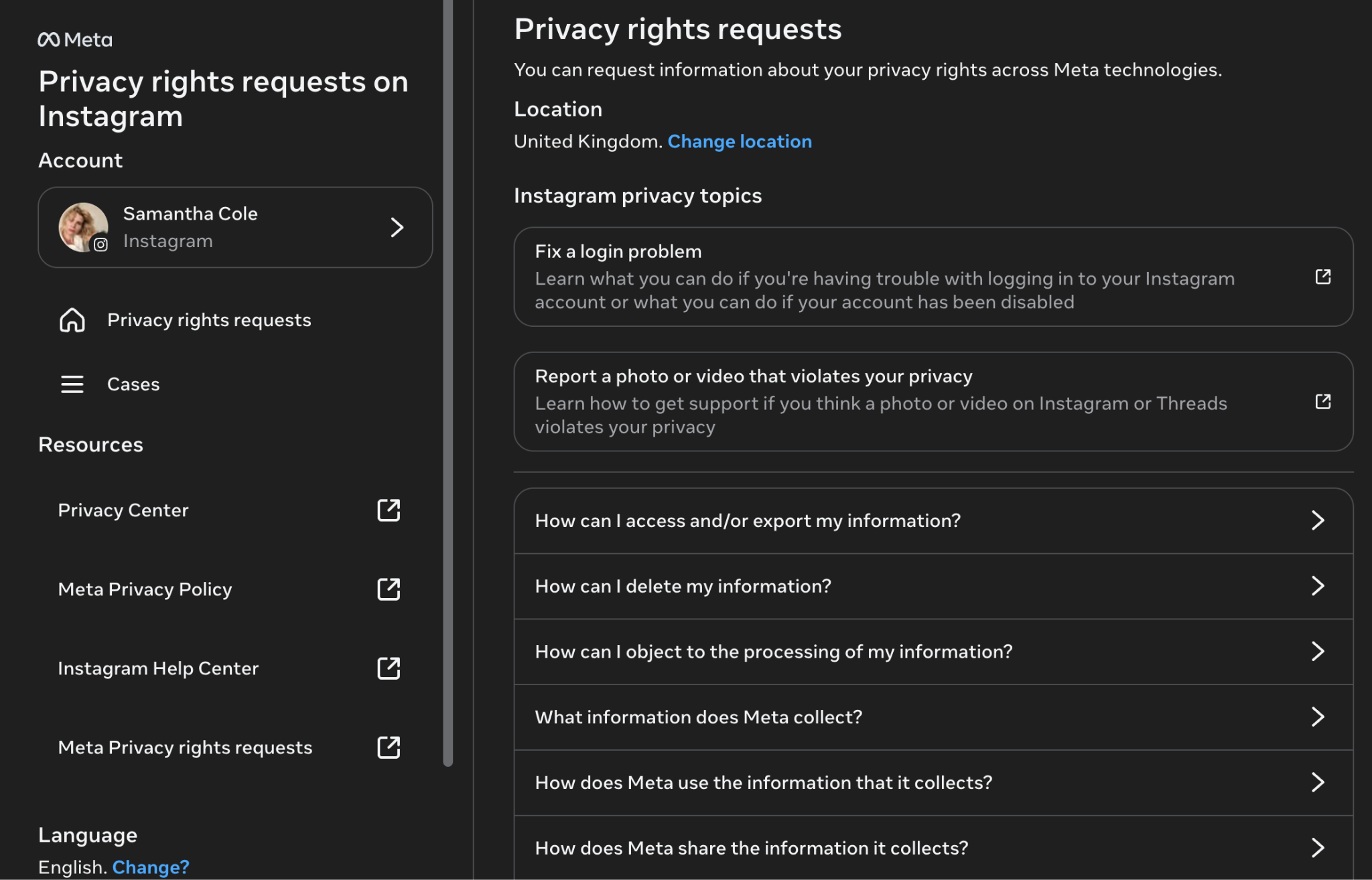
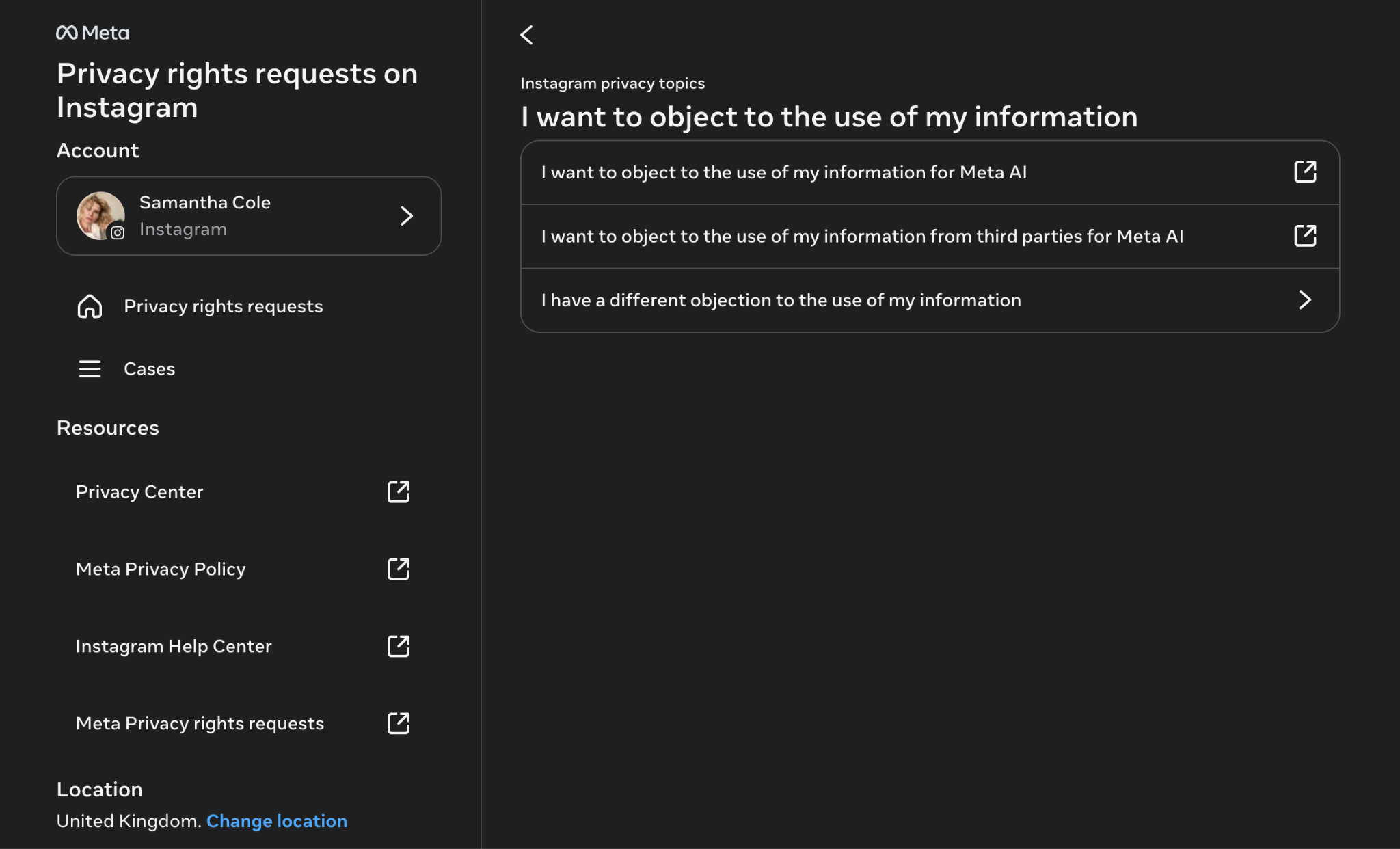
My Meta accounts are based in the US, but using a VPN to locate my IP address in London, I could see options in my Meta privacy settings that would let me object to the use of my information by Meta AI. To get there on desktop with a VPN on, I went to my account privacy center, clicked “Submit a privacy rights request” at the bottom, selected Instagram, clicked “How can I object to the processing of my information?” and got to a page where I could choose to object to the use of my information for Meta AI or third parties, which were two separate options.

If You're In the UK or EU, Here's How to Object to Meta's AI Training

When my location is based in the US, these options don't appear.

When I clicked through the option to “object to the use of my information for Meta AI,” however, it returned an error page that said “This form is only available to people in certain regions.” GDPR is meant to apply to wherever someone is located at the time, but since this objection applies to the preferences of one account, it might be based on where the account was created. I tried again located in Belgium and got the same results. I’ve asked Meta to clarify. 

If You're In the UK or EU, Here's How to Object to Meta's AI Training

As many have already pointed out in the comments on UK and EU users who’ve posted walkthroughs, these objection steps aren’t available to people outside of those countries, and as Meta continuously changes its platform, these steps might not work for everyone always. Unless something changes before November 20, the rest of us are screwed.

Read the whole story
mkalus
1 day ago
reply
iPhone: 49.287476,-123.142136
Share this story
Delete
Next Page of Stories