Resident of the world, traveling the road of life
69832 stories
·
23 followers

The Best Coffee Table Books for Design Enthusiasts

1 Share

The Best Coffee Table Books for Design Enthusiasts

A great coffee table book does more than look good sitting on a stack. It invites you to pick it up, lose yourself in its pages, and discover something you didn’t know before. Whether it’s an intimate look at a designer’s creative process, an architectural survey, or a collection of extraordinary photographs, the best examples offer plenty to explore beyond their covers.

Of course, presentation matters, too. Beautiful printing, thoughtful layouts, and striking imagery can turn a book into a design object in its own right. For this year’s selection, we’ve gathered titles that balance visual appeal with compelling content, spanning architecture, interiors, art, photography, and creative culture. They’re books worth giving, displaying, and returning to long after the holidays.

Hardcover book titled “Achille Salvagni” by Glenn Adamson, a standout among the best coffee table books, featuring a blue cover with an image of a yellow illuminated sculpture.

Photography courtesy of Assouline

Achille by Glenn Adamson

Italian designer Achille Salvagni has a way of making furniture feel like sculpture. Written by design historian Glenn Adamson, this richly illustrated monograph explores Salvagni’s distinctive approach to furniture, lighting, and decorative objects, where classical references meet contemporary forms. Across 336 pages and 246 illustrations, readers get a closer look at his extraordinary use of materials, from bronze and onyx to marble and rare woods.

Achille is available at assouline.com for $120.

Coffee table book titled “Villa Treville” featuring a cover of colorful, patterned decorative tiles, among the best coffee table books.

Photography courtesy of Assouline

Villa Treville Positano by Nicky Swallow and Govind Friedland

Perched above the Amalfi Coast, Villa Treville was once the private retreat of legendary Italian director Franco Zeffirelli, whose theatrical sensibility shaped the property’s richly layered interiors. Assouline’s Villa Treville Positano takes readers inside the historic estate, exploring its architecture, lush gardens, and eclectic collection of antiques and decorative objects. With more than 200 illustrations and a textured cover inspired by the villa’s patterned ceramic tiles, the book captures the property’s distinctive character inside and out.

Villa Treville Positano is available at shopbop.com for $120.

Book cover for the best coffee table book “Mid-Century Modern Designers” by Dominic Bradbury, published by Phaidon, featuring an abstract, colorful graphic design.

Photography courtesy of Phaidon

Mid-Century Modern Designers by Dominic Bradbury

From Charles and Ray Eames to Florence Knoll, the designers who shaped the midcentury movement continue to influence how we live today. Published by Phaidon, this richly illustrated hardcover profiles 300 influential figures, including lesser-known talents whose work deserves a closer look. Spanning furniture, ceramics, glassware, and textiles, it’s an absorbing gift for anyone curious about the history of modern design.

Mid-Century Modern Designers is available at hawkinsnewyork.com for $90.

Hardcover book titled “Après Ski: The Scene, The Style, The Menu” by Erin Isakov, a best coffee table book featuring people relaxing in lounge chairs on a snowy mountain.

Photography courtesy of Artisan Books

Après Ski by Erin Isakov

From cozy mountain chalets to the rituals that follow a day on the slopes, Après Ski captures the atmosphere of alpine living. Blending interiors, travel, food, and ski culture, the book celebrates a lifestyle that’s as much about gathering around the fire as it is about skiing. A fitting gift for anyone drawn to mountain retreats, whether or not they ever hit the slopes.

Après Ski is available at twowebster.com for $40.

Porsche: The Impossible Collection by Assouline, a standout among the best coffee table books, featuring a light blue and orange cover with a vintage race car graphic.

Photography courtesy of Assouline

Porsche: The Impossible Collection by A.J. Baime

Porsche enthusiasts will need to clear some serious coffee table space for this oversized tribute to the legendary automaker. Written by A.J. Baime in collaboration with Porsche, the 224-page volume explores 100 defining moments in the brand’s history, from the original 356 to its racing triumphs, design innovations, and collaborations with artists like Daniel Arsham. Archival photography, design sketches, and vintage advertisements reveal Porsche’s influence beyond the automotive world. Handcrafted in Italy, the book comes housed in a padded clamshell featuring a recessed metal image of the iconic Porsche 917K.

Porsche: The Impossible Collection is available at assouline.com for $1,400.

Book cover titled Wild Flowers of North America with botanical illustrations by Mary Vaux Walcott, making it one of the best coffee table books.

Photography courtesy of Prestel Publishing

Wild Flowers of North America by Pamela Henson with Illustrations by Mary Vaux Walcott

Long before botanical photography became commonplace, artist and naturalist Mary Vaux Walcott spent countless hours outdoors capturing the delicate details of North America’s wildflowers in watercolor. Originally published in 1925, her remarkable illustrations are brought together in this oversized volume featuring more than 250 botanical studies. From the subtle variations in petal color to the intricate shapes of leaves and stems, each painting reveals Walcott’s extraordinary eye for detail. Published in association with the Smithsonian Institution, it’s a beautiful intersection of art, science, and nature that deserves a place on the coffee table.

Wild Flowers of North America is available at mcgeeandco.com for $72.

MORE GIFT INSPIRATION

Still shopping? Explore Design Milk’s Complete 2026 Holiday Gift Guide for more thoughtful finds for everyone on your list.

The book “Cahiers d’Art: A Century of Modernism,” one of the best coffee table books, stands on a white mantel next to a wall-mounted sconce.

Photography courtesy of Maison Plage

Cahiers d’Art: A Century of Modernism by Daniel Birnbaum and Cécile Debray

For 100 years, Cahiers d’Art has helped shape the conversation around modern art, championing artists and ideas that challenged convention. Published to celebrate the centennial of the influential Parisian art journal, gallery, and publishing house, A Century of Modernism traces its extraordinary history through archival material, artwork, and contributions from figures including Pablo Picasso, Henri Matisse, and Marcel Duchamp. With approximately 200 illustrations and a striking graphic cover, the book traces the connections between art, design, and publishing.

Cahiers d’Art: A Century of Modernism is available at maisonplage.com for $85.

A hardcover copy of the book “The New Yorker: From Cover to Cover” with an illustrated cover, making it one of the best coffee table books.

Photography courtesy of Rizzoli

The New Yorker: From Cover to Cover by Françoise Mouly

For a century, The New Yorker has turned its covers into miniature works of art, capturing everything from everyday New York life to defining cultural moments. Edited by longtime art editor Françoise Mouly, with an introduction by editor-in-chief David Remnick, The New Yorker: From Cover to Cover celebrates that visual legacy through hundreds of illustrations by artists including Saul Steinberg, Roz Chast, Chris Ware, and David Hockney. Spanning 100 years of creativity, the 336-page collection reveals how illustration has shaped the magazine’s distinctive visual identity.

The New Yorker: From Cover to Cover is available at barnesandnoble.com for $75.

The cover of this best coffee table book, The Art of Korean Cooking by Onjium, features a shallow dish with flower petals floating in liquid next to a flowering branch.

Photography courtesy of Thames & Hudson

The Art of Korean Cooking by Onjium

Food, art, and cultural heritage come together in The Art of Korean Cooking, a visually rich exploration of Korea’s culinary traditions. Created by Onjium, a Seoul-based cultural research institute and Michelin-starred restaurant, the book pairs more than 80 recipes with essays exploring the history, ingredients, and techniques behind Korean cuisine. Beautifully composed photography captures everything from seasonal ingredients to finished dishes, revealing the artistry behind each preparation. With 200 illustrations, the 256-page hardcover is as much a celebration of Korean culture and craftsmanship as it is a cookbook.

The Art of Korean Cooking is available at thamesandhudson.com for $47.

A black coffee table book titled “FOOTBALL THE ULTIMATE BOOK,” one of the best coffee table books, featuring an embroidered football graphic on the cover.

Photography courtesy of teNeues

Football: The Ultimate Book by Alex von Kuczkowski

Not all coffee table books must be about art, architecture, or interiors. Football: The Ultimate Book celebrates America’s favorite sport through striking photography and stories spanning legendary players, iconic stadiums, historic games, and unforgettable Super Bowl moments. This special edition features a handsome black leather-bound cover that gives the 224-page book a sophisticated presence on any coffee table. It’s a winning gift for football fans who appreciate good design.

Football: The Ultimate Book is available at crateandbarrel.com for $200.

Book cover titled “Let’s DANCE!” featuring a vintage photograph of a crowded dance floor, a standout among the best coffee table books.

Photography courtesy of Taschen

LIFE. Let’s Dance by Lyndsey Winship

From Fred Astaire’s effortless elegance to the exuberance of 1960s dance floors, LIFE. Let’s Dance captures the joy of movement through the lens of Life magazine’s legendary photographers. Published by Taschen, the collection brings together more than 200 archival images, many previously unseen, documenting everything from ballet and ballroom to flamenco and the twist. Spanning the late 1930s through the early 1970s, the photographs are accompanied by original magazine covers and commentary from dance critic Lyndsey Winship, offering a lively look at how dance reflects culture, community, and self-expression.

LIFE. Let’s Dance is available at taschen.com for $50.

Hands holding the bright pink book “André Saraiva: A Graffiti Life,” one of the best coffee table books, against a colorful mural background.

Photography courtesy of Wynwood Walls

André Saraiva: Graffiti Life by André Saraiva

From the streets of Paris to collaborations with Chanel and Louis Vuitton, André Saraiva has built a career around his playful, instantly recognizable graffiti character, Mr. A. Published by Rizzoli, Graffiti Life explores the artist’s creative world through painting, photography, graphic design, fashion, and more. The 320-page hardcover is as expressive as its subject, featuring a vibrant cloth cover with foil lettering and seven pop-ups designed by Saraiva himself. It’s a colorful, interactive celebration of an artist who has never been one to stay within the lines.

André Saraiva: Graffiti Life is available at shop.thewynwoodwalls.com for $85.

A beige coffee table photo album titled “Life: Celebrating All the Precious Moments in Life” by Printworks, a staple among the best coffee table books.

Photography courtesy of Printworks

Life Photo Book by Printworks

The most meaningful coffee table book might be the one you fill yourself. Designed to look like a traditional art book, Printworks’ Life Photo Book features a minimalist beige cloth cover with understated white typography. Inside, 40 sheets of high-quality photo paper offer space to preserve favorite memories, from everyday moments to once-in-a-lifetime adventures. Its expandable binding accommodates photographs as they’re added, transforming a beautifully designed object into a personal keepsake.

The Life Photo Book is available at printworksmarket.com for $39.

A maroon Phaidon book titled “Designed for Life” featuring yellow text and line-art silhouettes of various objects, making it one of the best coffee table books.

Photography courtesy of Phaidon

Designed for Life: The World’s Best Product Designers by Phaidon Editors

What does contemporary product design look like around the world? Phaidon’s Designed for Life offers a fascinating look at 100 designers pushing the boundaries of furniture, lighting, everyday objects, and more. From established names like Faye Toogood and Sabine Marcelis to emerging talents, the 304-page hardcover explores the materials, techniques, and ideas shaping design today. With 500 illustrations, it’s an inspiring addition to any design enthusiast’s coffee table.

Designed for Life: The World’s Best Product Designers is available at store.hermanmiller.com for $70.

Taschen book titled “Fujimoto: Complete Works 1994-Today” by Philip Jodidio, a standout among the best coffee table books.

Photography courtesy of Taschen

Fujimoto. Complete Works 1994–Today by Philip Jodidio

Japanese architect Sou Fujimoto has spent his career challenging the boundaries between architecture and nature, creating structures that blur the lines between indoors and out. Published by Taschen, Fujimoto. Complete Works 1994–Today explores three decades of his experimental approach through projects including London’s Serpentine Gallery Pavilion, L’Arbre Blanc in Montpellier, and the Grand Ring at Expo 2025 Osaka. Filled with architectural photography, drawings, and sketches, the oversized, 464-page volume documents the evolution of one of contemporary architecture’s most inventive minds.

Fujimoto. Complete Works 1994–Today is available for preorder at taschen.com for $200.

Hardcover book titled “Grace: The American Vogue Years,” a best coffee table book featuring a stylized illustration of a woman with long red hair on a red cover.

Photography courtesy of Phaidon

Grace: The American Vogue Years by Grace Coddington

Few people have shaped fashion imagery quite like Grace Coddington. In Grace: The American Vogue Years, the legendary creative director revisits some of her most memorable editorials from 2002 to 2016, including collaborations with photographers Annie Leibovitz, Steven Meisel, and Tim Walker. More than 350 photographs showcase Coddington’s imaginative approach to fashion storytelling, while her behind-the-scenes commentary reveals how the elaborate shoots came together. This updated edition offers a fascinating look at the creative vision behind some of Vogue’s most iconic images.

Grace: The American Vogue Years is available at phaidon.com for $60.

Blue cookbook titled Levain Bakery: A Story of Friendship, Community, and Cookies, featuring a gold line drawing of a bakery storefront, making it one of the best coffee table books.

Photography courtesy of Crate & Barrel

Levain Bakery: A Story of Friendship, Community, and Cookies by Pam Weekes and Connie McDonald

There’s more to Levain Bakery than its famously oversized cookies. Celebrating 30 years of the beloved New York institution, this charming book traces the bakery’s beginnings, the friendship behind its success, and the community it’s built along the way. Whimsical illustrations by artist Libby VanderPloeg bring its story to life, capturing the warmth of neighborhood bakeries and the joy of sharing something homemade. It’s a sweet addition to any coffee table, especially for anyone who loves New York, baking, or both.

Levain Bakery: A Story of Friendship, Community, and Cookies is available at crateandbarrel.com for $45.

The book “Defining Style: The Book of Interior Design” by Joan Barzilay Freund, one of the best coffee table books, features a colorful radial pattern cover and the Phaidon logo.

Photography courtesy of Phaidon

Defining Style: The Book of Interior Design by Joan Barzilay Freund

From maximalist spaces bursting with color to minimalist interiors that celebrate simplicity, Defining Style explores the many ways we make a space our own. Written by Joan Barzilay Freund, the book examines 25 distinct design styles through 150 residential interiors by designers, including spaces by Studio Shamshiri, Laura Gonzalez, and Vincenzo De Cotiis, as well as artist Móyòsóré Martins’ studio. With 260 illustrations and a vibrant, geometric cover, it’s as visually engaging on the coffee table as the spaces featured inside.

Defining Style: The Book of Interior Design is available at phaidon.com for $70.

Coffee table book titled Art in the 20th and 21st Centuries featuring a pixelated portrait of Marilyn Monroe on the cover.

Photography courtesy of Assouline

Art Game Book by David Rosenberg

Art history gets a playful makeover in Assouline’s Art Game Book, which brings an interactive twist to the traditional coffee table book. Through quizzes, puzzles, games, and essays, author David Rosenberg takes readers from Cubism and Dada to Pop Art and contemporary digital art, featuring icons like Warhol, Basquiat, and Dalí along the way. Newly updated for 2026, the oversized, canvas-bound hardcover makes learning about art feel more like play than homework.

The Art Game Book is available at assouline.com for $120.

Hardcover book titled “Rainbow Dreams: Color and Light in Contemporary Art” by Olga Rei and Valentine Uhovski, a vibrant addition to the best coffee table books with a gradient rainbow cover.

Photography courtesy of Phaidon

Rainbow Dreams: Color and Light in Contemporary Art by Olga Rei and Valentine Uhovski

Color takes center stage in Rainbow Dreams, a vibrant exploration of how contemporary artists use the full spectrum to transform their work. Featuring more than 200 artworks by over 100 artists, including Yayoi Kusama, Takashi Murakami, Olafur Eliasson, and Ugo Rondinone, the book spans painting, sculpture, photography, and immersive installations. The 256-page hardcover is a colorful design object in its own right, with a seamless rainbow gradient wrapping around the cover and edges. It’s a joyful addition to any art lover’s collection.

Rainbow Dreams: Color and Light in Contemporary Art is available at phaidon.com for $40.

Editorial Transparency: This article was developed with the assistance of AI tools, which may have been used for research, outlining, editing, or copy refinement. Reporting, fact-checking, and editorial decisions were made by the Design Milk editorial team.


Read the whole story
mkalus
4 hours ago
reply
iPhone: 49.287476,-123.142136
Share this story
Delete

Carsten Höller’s Monumental Slides Bring Play to Mexico City

1 Share

Carsten Höller’s Monumental Slides Bring Play to Mexico City

Leaving the office through a 125-foot spiral slide might sound like something out of a dream, but it’s becoming a reality in Mexico City. Four monumental slides by artist Carsten Höller are the centerpiece of a major expansion at Antara, a mixed-use development designed by architecture firm Sordo Madaleno. The interactive installations bring an unexpected element of play to a destination that combines retail, hospitality, workplaces, and contemporary art.

A metal Carsten Höller spiral slide attached to a modern glass skyscraper.

Photography by Fernando Farfan

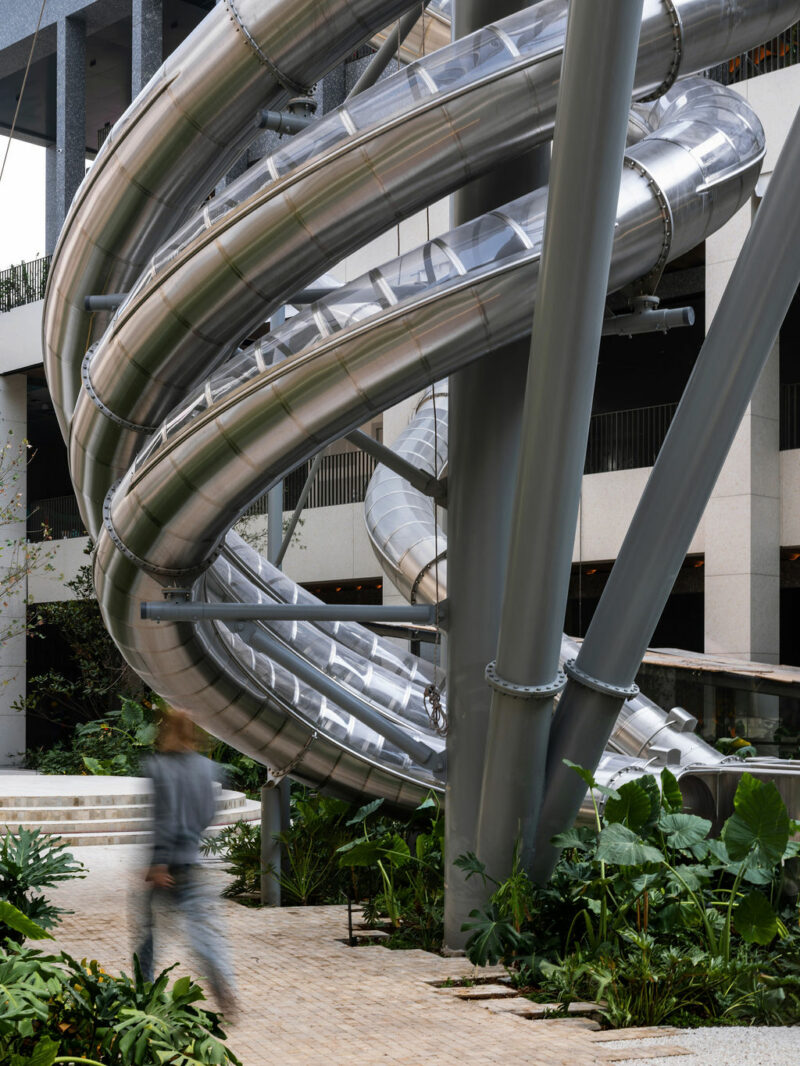
Titled Mexico City Slides (2026), the permanent installation is Höller’s largest slide project to date. The four spiraling structures range from 39 to 125 feet in height, with lengths extending from approximately 102 to 295 feet. Rather than functioning as standalone sculptures, they are integrated into the architecture, connecting different parts of the development while giving visitors a new way to move between them.

The slides descend from retail and dining spaces, offices occupied by Google, and the future Rosewood Mexico City hotel, converging at a common landing area. Their arrangement transforms what might otherwise be separate destinations into a shared experience, bringing people from different parts of the complex together in an unexpected way.

A person looks up at a series of large, interconnected metal Carsten Höller slides in Mexico City.

Photography by Fernando Farfan

“People sliding from a hotel, from offices, from restaurants, and from an art center are brought together in the air and land next to each other,” Höller explains. “They share the experience of being taken out of their usual form of being, into the unknown, dreamlike territory of simultaneous joy and fear.”

The installation is part of the latest chapter for Antara, which opened in 2006 on a former industrial site in Mexico City’s Colonia Granada neighborhood. Developed by SOMA and designed by Sordo Madaleno, the original project introduced an open-air retail concept that has since evolved into a larger destination for shopping, dining, and cultural programming.

A low-angle view of a metallic, tubular Carsten Höller sculpture spiraling upward against a clear sky, with a modern glass building visible in the background.

Photography by Fernando Farfan

Twenty years later, the expansion places greater emphasis on the spaces between buildings and the ways visitors move through them. A new 26,000-square-foot public garden, landscaped pathways, and stepped terraces connect the development’s different components, creating places to gather beyond its commercial spaces.

Art plays a central role in that approach. SOMA’s nonprofit contemporary art foundation, Arte Abierto, will open a new location within Antara, Arte Abierto Polanco, in December 2026. Alongside Höller’s installation, the venue will present Now What (2026), an exhibition by Danish artist collective Superflex that examines the relationship between built environments and natural forces. Combining architecture, sculpture, and text, the exhibition explores how human systems of design and organization influence our relationship with the surrounding world.

A large, spiraling Carsten Höller metal tube slide in an outdoor courtyard with a blurred person walking nearby.

Photography by Fernando Farfan

For SOMA president Javier Sordo Madaleno De Haro, the investment in publicly accessible space is fundamental to the development’s long-term value. “I’ve realized that the most valuable thing is not the capital gain of a building itself, but the value it brings to its surroundings,” he says. “Art and public space are how we create that value.”

The expansion also introduces more than 80 new retail brands and concepts, bringing Antara’s total to 260. A forthcoming 43-story tower will house Rosewood Mexico City, with 163 guest rooms and suites, restaurants, a spa, and an outdoor pool deck, along with office space for international companies.

A curved, tubular slide by Carsten Höller attached to the exterior of a glass skyscraper.

Photography by Fernando Farfan

Yet the most distinctive addition may be the one that challenges how people typically navigate a building. By incorporating Höller’s slides directly into the architecture, Sordo Madaleno and SOMA have made art part of the development’s circulation, turning movement between spaces into an experience in its own right.

The new public spaces and gardens are now open, while Mexico City Slides and the Superflex exhibition are scheduled to open in December. Access to the slides will be free, offering visitors a decidedly unconventional way to experience the evolving development.

Three parallel metal Carsten Höller playground slides descending from a multi-story tubular structure.

Photography by Fernando Farfan

Editorial Transparency: This article was developed with the assistance of AI tools, which may have been used for research, outlining, editing, or copy refinement. Reporting, fact-checking, and editorial decisions were made by the Design Milk editorial team.

Read the whole story
mkalus
4 hours ago
reply
iPhone: 49.287476,-123.142136
Share this story
Delete

OMA Rethinks Retail Through Craft and Circular Design at Potato Head Bali

1 Share

OMA Rethinks Retail Through Craft and Circular Design at Potato Head Bali

What if a store invited visitors to consider not just what they’re buying, but how it’s made? At Desa Potato Head in Bali, the new Good Times General Store explores that question through architecture, craftsmanship, and circular design. Created in collaboration with OMA, Potato Head’s first permanent retail space shifts the focus from consumption to discovery, inviting visitors to engage with the materials and processes behind the products.

A person stands on a stool to place a green bowl on a high shelf of a large, wooden open-faced display unit filled with handcrafted pottery and textiles.

Photography by Sharon Angelia

Building on a partnership spanning more than a decade, OMA and Potato Head envisioned the store as an extension of the hospitality brand’s “Good Times, Do Good” philosophy.

“Rather than focusing solely on the display and sale of products, the design prioritizes experience, participation and interaction,” explains David Gianotten, OMA managing partner and architect.

Exterior of a building featuring textured, straw-like wall cladding, a dark wood staircase and deck, and large glass windows.

Photography by Sharon Angelia

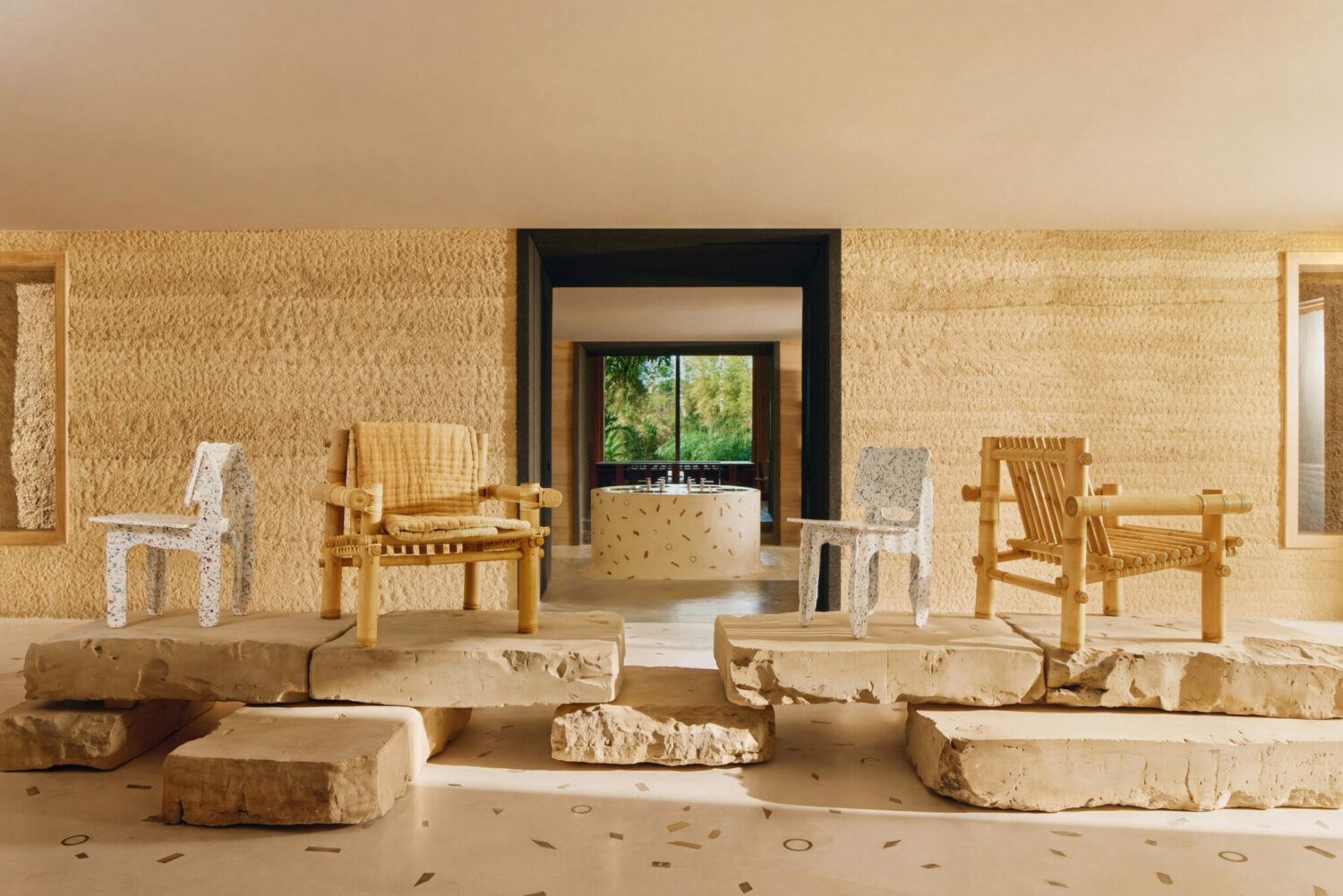
The architecture embraces a “contemporary-traditional” approach, bringing Balinese vernacular building techniques into a modern setting. An alang-alang thatch façade, made from locally sourced tropical grass, creates a textured outer layer, while rammed-earth walls made from local clay lend the interior a grounded, tactile quality. Bamboo appears throughout, including in the terrazzo flooring, where it’s used as an aggregate, and in the display elements.

“We wanted to reinterpret Balinese traditional architecture and craftsmanship in a contemporary way, rather than simply reproducing traditional forms or decorative elements,” says Ade Herkarisma, group head of architecture and development at Potato Head.

Modern kitchen featuring a stainless steel prep station, a wooden dish rack, and a large window looking out onto a wooden deck and garden.

Photography by Sharon Angelia

Reclaimed and locally sourced materials bring natural variations in color, texture, and form. Instead of concealing these irregularities, the designers embraced them, letting the materials guide the assembly and detailing.

Two curved sofas and a square ottoman with geometric patterns sit on a matching rug, flanked by clothing racks displaying shirts and jackets.

Photography by Sharon Angelia

Inside, the store unfolds across five interconnected bays, guiding visitors from finished products toward the processes behind their creation. The first showcases souvenirs and lifestyle objects by Indonesian craftspeople, while the second presents the Potato Head Collection, an apparel line inspired by Bali. The third introduces Wasted by Potato Head, a collaboration with British designer Max Lamb that transforms discarded materials into furniture and homewares.

A woman operating a mechanical film viewer in front of a wall featuring a grid of small plastic bins filled with colored bricks and digital display screens.

Photography by Sharon Angelia

In the final two bays, visitors move from browsing to making. A working natural dye studio transforms food and plant waste into pigments used in workshops exploring dyeing, painting, and pattern-making. Beyond it, The Workshop features a wall of shredded HDPE plastic recovered from waste collectors across Bali and Java. The colorful fragments become part of the architecture, making the material’s previous life visible, while the surrounding space is dedicated to experimentation.

“While the first three bays focus on products and the stories behind them, the final two bays prioritize participation, inviting visitors to engage directly with materials and processes,” Gianotten explains.

Four people in matching brown jumpsuits hold up large, golden, patterned fabric squares around a circular stone counter.

Photography by Sharon Angelia

The store also connects to Desa Potato Head’s broader sustainability initiatives, including its Waste Lab and Follow the Waste Tour, which demonstrate how discarded materials can be recovered, processed, and transformed into new objects. For OMA, the project extends ideas explored in N*thing is Possible, a 2022 exhibition in Singapore examining the potential of zero-waste hospitality.

“Circularity therefore becomes something experiential rather than abstract,” says Gianotten.

A stack of three rectangular, aggregate stone containers filled with vinyl records, placed in front of a wooden shelving unit.

Photography by Sharon Angelia

Designing around reclaimed resources required flexibility, especially around material consistency and availability. Rather than forcing materials into predetermined specifications, the team adapted the design to their natural characteristics and limitations.

“We discovered that circularity goes beyond material selection,” Herkarisma explains. “It is about rethinking how we design, build, operate, and engage people in the process of giving new value to resources that would otherwise be discarded.”

A group of people gathers around a circular workstation in an open doorway, framed by two large stone tables and bamboo shelving in a room with textured earthen walls.

Photography by Sharon Angelia

At the Good Times General Store, the act of making is as visible as the finished product. By placing workshops alongside retail displays and allowing reclaimed materials to shape the architecture, OMA and Potato Head offer a model of shopping that encourages visitors to look more closely at what they consume—and what might otherwise be thrown away.

Read the whole story
mkalus
4 hours ago
reply
iPhone: 49.287476,-123.142136
Share this story
Delete

The Peralta D Supercar Is Literally Sculpted From Copper

1 Share

The Peralta D Supercar Is Literally Sculpted From Copper

For the last century or so, ever since wood fell out of style, the bodies of most automobiles have been made from a few tried-and-true materials: carbon fiber, fiberglass, aluminum, and steel, with the metals proving most popular. The choices are a balancing act, forcing carmakers to weigh price, safety, convenience, and appearance to determine which substance makes the most sense for the masses.

A copper-colored concept car with a low-profile, angular design parked on an asphalt road.

Photography courtesy of GFG Style

But what if you didn’t have to worry about such concerns? What if cost was no object, practicality a formality, and there was no need to cater to the wants of more than one owner? Well, that was the lucky circumstance designer Fabrizio Giugiaro, founder and CEO of GFG Style, found himself in when creating the Peralta D, a gran turismo with a body made of hand-hammered copper.

Copper-colored futuristic concept car with angular styling and gull-wing doors open, parked on a paved road.

Photography courtesy of GFG Style

“It was a proposal I made to the client, Carlos Peralta,” Giugiaro says. The duo had worked together before on the design house’s first one-off automobile, the spitshine-polished 1980s-esque Peralta S. For the follow-up, Giugiaro wanted to draw a deeper connection to the owner. As an industrialist, Peralta has business interests involving copper, so Giugiaro suggested it as the material.

Copper-colored sports car with gull-wing doors open and rear hatch raised, parked on an asphalt road at sunset.

Photography courtesy of GFG Style

Giugiaro’s name is well known in the automotive world. His father, Giorgetto Giugiaro, is a master of clean-line designs—he penned the DeLorean DMC-12, the BMW M1, the original Lotus Esprit, and the first Volkswagen Golf. The senior Giugiaro’s career has included work for Ferrari, Lamborghini, Bugatti, and many more of the world’s most notable automotive brands. The father-and-son duo founded GFG Style together over a decade ago, but it’s only been in recent years that they’ve been dedicating their talents to bespoke coachbuilt cars for individual collectors, as with the Peralta D.

Copper-colored Peralta D sports car parked on a rural road at sunset.

Photography courtesy of GFG Style

And while using copper for a car’s bodywork may be unorthodox, the designer says it wasn’t as difficult as it may seem. “It really surprised us that copper proved to be much more malleable than the aluminum we had worked with previously; it is also considerably easier to weld and polish,” Fabrizio says. “Of course, it does come with the disadvantage of greater weight, but since it was combined with a supporting structure made entirely of carbon fiber, the overall balance between the materials ultimately worked out well.”

Copper-colored Peralta D sports car with butterfly doors and a glass roof, viewed from the rear three-quarter angle.

Photography courtesy of GFG Style

Beneath all that copper lies the chassis of a 2025 Maserati GranTurismo Trofeo—itself a stylish design, but one far removed from the almost brutalist simplicity of the Peralta D’s angles. Instead of traditional doors, the car features a dramatic opening system inspired by the Peralta S’s single-motion dome, with independently opening side windows and gullwing-style openings at the rear to access the back seats.

Interior of a car showing a brown leather dashboard, steering wheel, and seats, with a digital instrument cluster and a center touchscreen display.

Photography courtesy of GFG Style

Inside, copper-colored leather adorns most surfaces, broken up (almost) only by the infotainment and dashboard screens, which offer some of the few hints of its Maserati roots. Meant to showcase the bond between its owner and his daughters, the car comes with a few (perhaps stereotypically) female-oriented features, such as a passenger-side makeup station with an illuminated mirror and dedicated cosmetic storage. And while the rear seats are tight, a retractable refrigerator designed to hold a bottle of champagne and four copper glasses means occupants can easily distract themselves.

Interior of a Peralta D copper luxury car with metallic gold leather seats and a center console holding a bottle of champagne and two flutes.

Photography courtesy of GFG Style

While the Peralta D might seem to push the boundaries—or at least the materials—of road-going automobile design to their limits, Fabrizio suggests even wilder builds may follow in its tire tracks.

“I have another alternative material in mind, one that has only ever been used once before,” he says, “so it will be another surprise…”

Bronze, wedge-shaped concept car with an angular body and pop-up rear glass panel parked on a road.

Photography courtesy of GFG Style

Read the whole story
mkalus
20 hours ago
reply
iPhone: 49.287476,-123.142136
Share this story
Delete

Trump puts Jensen back in at Nvidia

1 Share

So who saw this coming? Jensen Huang is back as CEO of Nvidia! The company shoved an announcement of his reinstatement out the door half an hour before the stock market opened on Monday. [Nvidia, archive]

The Nvidia stock price opened $40 up on Friday’s close, then hovered around $165 until market close. Short sellers took a $12.2 billion dollar hit — their biggest one day hit since 2019. [Reuters, archive]

Jensen lost his job after his girlfriend, who worked at an Nvidia customer, appeared to be (totally was) illegally shipping Nvidia chips to China; the girlfriend was strongly alleged to be a spy for China; and then Jensen turned out also to be involved with two of his subordinates.

But the Nvidia board unanimously reinstated Jensen. Why? Because the US government told them to. According to the Nvidia press release:

the Board received input from senior levels of the United States government, and based on that input, the Board is confident that Mr. Huang’s reinstatement poses no national security risk.

Who would do this? President Donald Trump. He told CNBC Monday morning it was him: [CNBC, video]

I think that a lot of things changed. I felt very strongly that he should come back and we’ve done a very thorough investigation and the investigation showed that he did, I mean, he had bad judgment having to do with somewhat unrelated incidents. But he did nothing wrong.

… We have to protect our geniuses, and he’s certainly a genius. And I believe that. You have to protect our geniuses. We don’t have enough of them.

Did Trump give Nvidia assurances that Jensen would not be prosecuted? He told CNBC:

I didn’t use the word prosecuted, but I said that we believe he’s fine. He’s absolutely fine. I gave them enough assurances.

So Trump is still protecting Jensen and trying to kill all investigations.

According to Semafor, Trump called into the Nvidia board meeting on Sunday and persuaded them to reinstate Jensen. White House communications director Steven Cheung told Semafor: “Trump was totally involved and this was a great decision by the Nvidia board. We have to protect our geniuses.” [Semafor]

That is, the President of the United States called a private company board and pressured them to reinstate a CEO who is still alleged to be a threat to national security. He just told them the guy wasn’t, see.

Vice President J. D. Vance did all the behind-the-scenes work over the weekend to set up the deal. We assume he was acting on behalf of his Silicon Valley buddies: [NYT, archive]

Mr. Vance spoke privately with Mr. Huang over the weekend and helped the Nvidia board get the assurances it needed that the Trump administration did not believe that Mr. Huang himself posed a national security risk. Only a tiny handful of officials at the highest level of the government were aware of these conversations.

Trump posted to Truth Social how great it was that Jensen was back. [Truth Social, archive]

Trump also posted to Truth Social a photo edit of the July 2024 assasination attempt on himself — but instead of Trump, it’s Jensen with the blood splatter on his face. Jensen is triumphantly holding up a small red bra. There’s an Nvidia flag behind him. [Truth Social, archive]

The spy story isn’t going away. On Monday morning, the New York Times posted a story claiming that Alice Huang from Megaspeed: [NYT, archive]

kept in contact with an official of China’s top spy agency for more than a year while she was carrying out a secret affair with Jensen Huang, according to multiple people with knowledge of U.S. intelligence reports that describe the encounters.

… U.S. intelligence agencies have also gathered evidence that Ms. Huang’s business partner, Kang Wei, who was often introduced as her husband, worked with the same Chinese spy agency, the people said.

The SEC is apparently launching an investigation into Nvidia’s accounting. Maybe Trump thinks he can kill that, too. [NYT, archive]

But legislators are not happy and Trump can’t kill their investigations. The Democrats will be taking the House and Senate in January.

Congress still expects to speak to Jensen and Nvidia general counsel Tim Teeter on Monday 1 December about national security.  Jensen will be testifying before the banking committee on Wednesday 3 December. [press release; press release]

Trump can’t stop state investigations either. California is doing its own probe into whether Nvidia illegally sold chips to China and misled investors about it, including criminal violations of the state law. [Bloomberg, archive]

Why did Trump want Jensen back so much? Well, obviously, he just thinks Jensen’s a great guy. But the rest of Silicon Valley also wanted Jensen back — going so far as to circulate a petition to bring him back. [Stand with Jensen, archive]

That’s because the AI bubble was largely architected by Jensen.

Jensen arranged all the deals. Jensen made sure all the companies buying Nvidia chips had the money to buy the chips. He even strong-armed customers to buy ever more chips they didn’t need.

Jensen is back because Nvidia is the central bank of AI. And everyone wants to keep the party pumping — including Trump, who personally owns Nvidia stock. [NYT, archive]

The interesting thing is that Jensen was starting to wind all of this back a bit. In October, he told some customers at a conference: [WSJ, archive]

Huang told his partners that if their companies wanted allocations of Nvidia’s prized GPUs, they would need to secure upfront payments from customers, people in attendance said. That would make their projects easier to finance and ensure that Nvidia wasn’t alone in being a source of financial support.

“You’re not charging what you should be charging,” he said, telling them that Elon Musk was renting Nvidia chips to customers at better rates than they were. “I don’t even need you guys. I could just give all this capacity to Elon! Elon wants it!”

The bank of Nvidia is over. Nvidia would like the cash now.

Jensen’s job now is to survive the AI bubble deflating and give Nvidia a controlled descent. There’s a pile of stuff not quite going right.

Anthropic went public on Thursday and its stock price is stuck around $85-90, just a few dollars above the IPO price of $83. Dutch bank ING cannot find a buyer for its $500 million of data centre loans. And Oracle put out a weird press release on Friday, just after the close of trading, saying that its OpenAI deals were fully funded and “any media reports that will come out and say the contrary are incorrect and wrong.” Okay? [Bloomberg, archive; Oracle]

In conclusion: keep the popcorn hot.

Read the whole story
mkalus
1 day ago
reply
iPhone: 49.287476,-123.142136
Share this story
Delete

Anthropic looting your pension is running as planned

1 Comment and 2 Shares

Anthropic’s wizard scheme to pay their massive debts from your pension fund is ticking along nicely!

Anthropic (Nasdaq:ANT) priced its initial public offering at $83 per share for just over 956 million shares. This netted Anthropic just under $79.4 billion. That’s Anthropic’s take from this IPO in actual cash dollars. Trading started midday Thursday in New York. [Anthropic]

Anthropic’s valuation at launch was on the order of $1.5 trillion. But most of that is company equity that isn’t on the market. The $79.4 billion of actual cash Anthropic took in is very real. The price of the $100 billion or so of stock available on the market is pretty real.

Where did this $79 billion of cash come from? The main source will be your pension fund. That’s why there were protestors outside the Nasdaq this morning. They know what all this is for.

Stealing from everyone’s future

The Anthropic IPO is about Wall Street seeing the gigantic, juicy pension funds and trying to work out how to steal them.

As smiling Anthropic executives rang the opening bell on the Nasdaq, protestors were lined up outside holding signs that read “Stop tech oligarchs” and chanting “Anthropic, get off it, put people over profit.” [Youtube]

ANT is speculative trash that has no business trading on public markets. But Nasdaq changed its rules in May to let huge stocks like SpaceX and Anthropic onto the indexes that the pension funds buy, after just 15 days of trading, without the old rules about stability. Nasdaq made this rule change specifically to lure SpaceX and Anthropic to Nasdaq.

Hedge funds who buy into the IPO will make a bundle flipping the stock. Retail investors who were told chatbots will change the world will be their suckers.

If you have a pension fund, you will get soaked. Once Anthropic is in the major index funds, nearly every public pension plan in the US will own some. Nasdaq-100 funds will probably add Anthropic effective Monday, December 21st.  [Morningstar]

At least 18 state and local US government pension funds also hold Anthropic exposure through private investments. [Equable, PDF]

Anthropic has never made a penny in profit. A third of its S-1 is risks, including lots of science fiction about killer robots.

This is the world’s biggest penny stock.

Calling in rich

Anthropic employees’ futures are fine. They just got hilariously rich. The seven founders get more than $20 billion each in shares. Early employees get over a billion dollars each; 598 employees get over $100 million each; and 2,800 employees get over $10 million each. [WSJ, archive]

Some of the employees will take the money and run. We expect that quite a lot of them will not — because Anthropic is an effective altruism cult on a mission to stop the AI doomsday. They will stay at their jobs for the mission.

Wall Street banks are making $550 million on the deal, with lead underwriters Goldman Sachs and Morgan Stanley taking the biggest slice of that pie. Venture capital firms are making money like they’ve never seen before. [The Banker; Moonfare]

Anthropic S-1 final FINAL (1) USE THIS ONE.docx.pdf

You’re supposed to wait at least 21 days from filing your S-1 to start trading. But it looks like Anthropic was counting from their original S-1 filing on 26 October — the one they wrote in crayon, with half the numbers missing.

The SEC is apparently fine with this. Wouldn’t it be good if the US had a regulator for stock trading? We should try that.

Up to 20% of the offering is set aside for retail investors, versus the typical 5% to 10%.

Anthropic filed second and third amendments to the S-1, which mostly added details on the sale and shuffled the risks a bit. [SEC]

The company still doesn’t mention the risk of the bubble popping and customer demand for AI going down. You’d think demand going down would be a bit of a risk. Nor of the circular financing collapsing — as may be happening with Jensen Huang being ousted at Nvida.

The important new bit in the first amended version was the Q3 2026 numbers, which were notably worse than the Q2 2026 numbers — more revenue, but an even bigger operating loss, mainly due to tokenmaxxing coming to an end.

Anthropic really should have run this IPO in August or September so they could tout the juiced Q2 numbers without worrying about what came next. Oh, well.

The first revision also revealed that Anthropic’s non-cancellable contractual obligations for computing spend are currently $895 billion. This could be a problem when your revenue is a lot smaller than that — and your profit doesn’t exist. [Bloomberg, archive]

The IPO includes $26 billion of private placements of class N non-voting shares. Anthropic is paying off some of its debts with these, not receiving actual cash.

Not so fast, Mr Bond

Now that Anthropic’s public, they have bills to pay with actual money.

The company somehow thought they would have an investment grade credit rating for their bonds. Unfortunately, stock markets work on speculation — but credit markets work on whether you can actually pay.

Anthropic has never made a profit and really just won’t. So their bonds are likely to get a junk rating after the IPO. This means insurance companies and pension funds, which are restricted to investment-grade debt, won’t be touching them. [FT, archive]

This means that Anthropic could have difficulties feeding its massive cash incinerator.

The company could issue more stock at will, with a bit of paperwork. If that doesn’t crash the current price.

First day trading

The stock popped out the gate, with the first trade being $111 on stock offered at $83. Other AI-associated stocks went down 4%-7% in the first hour. [CNBC]

After surging to $115.10, the stock closed at $97.17, up 17% from its initial IPO price.

What happens next?

Anthropic has put off the Grim Accountant just that little bit longer.

After SpaceX and Anthropic, It’s not clear there will be enough money left in the public markets if OpenAI wants to IPO in 2027 at the same sort of $100 billion scale. OpenAI’s numbers are at least as awful as Anthropic’s. OpenAI needs to IPO, the same way SpaceX and Anthropic needed to IPO.

But SpaceX and Anthropic have sucked the life out of AI as a funding proposition at scale. And Nvidia’s new interim CEO wants to end Jensen’s circular financing racket. We think the money’s going to be a bit shorter for the AI bubble. Good.

Anthropic’s stock price will last as long as the bubble — and bubbles pop. Retail investors and pensioners will be left holding the bag. You might want to call your pension fund.

Read the whole story
mkalus
5 days ago
reply
iPhone: 49.287476,-123.142136
Share this story
Delete
1 public comment
jhunorss
5 days ago
reply
"Anthropic employees’ futures are fine. They just got hilariously rich. The seven founders get more than $20 billion each in shares. Early employees get over a billion dollars each; 598 employees get over $100 million each; and 2,800 employees get over $10 million each."
Next Page of Stories